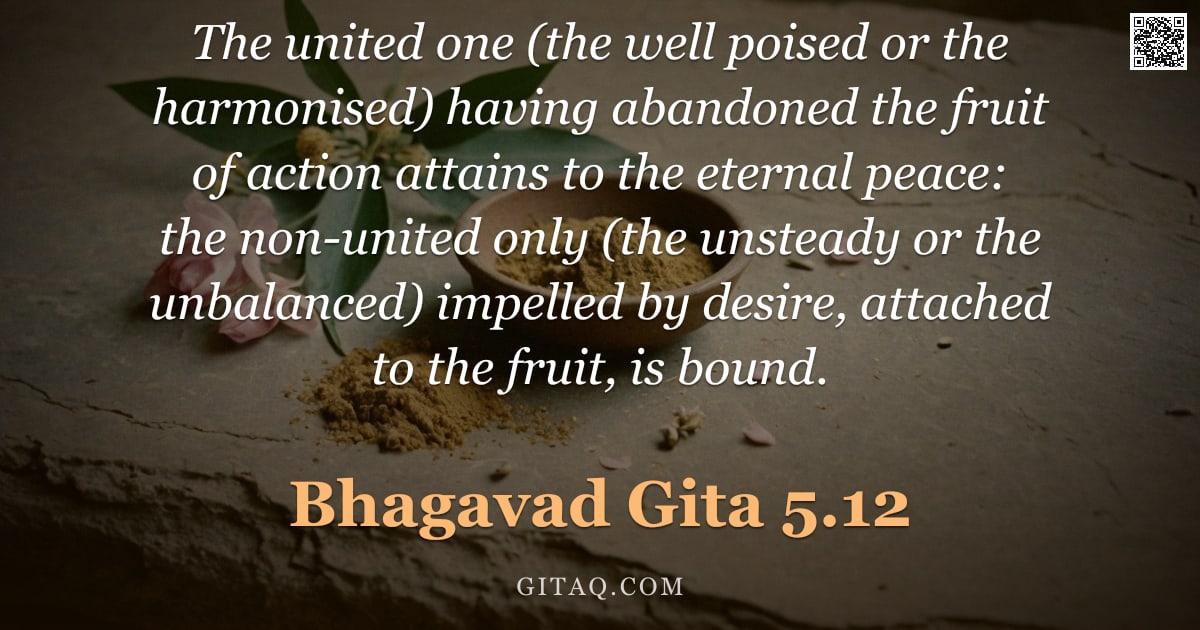
Bhagavad Gita 5.12
Karma Sanyasa Yoga · English Translation
युक्तः कर्मफलं त्यक्त्वा शान्तिमाप्नोति नैष्ठिकीम् | अयुक्तः कामकारेण फले सक्तो निबध्यते ||५-१२||
yuktaḥ karmaphalaṃ tyaktvā śāntimāpnoti naiṣṭhikīm . ayuktaḥ kāmakāreṇa phale sakto nibadhyate ||5-12||
What Does This Verse Mean?
In this verse, Lord Krishna explains the difference between a wise person and an ordinary person to Arjuna. He teaches that those who act without attachment to the results find lasting inner peace, while those driven by desire for specific outcomes remain trapped in cycles of stress and binding actions. The core message is that true freedom comes from doing one's duty wholeheartedly but letting go of any need for a particular reward.
The Teaching Behind It
This verse belongs to the synthesis of Karma Yoga (the yoga of action) and Sankhya philosophy developed in Chapter 5. It elaborates on the concept that true renunciation is not abandoning work, but abandoning attachment to the 'fruit' (phala-tyaga), which transforms ordinary duty into a spiritual practice.
Word by Word
Classical Commentary
Where This Happens
This verse occurs in Chapter 5 of the Bhagavad Gita on the battlefield of Kurukshetra during the great war between the Pandavas and Kauravas. Lord Krishna has just been explaining to Arjuna that both renouncing action (sannyasa) and performing actions with devotion lead to liberation, but he now clarifies which path is superior for a person already engaged in life's duties. Arjuna is currently confused about whether to fight or retreat from the battlefield, seeking clarity on how to act without being bound by fear of consequences.
Living It Out Today
Consider a professional who has spent months preparing an important presentation; they can either obsess over getting a promotion if it succeeds or fearing failure and losing their job. By focusing entirely on delivering high-quality work with honesty and skill, while accepting that the outcome is not fully in their control, they perform at their best without anxiety paralyzing them. This approach allows for clear decision-making during crises, as the mind remains steady rather than clouded by fear of loss or greed for gain.
Explained for Children
Imagine you are playing soccer with your friends. If you play hard to win the trophy, you might feel sad if you lose or angry at the referee; this makes it hard to enjoy the game. But if you just focus on passing and kicking well because that's what good players do, without worrying about winning, you stay happy no matter what happens. Krishna says being like a player who loves the game itself is how we find real happiness.
Daily Reflection
Today, I invite you to examine where your energy is being drained not by the work itself, but by your anxious attachment to specific results. When we act without this desire for control, our actions become fluid and free rather than stiff with fear of loss; try letting one small task go today knowing that doing it well is enough, regardless of what happens next. This shift from 'needing' a result to simply 'doing' the right action brings an immediate peace into your heart.
A Practice for Today
Sit quietly and visualize your current tasks as offerings rather than transactions, releasing any grip on the outcome before you begin. As you act from this place of surrender, notice how the heavy weight of anxiety lifts, replaced by a steady, quiet stillness that remains unshaken by success or failure.
Key Teachings
- The Power of Equanimity
True union with the Divine arises when one performs duty without being swayed by the fruits of success or failure. This balanced state, known as 'yukta', transforms action into a spiritual practice rather than a source of bondage. - The Trap of Desire
Action driven solely by personal desire and attachment to outcomes creates an invisible chain that binds the soul. Without this detachment, even good deeds can become sources of future suffering and entanglement in the cycle of reaction. - Eternal Peace as a Gift
By abandoning the claim over results, one automatically accesses 'naiṣṭhikī śānti', or peace that is permanent and unshakeable. This peace is not found in changing circumstances but in the steady consciousness of the self beyond them.
Themes
Related Verses
Read This Next
- 2.47 — This foundational verse establishes the core principle of acting only on one's right to action while renouncing all claim to results.
- 3.30 — It expands on this by instructing us to dedicate all actions and their fruits entirely to the Divine, deepening the practice of surrender.
- 12.15 — This verse describes the qualities of a devotee who has mastered such detachment, being dear to Krishna for not disturbing others through attachment.
Recommended Reading
GitaQ earns from qualifying purchases as an Amazon Associate.