Bhagavad Gita 5.13
Karma Sanyasa Yoga · English Translation
सर्वकर्माणि मनसा संन्यस्यास्ते सुखं वशी | नवद्वारे पुरे देही नैव कुर्वन्न कारयन् ||५-१३||
sarvakarmāṇi manasā saṃnyasyāste sukhaṃ vaśī . navadvāre pure dehī naiva kurvanna kārayan ||5-13||
What Does This Verse Mean?
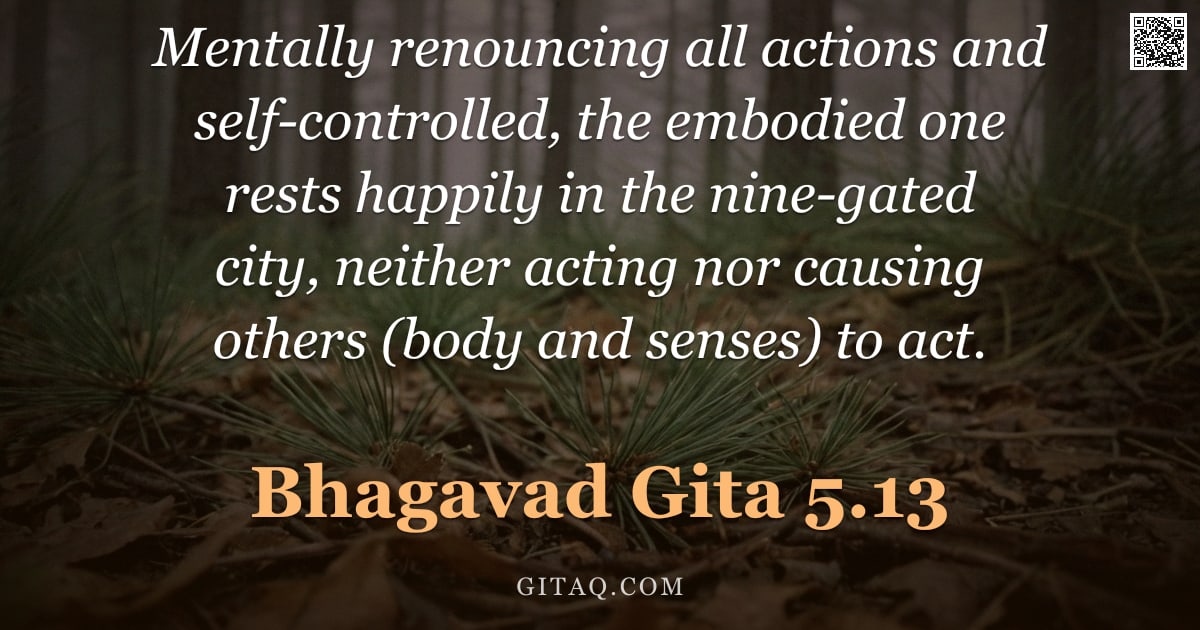
In this verse, Lord Krishna describes the state of a wise person who has mentally renounced all actions while remaining physically active and self-controlled. The individual rests happily in their body, which is compared to a city with nine gates (two eyes, two ears, nose, mouth, urethra, and anus). Such a person understands that they are not the doer; instead, they observe the senses performing duties without attachment or egoistic involvement.
The Teaching Behind It
This verse synthesizes the teachings of Karma Yoga and Sankhya philosophy by defining true renunciation as mental detachment rather than physical withdrawal. It develops the concept of 'Karmaphala Tyaga' (renouncing the fruits of action), where the realized soul sees themselves not as the agent but merely a witness to the activities of nature's three modes.
Word by Word
Classical Commentary
Where This Happens
This verse appears in Chapter 5 of the Bhagavad Gita during a conversation on the battlefield of Kurukshetra. Lord Krishna is speaking to Arjuna, who has just expressed confusion about whether he should pursue the path of renunciation (Sannyasa) or active duty (Karma Yoga). Having explained that true wisdom lies in performing action without attachment rather than physically abandoning duties, Krishna uses this verse to illustrate what a person with such realized knowledge actually experiences internally.
Living It Out Today
Consider a project manager leading a high-stakes product launch who feels overwhelmed by the pressure of potential failure. Instead of identifying personally with every outcome or blaming their team for delays, they mentally step back and view themselves as an observer guiding the process. They perform all necessary decisions (acting) but do not let anxiety control them or feel that 'they' are solely responsible for success or failure, allowing them to lead calmly while trusting in the collective effort.
Explained for Children
Imagine you are playing a video game where your character runs around in a castle. Even though the character is running and fighting, *you* know it's just a game on the screen, so you don't get truly hurt or stressed out if things go wrong. This verse teaches that we can play our games of life—like school, sports, or helping family—but with the same mindset: 'I am watching my body do these things, but I am not the character in danger.' When we realize this difference between who we really are and what our bodies do, we find true happiness inside ourselves.
Daily Reflection
In the rush of daily life, it is easy to forget that true peace comes not from stopping your work, but from shifting where you identify as the doer. Imagine yourself resting in this inner sanctuary today; notice how the weight of responsibility lifts when you realize you are the witness rather than the worker. This shift allows you to engage fully with your duties while remaining a calm presence within.
A Practice for Today
Sit quietly and visualize your body as a nine-gated temple, with the senses at their thresholds under gentle watch. Silently repeat that you are the silent observer within, untouched by the activities of speech or movement around you.
Key Teachings
- The Nine-Gated City
This verse introduces the profound metaphor of the body as a city with nine gates, representing the two eyes, two ears, two nostrils, mouth, and lower apertures. Understanding this structure helps us see that while our physical instruments interact with the world, our true self remains distinct from them. - Mental Renunciation
The core of renunciation (sannyasa) here is not abandoning actions physically, but internally releasing attachment to being the doer. By mentally offering all deeds to the Divine or simply letting go of egoic ownership, one finds a state of effortless happiness. - Non-Action in Action
The realized soul appears inactive because they understand that their true nature is beyond action and reaction. Even as the body acts through senses and organs, the inner Self remains like a silent spectator who neither initiates nor compels these movements.
Themes
Related Verses
Read This Next
- 2.47 — This foundational verse on 'right to action without attachment' establishes the theoretical basis for the mental renunciation described in 5.13.
- 3.30 — Krishna instructs Arjuna to surrender all actions here, providing a practical method to achieve the 'mentally renouncing' state mentioned in this verse.
- 12.15 — This verse describes how one who is not disturbed by others and does not disturb them perfectly embodies the tranquil spirit of resting happily within oneself.
Recommended Reading
GitaQ earns from qualifying purchases as an Amazon Associate.