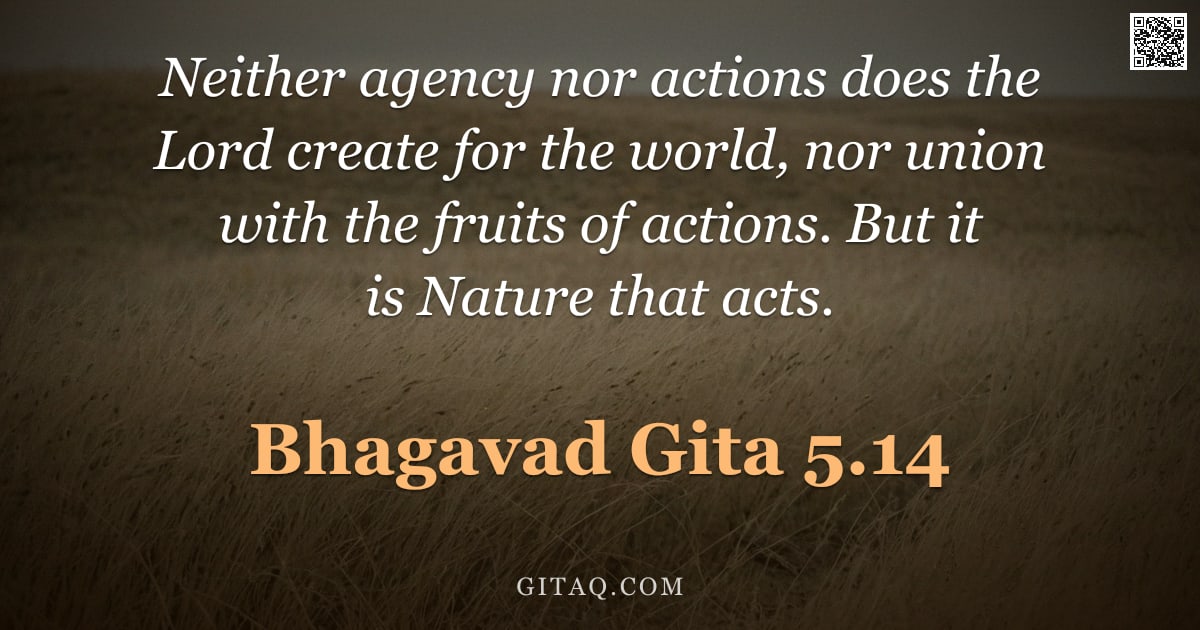
Bhagavad Gita 5.14
Karma Sanyasa Yoga · English Translation
न कर्तृत्वं न कर्माणि लोकस्य सृजति प्रभुः | न कर्मफलसंयोगं स्वभावस्तु प्रवर्तते ||५-१४||
na kartṛtvaṃ na karmāṇi lokasya sṛjati prabhuḥ . na karmaphalasaṃyogaṃ svabhāvastu pravartate ||5-14||
What Does This Verse Mean?
In this verse, Lord Krishna explains to Arjuna that the Supreme Being does not force anyone to act or dictate the results of those actions. Instead, every individual acts according to their own inherent nature (Swabhava), which is a mix of past karma and current qualities. This teaching removes fear by clarifying that we are not victims of divine punishment for our mistakes; rather, we create our experiences through our natural tendencies.
The Teaching Behind It
This verse sits at the intersection of Sankhya philosophy and Karma Yoga, specifically developing the concept of Akarma (action that does not bind). It establishes that while actions are performed by material Nature through the three Gunas (qualities), the individual soul is distinct from these actions. This realization helps practitioners detach from the ego-sense of being the doer.
Word by Word
Classical Commentary
Where This Happens
This verse occurs during Lord Krishna's discourse to Prince Arjuna on the battlefield of Kurukshetra, just after explaining the nature of the self and renunciation. Arjuna is still struggling with confusion about whether he should fight his relatives or abandon all action entirely out of fear. Krishna responds by clarifying that God does not create the bondages or actions themselves; these arise from the interplay of material Nature (Prakriti) within each person.
Living It Out Today
When facing a difficult work decision where you feel paralyzed by anxiety over potential failure, remember that your outcome is driven by your current skills and mindset, not by an external force controlling your destiny. Instead of blaming yourself for bad luck or feeling helpless against fate, focus on acting with the integrity you possess right now. By shifting your view from 'I am being punished' to 'This is my nature responding,' you can engage in the work without the heavy burden of fearing the results.
Explained for Children
Imagine the universe is like a giant playground with different games available. The Teacher (God) sets up the rules but never forces you to play a specific game or tells you exactly how it will end. You choose which game to join and what you do because of your own personality—some kids love running, while others prefer building things. This means if you make a mistake in a game, it's not the Teacher's fault; it happened because of the choices you made based on who you are.
Daily Reflection
You often feel burdened because you believe every result is solely on your shoulders to carry or fix today. Yet, Krishna reminds us that even as you act with dedication, it is simply the interplay of nature's forces (Prakriti) moving through your body and mind. When you release the claim of being the 'author' of events, you find a surprising freedom from anxiety about what happens next. This shift allows you to serve more purely, knowing that the Lord does not force actions upon anyone.
A Practice for Today
Close your eyes and silently repeat, 'I am not the doer; I am the witness.' Feel the weight of expectation lift from your shoulders as you imagine actions flowing through you rather than originating from a grasping self. Rest in this quiet space where Nature performs its work while you remain untouched by the outcome.
Key Teachings
- The Illusion of Agency
We mistakenly claim ownership over our actions and their results, believing we are the sole architects of reality. This verse clarifies that the Supreme Lord never creates a false sense of agency or forces anyone to act against their nature. - The Role of Prakriti
All activity is driven by the three modes of material nature (gunas) interacting within an individual, not by a divine puppeteer pulling strings. Understanding this helps us see that our actions are natural processes rather than personal failures or successes. - Detachment from Fruits
The connection to the results of action is also part of nature's play, not a divine imposition meant for punishment. By recognizing this, we can engage in duty without being enslaved by the desire for specific outcomes.
Themes
Related Verses
Read This Next
- 2.47 — Read this next to understand Krishna's instruction on performing duty without attachment to results, complementing the concept of non-agency.
- 3.30 — This verse follows logically as it instructs dedicating all actions and their fruits to the Lord, deepening the practice of renunciation in action.
- 12.15 — Explore this chapter on devotion next to see how a person who is not disturbed by others' suffering or joy embodies the wisdom of non-doership.
Recommended Reading
GitaQ earns from qualifying purchases as an Amazon Associate.