Bhagavad Gita 5.15
Karma Sanyasa Yoga · English Translation
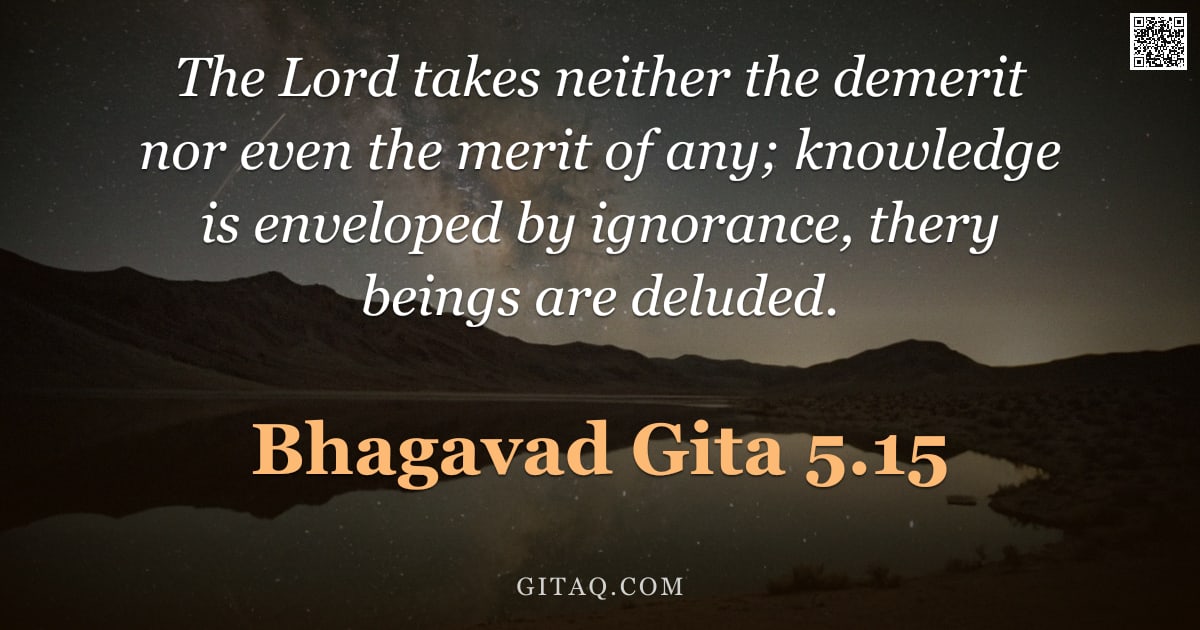
नादत्ते कस्यचित्पापं न चैव सुकृतं विभुः | अज्ञानेनावृतं ज्ञानं तेन मुह्यन्ति जन्तवः ||५-१५||
nādatte kasyacitpāpaṃ na caiva sukṛtaṃ vibhuḥ . ajñānenāvṛtaṃ jñānaṃ tena muhyanti jantavaḥ ||5-15||
What Does This Verse Mean?
In this verse, Lord Krishna explains to Arjuna that the Divine does not accept anyone's sins nor their good deeds as personal attributes; these actions belong entirely to the individual actor. Instead of judging souls based on merit or demerit, the Lord reveals that beings are deluded because true knowledge is covered by ignorance, like a mirror hidden under dust. The core teaching is that suffering and confusion arise not from divine punishment, but from our own failure to see the truth within ourselves due to this veiling ignorance.
The Teaching Behind It
This verse is a cornerstone of Jnana Yoga (the path of knowledge) within the broader framework of Sankhya philosophy presented in the Gita. It develops the concept of 'Atman' (the self) as distinct from action and its results, emphasizing that the Divine remains ever-pure while ignorance covers one's innate wisdom. The teaching asserts that liberation comes not by accumulating merit to please God, but by removing the veil of Avidya (ignorance) through spiritual insight.
Word by Word
Classical Commentary
Where This Happens
This verse appears in Chapter 5 during the intense dialogue on the battlefield of Kurukshetra, where Lord Krishna is instructing his disciple Arjuna. Just prior to this teaching, Krishna has been explaining 'Karma Sanyasa Yoga,' or the path of renunciation through action, urging Arjuna to fight without attachment to results. Arjuna was previously confused by the apparent contradiction between performing duties and giving up all actions; he now seeks clarity on how a wise person acts if they are detached from outcomes. Krishna uses this moment to reassure Arjuna that the Supreme Soul remains untouched by human duality, alleviating his fear of spiritual failure.
Living It Out Today
Consider a professional who receives harsh criticism at work for a project error; instead of spiraling into self-loathing or blaming their boss for being unfair, they apply this verse to realize that the mistake is simply an event with consequences, not a definition of their soul's worth. By understanding that 'knowledge enveloped by ignorance' causes them to take feedback personally rather than objectively, they can detach from the emotional weight and focus on solving the problem without anxiety. This shift allows them to recover quickly, learning from the error while maintaining inner peace, knowing that neither the success nor failure defines their true identity.
Explained for Children
Imagine you have a super-clean superhero friend who watches over everyone in your class without ever getting dirty or upset when someone makes a mistake. This verse tells us that God is like that friend; He doesn't take any blame for bad things we do, nor does He get extra credit for good things—we keep those results ourselves! The reason people sometimes feel confused or sad about their choices is because they are wearing 'blindfolds' made of not knowing the truth. When we learn to see clearly and understand who we really are inside, those blindfolds fall off, and everything makes sense.
Daily Reflection
Today, try to release the heavy burden of believing you must constantly earn divine favor through perfect behavior or atone for every mistake with guilt. Remember that just as a mirror reflects an image without being stained by it, your true Self remains untouched by the good and bad deeds performed in this body. When mistakes happen today, do not let them define your worth; instead, see them as clouds passing over a clear sky of consciousness.
A Practice for Today
Close your eyes and visualize the divine presence within you as vast and untouched, like a lotus leaf remaining dry despite sitting on water. Silently repeat that this Supreme Being neither accepts nor rejects your past actions or future merits, leaving them to their natural consequences while You rest in pure awareness.
Key Teachings
- The Transcendence of Divine Neutrality
Lord Krishna clarifies that the Supreme Self is beyond dualities like merit and demerit, meaning divine grace does not operate on a transactional basis. This teaching frees us from the fear of punishment or the arrogance of reward-seeking in spiritual practice. - The Veil of Ignorance
Delusion arises not because God is unjust, but because our own knowledge is covered by ignorance (ajñana), which clouds our perception of reality. It is this internal fog that causes us to identify with the doer and feel bound by karma rather than witnessing it. - The Path Through Knowledge
Since delusion stems from a lack of true understanding, the solution lies in removing ignorance through spiritual wisdom (jnana) rather than mere ritualistic action. When knowledge shines forth to clear this veil, beings naturally transcend confusion and realize their eternal nature.
Themes
Related Verses
Read This Next
- 2.47 — This verse establishes the foundational principle of performing duty without attachment to results, complementing the idea that God does not accept or reject those fruits.
- 3.30 — Krishna explicitly instructs Arjuna to surrender all actions and their outcomes to Him, reinforcing how one can live without being burdened by merit or demerit.
- 12.15 — This verse describes the qualities of a devotee who is not disturbed by others' reactions, illustrating the state of mind that arises when ignorance no longer clouds one's perception.
Recommended Reading
GitaQ earns from qualifying purchases as an Amazon Associate.