Bhagavad Gita 5.11
Karma Sanyasa Yoga · English Translation
कायेन मनसा बुद्ध्या केवलैरिन्द्रियैरपि | योगिनः कर्म कुर्वन्ति सङ्गं त्यक्त्वात्मशुद्धये ||५-११||
kāyena manasā buddhyā kevalairindriyairapi . yoginaḥ karma kurvanti saṅgaṃ tyaktvātmaśuddhaye ||5-11||
What Does This Verse Mean?
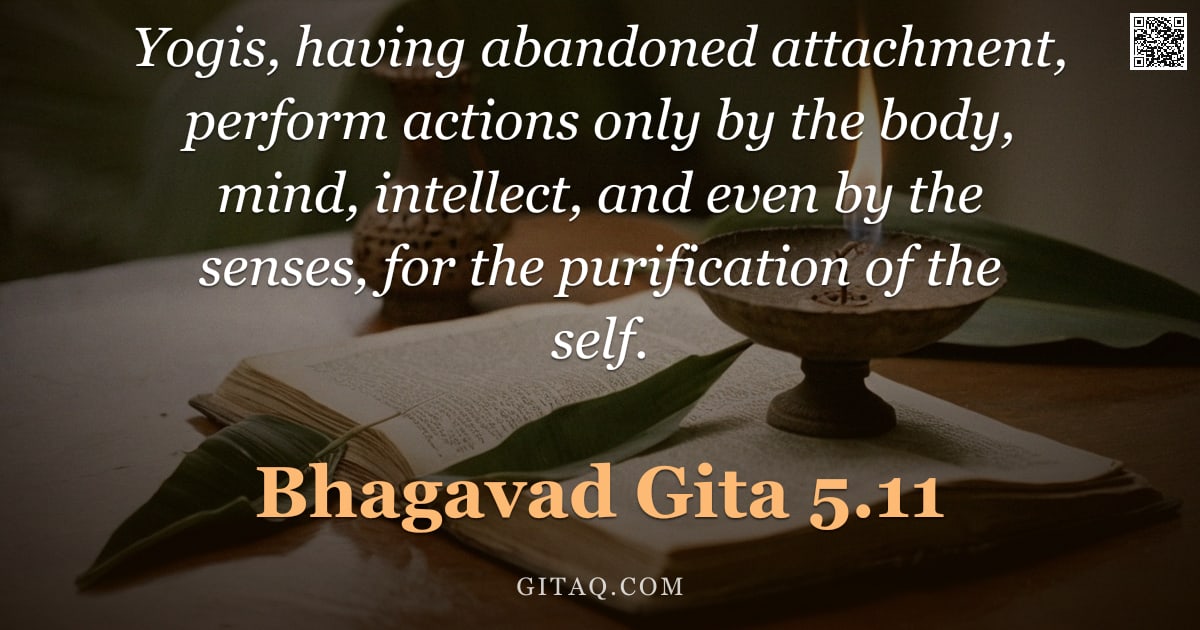
Lord Krishna explains to Arjuna that true yogis do not abandon action itself, but rather the attachment and selfish desire behind it. They perform duties using their body, mind, intellect, and senses with full focus, yet without any personal stake in the outcome. The ultimate purpose of this detached action is to purify the heart and awaken one's inner self.
The Teaching Behind It
This verse is a cornerstone of Karma Yoga (the yoga of selfless action) integrated with Sankhya philosophy's distinction between the doer and the instrument. It develops the concept that actions are performed by the instruments of nature—the body, senses, mind, and intellect—while the true Self remains distinct from these tools.
Word by Word
Classical Commentary
Where This Happens
This verse appears in Chapter 5 of the Bhagavad Gita during the conversation between Lord Krishna and Arjuna on the battlefield of Kurukshetra. Just before this, Arjuna was confused about whether to renounce all action (Sannyasa) or continue fighting with dedication. Krishna clarifies that true spiritual growth comes not from hiding away from life's duties, but by performing necessary actions like war as a form of worship and self-purification.
Living It Out Today
Consider a project manager facing a high-stakes deadline where the team is exhausted. Instead of micromanaging out of fear or demanding personal credit for success, they delegate tasks clearly using their intellect and body to guide the process while remaining emotionally detached from the specific outcome. By focusing solely on doing their part with integrity rather than worrying about praise or blame, they reduce anxiety and lead the team more effectively.
Explained for Children
Imagine you are a superhero cleaning up your room or finishing homework. A yogi does these things like a pro—using their hands (body) and brain (mind)—but they don't do it just to win a trophy or get praised by parents. They clean because it's the right thing to do, and doing it with love makes them feel happy and strong inside, without worrying about what others think.
Daily Reflection
Today, try to notice when you feel attached to the results of what you are doing. When that attachment arises, gently remind yourself that your body and mind are merely tools being used for purification. You do not need to abandon action itself; instead, shift your identity from the actor who seeks reward to the witness offering service.
A Practice for Today
Sit quietly and observe your hands, mind, and senses as instruments of action rather than extensions of 'you'. Visualize performing a daily task with full awareness but without the mental grip of ownership or fear of the outcome.
Key Teachings
- Action as Purification
The Gita reframes work not as a source of bondage but as a spiritual practice (sadhana) designed to cleanse the heart. By performing duties without selfish desire, even mundane actions become offerings that refine our character. - Detached Engagement
True renunciation is not about fleeing responsibilities or hiding from the world, but engaging fully while remaining internally free of attachment (sanga). This allows one to act with total dedication without being shaken by success or failure. - The Instrumentality of Body and Mind
A yogi understands that action is simply the functioning of physical, mental, and sensory faculties acting in harmony. By identifying only as the conscious observer behind these instruments, one transcends the illusion of being doer.
Themes
Related Verses
Read This Next
- 2.47 — This foundational verse establishes the core principle of acting without concern for results, which is essential to understanding how one performs action with detachment.
- 3.30 — It expands on this theme by instructing us to dedicate all actions to the Divine, transforming work into a spiritual offering that aligns perfectly with self-purification.
- 12.15 — It completes the picture by showing how this detached lifestyle cultivates deep peace and becomes attractive to the Divine.
Recommended Reading
GitaQ earns from qualifying purchases as an Amazon Associate.