Bhagavad Gita 4.6
Jnana Karma Sanyasa Yoga · English Translation
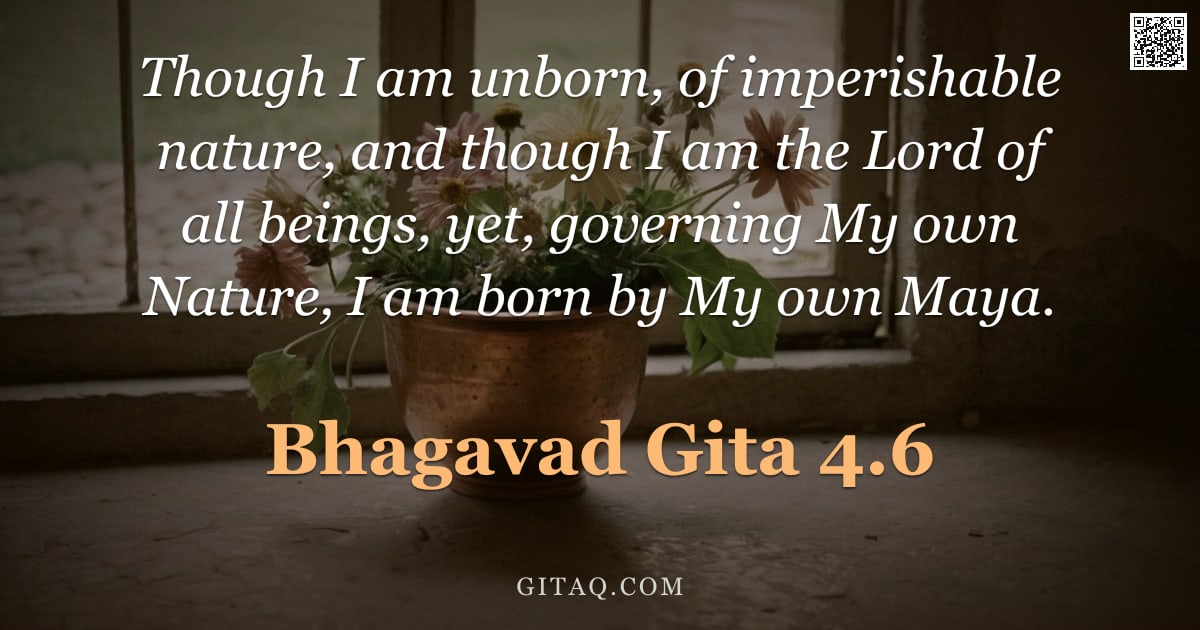
अजोऽपि सन्नव्ययात्मा भूतानामीश्वरोऽपि सन् | प्रकृतिं स्वामधिष्ठाय सम्भवाम्यात्ममायया ||४-६||
ajo.api sannavyayātmā bhūtānāmīśvaro.api san . prakṛtiṃ svāmadhiṣṭhāya sambhavāmyātmamāyayā ||4-6||
What Does This Verse Mean?
In this verse, Lord Krishna explains his divine nature to Arjuna, stating that although he is eternal and the master of all existence, he chooses to appear in a human form through his own power of illusion (Maya). He emphasizes that unlike living beings who are born due to past actions or biological necessity, his birth is voluntary and controlled. This teaching establishes that God is not bound by the laws of nature but operates beyond them while remaining fully present within creation.
The Teaching Behind It
This verse is foundational to the Vedanta school's concept of Ishvara (the personal God) who transcends Samsara while remaining its source through Maya. It bridges Jnana Yoga, which teaches that the Self (Atman) and Brahman are unchanging, with Bhakti Yoga by illustrating how the Divine voluntarily enters the realm of action to guide devotees.
Word by Word
Classical Commentary
Where This Happens
This verse occurs in Chapter 4 of the Bhagavad Gita during a quiet moment on the battlefield of Kurukshetra between Krishna and Arjuna. After Arjuna's initial despair and confusion about fighting his relatives, he asks how an eternal being can be born like others, seeking to understand Krishna's true identity. Having just declared himself as the supreme teacher who imparts this ancient knowledge again after ages, Krishna now clarifies that while he is beyond birth and death, he descends through Maya whenever righteousness declines.
Living It Out Today
When facing a high-stakes career decision or family crisis where you feel overwhelmed by external pressures, remember to act from your 'inner authority' rather than reacting out of fear. Just as Krishna governs his own nature while appearing in the world, you can engage deeply with modern problems without letting them define your self-worth or cause anxiety. By recognizing that challenges are part of a larger play (Maya) and maintaining your inner peace (unchanging soul), you can make clear-headed decisions instead of being swept away by emotions.
Explained for Children
Imagine a superhero actor playing a role in a movie; they know all their lines perfectly well because it's their own imagination creating the story, so they aren't confused or trapped like an ordinary person who forgets they are acting. Lord Krishna is saying he is exactly like that: even though he appears as a human baby and grows up just like you, he never loses his divine power inside him. He chooses to be born only because it helps people understand how to live good lives, not because he was forced into life by any outside rule.
Daily Reflection
Today, notice how often you feel bound by circumstances or defined by your past actions, forgetting that your core nature is untouched like a mirror reflecting images without being stained. Just as Krishna reveals His power to appear through divine will rather than necessity, remember that your own challenges are experienced from the depth of an inner freedom that remains unshaken. You do not need to escape this world; instead, find the stillness within yourself where you can govern your nature with grace and clarity.
A Practice for Today
Sit quietly and visualize your own true nature as unborn, changeless consciousness beneath the constant flux of thoughts and emotions. Rest your awareness in that timeless center where you are both the silent Lord within all beings and yet fully present in this fleeting world.
Key Teachings
- The Paradox of Divine Birth
Krishna teaches that even though He is eternal and unborn (aja), He voluntarily takes birth through His own divine power. This establishes that the Supreme does not undergo rebirth out of compulsion but appears by choice to uphold Dharma. - The Power of Maya
The verse highlights 'Atma-maya,' or self-generated illusion, as the instrument through which the Lord manifests in material form. This distinguishes divine manifestation from human birth caused by karma and ignorance, showing that God is never bound by His own creation. - Sovereignty Over Nature
By stating 'governing My own nature,' the Lord asserts total control over Prakriti (material energy) rather than being controlled by it. This assures seekers that they too can eventually master their mind and environment through alignment with divine will.
Themes
Related Verses
Read This Next
- 2.47 — Read this next to understand how the Lord's teachings on action connect with His nature as the unchanging observer of all deeds.
- 3.30 — This verse follows up by showing how a devotee can surrender their actions, mirroring Krishna's own voluntary submission to his divine plan.
- 12.15 — Conclude with this chapter on Bhakti to see the ultimate result of recognizing the Lord who is born by Maya but remains beyond it.
Recommended Reading
GitaQ earns from qualifying purchases as an Amazon Associate.