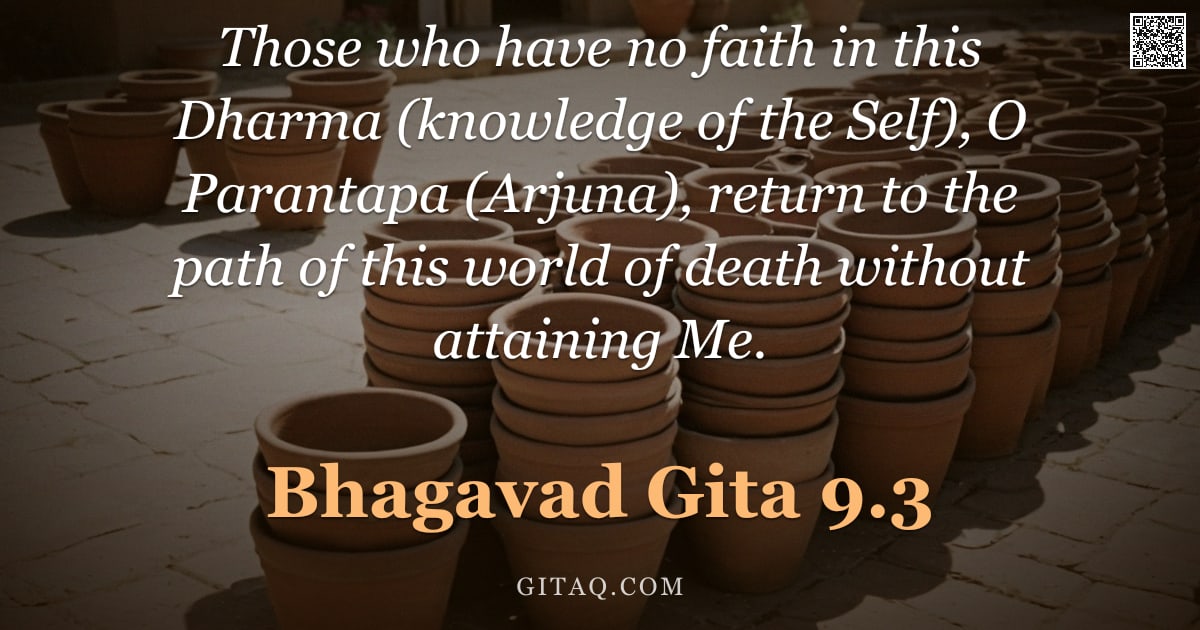
Bhagavad Gita 9.3
Raja Vidya Raja Guhya Yoga · English Translation
अश्रद्दधानाः पुरुषा धर्मस्यास्य परन्तप | अप्राप्य मां निवर्तन्ते मृत्युसंसारवर्त्मनि ||९-३||
aśraddadhānāḥ puruṣā dharmasyāsya parantapa . aprāpya māṃ nivartante mṛtyusaṃsāravartmani ||9-3||
What Does This Verse Mean?
In this verse, Lord Krishna speaks to Arjuna on the battlefield of Kurukshetra, explaining that those who lack faith in the spiritual knowledge he is revealing will eventually return to the cycle of birth and death without attaining liberation. The core teaching emphasizes that faith (shraddha) is the essential gateway to realizing the Self; without it, even a person's efforts remain superficial and they cannot cross over the ocean of mortality. Krishna warns that doubt acts as a barrier, causing individuals to fall back into worldly existence rather than achieving spiritual freedom.
The Teaching Behind It
This verse is central to Bhakti Yoga (the path of devotion) and Jnana Yoga (the path of knowledge), as it establishes faith (shraddha) as the prerequisite for both spiritual realization and action. It highlights that without unwavering belief in the truth of the Self, one cannot transcend the material world or attain union with the Divine.
Word by Word
Classical Commentary
Where This Happens
This verse occurs during Chapter 9 of the Bhagavad Gita, known as 'Raja Vidya Raja Guhya Yoga' (The Royal Knowledge), set on the battlefield of Kurukshetra. Krishna has just finished explaining his divine nature and is now addressing Arjuna's lingering doubts about surrendering to this higher knowledge after offering detailed instructions in previous chapters. The listener, Arjuna, is still grappling with a deep sense of sorrow and confusion regarding duty versus emotion, prompting Krishna to warn that doubt alone cannot lead him back to the path he seeks.
Living It Out Today
Consider a professional facing a difficult career pivot who has researched new paths but keeps hesitating because they fear failure or don't fully trust their own potential. This hesitation is like having 'no faith' in the process; as long as this doubt persists, they will likely stay stuck in an unfulfilling job (the cycle of death) rather than taking the leap required to grow and find true satisfaction. The lesson teaches that overcoming fear requires a foundational trust in one's ability to adapt and succeed before any tangible results can be achieved.
Explained for Children
Imagine you are trying to learn how to ride a bicycle, but every time your teacher gives you instructions on balancing or pedaling, you shake your head and think it's impossible. Because you don't believe the lesson will work, you never actually try properly, so you keep falling down instead of learning to ride. Lord Krishna is telling Arjuna that if we don't truly trust in the good advice about how to live a happy life without fear, we just stay stuck feeling worried and sad forever.
Daily Reflection
Today you might feel pulled back into old patterns because faith feels difficult to hold onto in moments of uncertainty. Yet, remember that this verse is not a condemnation but a compassionate warning about what happens when we disconnect from our true nature. When trust fades, the cycle of fear and repetition tightens its grip; conversely, even a small spark of sincere belief opens you to something far greater than your current struggles.
A Practice for Today
Sit quietly and ask yourself where your trust wavers today, allowing the doubt to surface without judgment. Visualize a path of returning to fear or confusion, then gently turn your gaze toward the steady presence that holds all paths together.
Key Teachings
- The Power of Faith
Faith is not blind belief but the essential foundation that allows us to access higher spiritual truths. Without this inner conviction, even the most profound knowledge remains inaccessible and ineffective. - The Cycle of Return
Lack of faith leads to a return in samsara, trapping one in the endless cycle of birth, death, and suffering. This 'return' signifies being pulled back into mundane existence rather than transcending it. - The Goal is Union
The ultimate purpose of this spiritual path is attaining the Divine Self (Mam), not just moral improvement or worldly success. Without reaching that union, all efforts on the material plane remain incomplete and temporary.
Themes
Related Verses
Read This Next
- 2.47 — To understand how right action without attachment is the practical application of the faith discussed in this verse.
- 3.30 — To see the specific instruction on surrendering all actions to the Divine, which cures the lack of trust mentioned here.
- 12.15 — To learn about the qualities of those who are dear to Krishna and how they transcend the very cycle described in verse 9-3.
Recommended Reading
GitaQ earns from qualifying purchases as an Amazon Associate.