Bhagavad Gita 4.5
Jnana Karma Sanyasa Yoga · English Translation
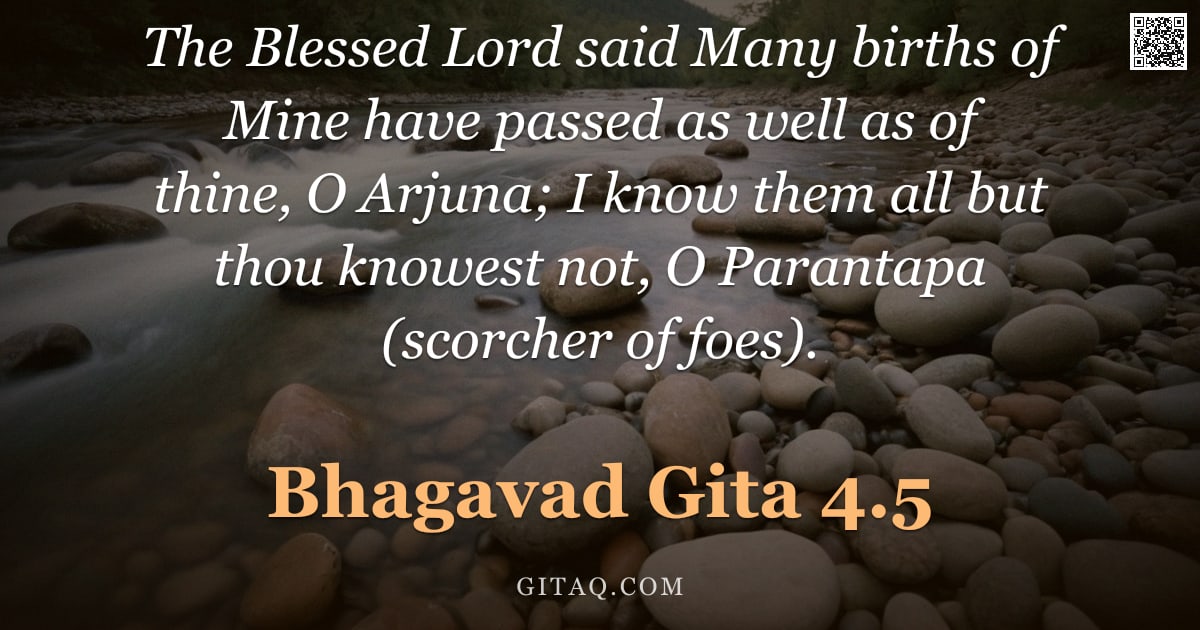
श्रीभगवानुवाच | बहूनि मे व्यतीतानि जन्मानि तव चार्जुन | तान्यहं वेद सर्वाणि न त्वं वेत्थ परन्तप ||४-५||
śrībhagavānuvāca . bahūni me vyatītāni janmāni tava cārjuna . tānyahaṃ veda sarvāṇi na tvaṃ vettha parantapa ||4-5||
What Does This Verse Mean?
In this verse, Lord Krishna reveals to Arjuna that He possesses infinite divine consciousness and has been present through countless past lives for both Himself and the warrior prince. While Arjuna only remembers his current life or recent memories, Krishna's omniscience allows Him to recall every single birth they have shared since time began. The core teaching here is a revelation of God's eternal nature versus human limited perception, establishing that divine wisdom transcends temporal constraints.
The Teaching Behind It
This verse is foundational to the Jnana Yoga (path of knowledge) strand of the Gita's teaching, specifically establishing the concept of 'Aparoksha Anubhuti' or direct realization of divine omniscience. It introduces the doctrine that while individual souls are bound by the cycle of birth and death with limited memory, the Supreme Self remains eternally aware of all past, present, and future events.
Word by Word
Classical Commentary
Where This Happens
This verse occurs on the battlefield of Kurukshetra within Chapter 4, where Krishna is transitioning from instructing Arjuna on the duty of action to revealing his own divine nature. Just prior, Arjuna was confused about how he could fight if Krishna claims to be a teacher of an ancient yoga lineage that seems impossible for him to have witnessed in this lifetime. Overcome by doubt and emotional distress after seeing his relatives as enemies, Arjuna is being reassured through the revelation that their shared existence spans beyond human memory.
Living It Out Today
When you face a seemingly unsolvable problem at work or feel overwhelmed by anxiety about your future, remember that the universe operates on patterns much larger than your current moment of stress. Just as Krishna knows every past challenge and lesson from his infinite timeline to guide Arjuna, there is a deeper wisdom supporting your journey even when it feels chaotic now. Instead of panicking over immediate setbacks, use this perspective to trust in long-term growth, knowing that difficulties are simply part of an unfolding process you cannot fully see yet.
Explained for Children
Imagine you are playing a video game and just started Level 10; you only know the rules for this level. But your older brother has been playing since Level 1 all the way back to when he first learned how to hold the controller, so he remembers every single trick from the very beginning. Lord Krishna is like that super-experienced player who knows everything about life's journey because He has been around forever, while Arjuna (and us) are still figuring out what happens next in our current game.
Daily Reflection
You may feel overwhelmed by the weight of your past actions and the confusion of not knowing where they lead. Yet today, remember that there is a consciousness within you which knows every birth you have lived without judgment or loss. When you surrender this burden of trying to track your own history, you find freedom in the assurance that you are never truly forgotten.
A Practice for Today
Close your eyes and visualize the vast river of time flowing through you, carrying countless lives like leaves on a current. Resting gently in that flow is an eternal presence who remembers every single moment, while you remain unaware; find peace in being held by this infinite memory rather than striving to recall it all yourself.
Key Teachings
- The Mystery of Divine Memory
Krishna reveals a unique attribute where He retains full knowledge of His infinite past births while humanity operates with limited recall. This establishes the divine as the constant witness who connects all eras, unlike the fragmented memory of the individual soul. - The Cycle of Reincarnation
Both the Lord and Arjuna have traversed many births, confirming the universal law of reincarnation that binds all beings. The verse gently corrects Arjuna's assumption by showing that while the process is shared, the perspective on it differs vastly between the finite self and the infinite Self. - Transcending Ignorance through Faith
The Lord addresses Arjuna as 'Parantapa' to remind him of his heroic nature while simultaneously pointing out that even great warriors are bound by spiritual ignorance. True wisdom begins when one acknowledges what they do not know and places trust in the One who knows everything. - The Mystery of Divine Memory
Krishna reveals a unique attribute where He retains full knowledge of His infinite past births while humanity operates with limited recall. This establishes the divine as the constant witness who connects all eras, unlike the fragmented memory of the individual soul. - The Cycle of Reincarnation
Both the Lord and Arjuna have traversed many births, confirming the universal law of reincarnation that binds all beings. The verse gently corrects Arjuna's assumption by showing that while the process is shared, the perspective on it differs vastly between the finite self and the infinite Self. - Transcending Ignorance through Faith
The Lord addresses Arjuna as 'Parantapa' to remind him of his heroic nature while simultaneously pointing out that even great warriors are bound by spiritual ignorance. True wisdom begins when one acknowledges what they do not know and places trust in the One who knows everything.
Themes
Related Verses
Read This Next
- 2.13 — This verse establishes the fundamental principle that just as a person puts on new clothes after discarding old ones, the soul accepts new bodies after death.
- 2.15 — Following this discussion on memory, you will learn how a person who is unaffected by pleasure or pain becomes worthy of liberation.
Recommended Reading
GitaQ earns from qualifying purchases as an Amazon Associate.