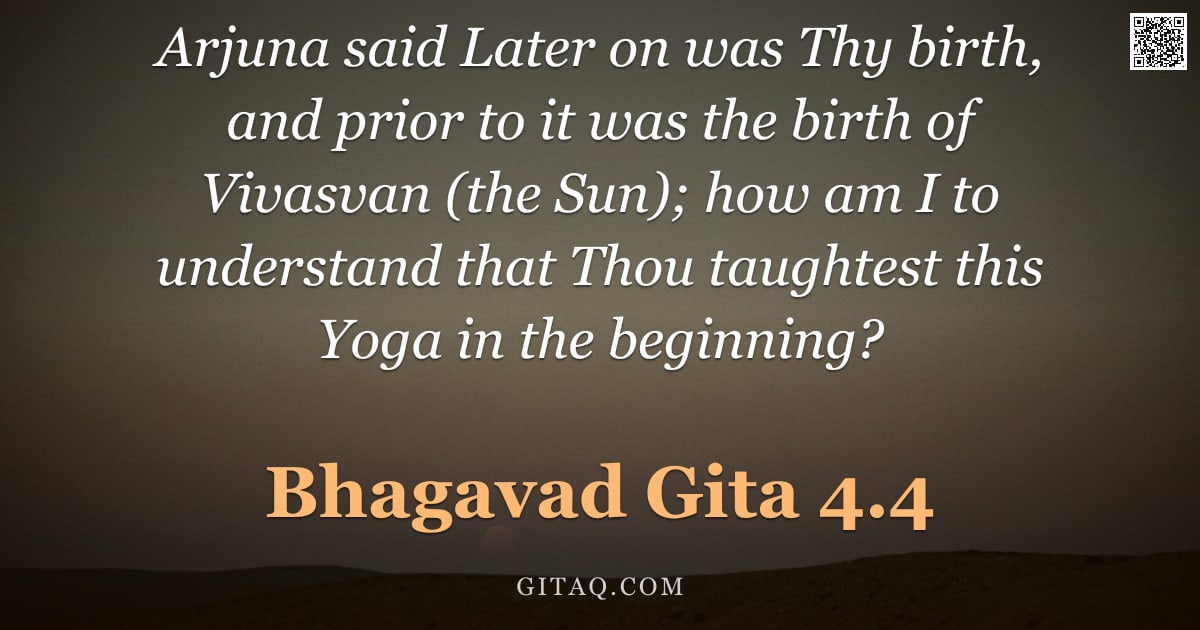
Bhagavad Gita 4.4
Jnana Karma Sanyasa Yoga · English Translation
अर्जुन उवाच | अपरं भवतो जन्म परं जन्म विवस्वतः | कथमेतद्विजानीयां त्वमादौ प्रोक्तवानिति ||४-४||
arjuna uvāca . aparaṃ bhavato janma paraṃ janma vivasvataḥ . kathametadvijānīyāṃ tvamādau proktavāniti ||4-4||
What Does This Verse Mean?
In this verse, Arjuna respectfully questions Lord Krishna about a logical paradox regarding their birth timelines. He points out that the Sun god Vivasvan was born long before him and also before Krishna, making it seem impossible for Krishna to have taught him the ancient knowledge of Yoga at the very beginning of creation. This marks the moment Arjuna shifts from confusion to seeking clarity on how divine teachings transcend time.
The Teaching Behind It
This verse anchors the philosophy of 'Aparoksha Anubhuti' (direct realization) and introduces the concept of Divine Incarnation (Avatara). It belongs primarily to Jnana Yoga, as it requires intellectual discernment to understand how the eternal Self can manifest in time without being bound by birth or death.
Word by Word
Classical Commentary
Where This Happens
This verse occurs on the battlefield of Kurukshetra during the Mahabharata epic, where Arjuna has just heard Lord Krishna describe Himself as the eternal Supreme Soul. After Krishna declares that He taught this Yoga to Vivasvan long ago and now re-teaches it to Arjuna, Arjuna is struck by a momentary doubt regarding his own identity and the timeline of events. The context captures the transition from Arjuna's initial despair to an intellectual inquiry about divine incarnation.
Living It Out Today
When you face a career decision where a new strategy seems impossible because your resources or team are currently 'younger' than competitors who have been doing it for decades, this verse offers comfort. It reminds us that the core principles of success (like integrity and focus) are timeless truths available to anyone in any generation. Instead of being paralyzed by feeling behind schedule, you can trust that these ancient wisdoms apply directly to your current challenges.
Explained for Children
Imagine if your teacher said they were teaching you a special game that started when the Sun was born, but the teacher is also alive today while you are just starting school now! That sounds confusing, right? Arjuna feels exactly like this: he knows Krishna's birth happened recently in his lifetime, and Vivasvan (the Sun God) lived ages ago. He asks how Krishna could have been the first one to teach something if everyone was born at different times.
Daily Reflection
It is natural to feel puzzled when divine truths seem impossible within our limited timeline, just as Arjuna struggled with Krishna's ancient teachings. Yet, this verse invites you to trust a wisdom that transcends your personal history or current understanding of cause and effect. When you release the need for logical proof in every moment, you open yourself to a connection that has existed since before time began.
A Practice for Today
Sit quietly and imagine the sun rising, remembering that just as light has no beginning or end, your true Self exists beyond time's flow. Let go of the confusion regarding 'when' things happened; instead, rest in the awareness that you are the eternal witness behind every birth and teaching.
Key Teachings
- The Timeless Nature of Truth
Spiritual knowledge is not bound by linear chronology; it exists eternally and was taught at the beginning of creation. The apparent contradiction between Arjuna's birth and Krishna's ancient instruction dissolves when we recognize that truth itself has no start or end. - The Cycle of Divine Appearance
God appears in every age to re-establish dharma, meaning divine guidance is a recurring constant rather than a one-time historical event. This teaches us that the source of wisdom is always available whenever we seek it with sincerity. - Faith Beyond Rational Limitation
Arjuna's question highlights how human logic often fails to grasp divine mysteries, requiring a shift from intellectual analysis to spiritual faith. True understanding comes not by solving the puzzle of time but by surrendering to the timeless reality behind it.
Themes
Related Verses
Read This Next
- 2.19 — To understand why fear regarding birth and death is misplaced when one realizes the soul's immortality.
- 4.7 — The immediate follow-up where Krishna explains His purpose in descending to protect the righteous.
- 13.25 — To deepen the understanding of how knowledge is gained and why it requires both intellect and devotion.
Recommended Reading
GitaQ earns from qualifying purchases as an Amazon Associate.