Bhagavad Gita 4.7
Jnana Karma Sanyasa Yoga · English Translation
यदा यदा हि धर्मस्य ग्लानिर्भवति भारत | अभ्युत्थानमधर्मस्य तदात्मानं सृजाम्यहम् ||४-७||
yadā yadā hi dharmasya glānirbhavati bhārata . abhyutthānamadharmasya tadātmānaṃ sṛjāmyaham ||4-7||
What Does This Verse Mean?
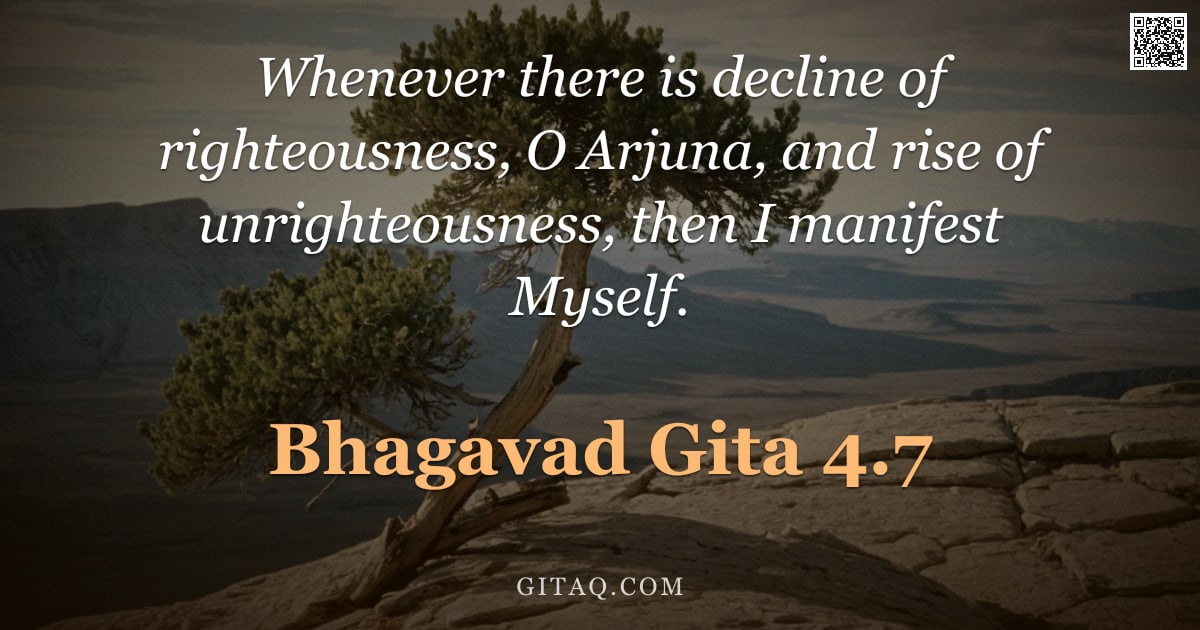
In this verse, Lord Krishna addresses Arjuna to explain the cyclical nature of time and justice. He states that whenever there is a significant decline in righteousness (dharma) and a surge in unrighteousness (adharma), he manifests himself in physical form. This divine intervention occurs specifically to restore balance, protect the virtuous, and re-establish moral order on earth.
The Teaching Behind It
This verse is central to the Vedantic concept of Avatar (divine incarnation) within the framework of Bhakti Yoga and cosmic order (Rta). It develops the teaching that the Divine is not passive or distant but actively engaged in time, descending through a process called 'Srishti' (creation/manifestation) whenever spiritual equilibrium is threatened.
Word by Word
Classical Commentary
Where This Happens
This verse occurs during the Bhagavad Gita's dialogue on the battlefield of Kurukshetra, where Prince Arjuna has just refused to fight his own relatives in a civil war due to overwhelming grief. Krishna is beginning to reveal his universal form and divine nature (Vibhuti) after explaining that he is beyond birth and death. The context is crucial because Arjuna's despair stems from seeing adharma (unrighteousness) winning through the actions of Duryodhana, prompting Krishna to explain why a cosmic force must intervene.
Living It Out Today
Consider a workplace where unethical shortcuts are becoming common practice, causing honest employees to lose motivation and integrity. Instead of feeling helpless or quitting immediately, this verse teaches you that your role is to act as an anchor for dharma by upholding truth in your own sphere, trusting that the larger cosmic balance will eventually correct itself through divine timing. It transforms anxiety about 'why bad things happen' into a calm resolve to be part of the solution rather than a victim of the chaos.
Explained for Children
Imagine if everyone stopped following the rules of fairness at school or home; it would be a very confusing and scary place. Just like how parents step in when things get too unfair to help fix everything, Krishna says he comes down whenever people forget what is right from wrong. He appears not as an ordinary person, but with special love and power to teach us the correct way again.
Daily Reflection
When you feel overwhelmed by the rise of unrighteousness around you today, remember that you do not have to carry the weight alone. The Divine responds precisely at these moments of crisis with a personal presence meant to guide and restore balance. Trust that your call for clarity is already met in this very moment.
A Practice for Today
Close your eyes and visualize darkness receding as light naturally returns, trusting that the divine presence is already active whenever chaos arises in your life or the world. Rest in this quiet certainty that you are never abandoned when righteousness seems to fade.
Key Teachings
- The Cyclic Nature of Dharma
Righteousness (dharma) naturally wanes over time, just as unrighteousness rises, creating a cycle that requires divine intervention to reset the moral order. This verse teaches us that decline is not permanent but part of a larger rhythmic process. - Divine Immanence in Crisis
God does not wait for perfection before acting; rather, the Divine manifests specifically when the balance tips toward chaos. This assures us that help arrives at the moment it is most needed, not a second later. - The Personal Address of Arjuna
By addressing 'O Arjuna' (Bharata), Krishna establishes an intimate relationship with every individual facing moral confusion. It reminds us that the promise of divine manifestation is a personal assurance directed at each soul.
Themes
Related Verses
Read This Next
- 2.47 — Read this next to understand how one should act dutifully without attachment while awaiting or supporting the restoration of dharma, complementing Krishna's promise of manifestation.
- 3.30 — This verse follows well as it discusses offering all actions to God and renouncing egoistic desire, which is essential for maintaining righteousness in a chaotic world.
- 12.15 — Read this final selection to see the qualities of a devotee who has become dear to Krishna, as such individuals often embody and restore dharma when it declines.
Recommended Reading
GitaQ earns from qualifying purchases as an Amazon Associate.