Bhagavad Gita 7.8
Jnana Vijnana Yoga · English Translation
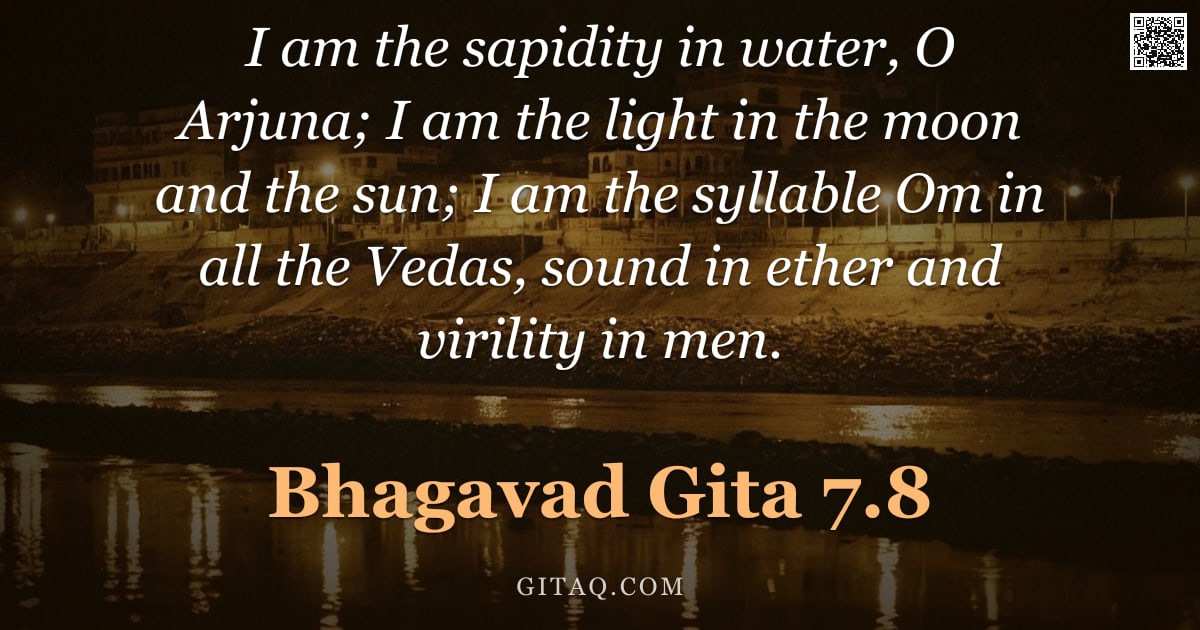
रसोऽहमप्सु कौन्तेय प्रभास्मि शशिसूर्ययोः | प्रणवः सर्ववेदेषु शब्दः खे पौरुषं नृषु ||७-८||
raso.ahamapsu kaunteya prabhāsmi śaśisūryayoḥ . praṇavaḥ sarvavedeṣu śabdaḥ khe pauruṣaṃ nṛṣu ||7-8||
What Does This Verse Mean?
In this verse, Lord Krishna speaks to Arjuna about his omnipresent nature as the Supreme Being. He explains that just as sapidity exists in water or light exists in celestial bodies, he is the essential essence behind all natural phenomena and spiritual truths. The key teaching is that God is not distant but is the very life force and consciousness animating every aspect of creation.
The Teaching Behind It
This verse is a core teaching of Jnana Yoga (the path of knowledge) and Vishishtadvaita Vedanta, illustrating the concept of Ishta-devata or Saguna Brahman. It develops the idea that the Absolute Reality is not formless but manifests through specific qualities in all beings, allowing devotees to recognize God in everyday experiences.
Word by Word
Classical Commentary
Where This Happens
This verse occurs on the battlefield of Kurukshetra during the Mahabharata war, where Arjuna has laid down his weapons and is overwhelmed by despair. Krishna is transitioning from explaining cosmic duty to revealing his divine nature as Vishnu's incarnation to lift Arjuna out of confusion. By listing examples like water, light, and sound, he is gently guiding a grief-stricken warrior to see the spiritual reality behind the physical world.
Living It Out Today
When you feel anxious about an upcoming work presentation or difficult family decision, pause to remember that your inner confidence (virility) is just as real and powerful as any external success. Instead of fearing failure, recognize that this same divine energy that powers the sun also fuels your own potential in moments of doubt. This perspective shifts focus from 'what if I fail?' to trusting the source of all capability within you.
Explained for Children
Imagine if you could taste your favorite juice in a glass of water or see sunlight glowing inside a moonbeam; that's how Krishna feels about being everywhere! He tells Arjuna that he is like an invisible spark hiding inside the sun, the sound hidden inside music, and strength hidden inside people. So just as you can't have bright light without the sun, nothing in our world exists or works without him holding it all together.
Daily Reflection
You often look for God in distant mountains or complex rituals, but today remember that He has already invited you into the most ordinary parts of your life. The coolness of water on a hot day and the warmth of sunlight are not random occurrences; they are His hands reaching out to touch you with love. When you feel weak or depleted, know that the same virility and strength reside in every human heart waiting for you to claim it.
A Practice for Today
Close your eyes and imagine water flowing through you; recognize that the very taste of freshness is a manifestation of the Divine presence within this moment. As you breathe, feel that same light illuminating your inner darkness just as the sun lights up the world.
Key Teachings
- Divine Immanence
The Lord is not a distant observer but exists as the essential quality within all material elements, from water's taste to sound in space. - Sensory Sacredness
Every perception of beauty and power, whether it is light or strength, serves as a direct gateway for the soul to recognize its source. - Universal Presence in Knowledge
The ultimate truth (Om) found in sacred texts like the Vedas is not merely intellectual but is the living vibration that sustains all existence.
Themes
Related Verses
Read This Next
- 2.47 — This verse follows naturally by teaching how to act while knowing that all results belong to the Lord.
- 3.30 — It expands on Chapter 8's theme of surrender, instructing one to dedicate every action and its fruit to the Divine.
- 12.15 — This verse describes the qualities of a devotee who is dear to Krishna, complementing the realization that God resides in all beings.
Recommended Reading
GitaQ earns from qualifying purchases as an Amazon Associate.