Bhagavad Gita 2.8
Sankhya Yoga · English Translation
न हि प्रपश्यामि ममापनुद्याद् यच्छोकमुच्छोषणमिन्द्रियाणाम् | अवाप्य भूमावसपत्नमृद्धं राज्यं सुराणामपि चाधिपत्यम् ||२-८||
na hi prapaśyāmi mamāpanudyād yacchokamucchoṣaṇamindriyāṇām . avāpya bhūmāvasapatnamṛddhaṃ rājyaṃ surāṇāmapi cādhipatyam ||2-8||
What Does This Verse Mean?
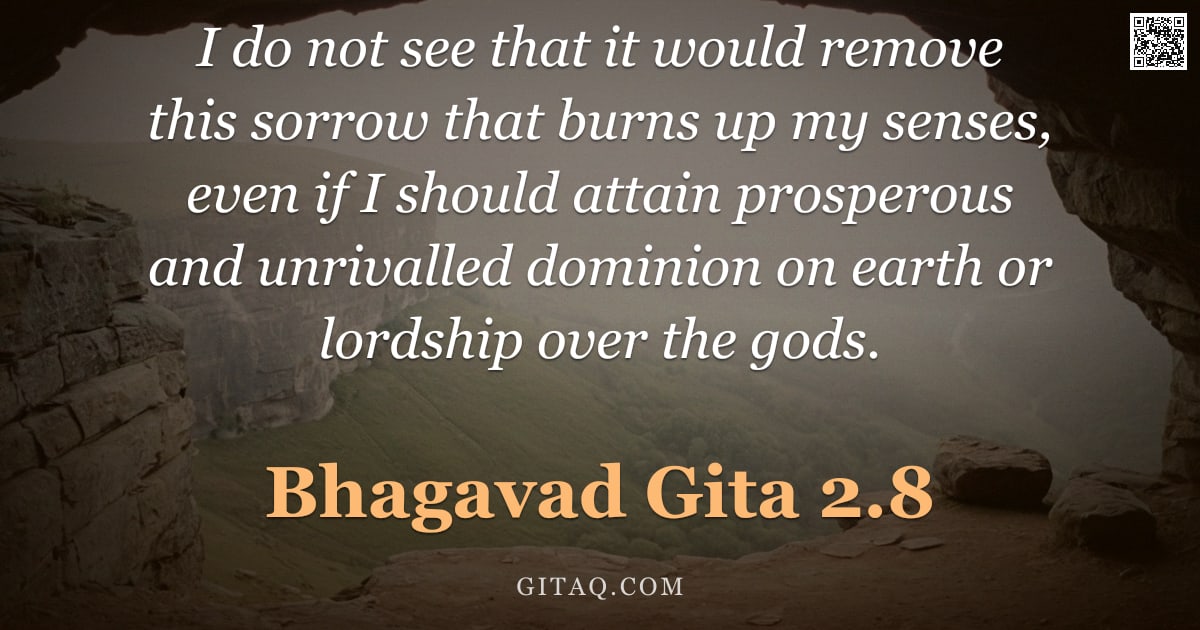
In this verse, Arjuna speaks to Krishna on the battlefield of Kurukshetra, expressing his deep despair and inability to see any solution through worldly success. He states that even if he were to gain an unrivaled kingdom or become a king over the gods himself, it would not remove the intense grief burning within him. The core teaching is that material power and status are powerless against internal sorrow caused by attachment and confusion about duty.
The Teaching Behind It
This verse belongs to the Sankhya Yoga strand, which focuses on transcendental knowledge and discrimination between the temporary material world and the eternal self. It develops the concept of 'vairagya' (detachment), illustrating that external achievements cannot resolve internal suffering caused by ignorance of one's true nature.
Word by Word
Where This Happens
This moment occurs in Chapter 2 of the Bhagavad Gita during the Mahabbarata war on the battlefield of Kurukshetra. Arjuna has just refused to fight against his own relatives and teachers, overwhelmed by a wave of grief that makes him drop his bow. He is speaking directly to Krishna, who serves as both his charioteer and divine guide, admitting that even the promise of supreme power cannot cure his current state of mental anguish.
Living It Out Today
Consider a professional who has just been passed over for a promotion they desperately wanted; despite their ability to secure a massive bonus or title elsewhere in the future, the sting of rejection makes them feel paralyzed and unmotivated. They realize that acquiring more status will not cure the immediate anxiety and loss of self-worth they are feeling right now. This verse reminds us that when we face emotional crises rooted in attachment, seeking external validation is rarely a quick fix for internal turmoil.
Explained for Children
Imagine Arjuna was so sad he couldn't even play his favorite games or eat dinner because of a heavy heart. He told Krishna, 'Even if I got to be the king of the whole world or had all the toys in existence, it wouldn't stop my sadness.' It's like having a broken toy that you can never fix; no matter how many new ones you get, you still feel sad about the old one being gone. This verse teaches us that true happiness comes from fixing what is inside our hearts, not just getting more things.
Daily Reflection
You might feel tempted to believe that acquiring more wealth or power will finally silence your inner restlessness today. However, Arjuna reminds us in this verse even supreme dominion cannot cure a sorrow that burns from within. True peace comes not from changing our external circumstances but from addressing the deeper spiritual disconnection causing the pain.
A Practice for Today
Sit quietly and observe any current sorrow or anxiety that feels like it demands an external fix, such as money or status. Silently repeat to yourself that no amount of worldly success can extinguish the fire within if the root cause is ignored.
Key Teachings
- The Futility of Worldly Remedy
Arjuna asserts that no amount of material gain, even ruling over all gods or earthly kingships, can cure deep internal sorrow. This teaches us that external solutions are inherently limited when the root cause is spiritual ignorance. - The Nature of Lingering Sorrow
Sorrow acts like a fire that consumes the senses and clouds judgment if left unaddressed by higher knowledge. It persists regardless of how much one achieves in the material world, showing its origin lies beyond physical possessions. - The Necessity of Transcendental Knowledge
Since worldly achievements fail to remove this burning sorrow, the only viable solution is the transcendental knowledge offered by Krishna. This verse sets the stage for understanding that spiritual realization is required where material success falls short.
Themes
Related Verses
Read This Next
- 2.47 — Continues the theme of duty without attachment to results, showing how action differs from seeking outcomes as relief.
- 3.30 — Expands on surrendering all actions and their fruits to the Divine as a practical method for removing inner burden.
- 12.15 — Describes the qualities of those who are dear to Krishna, illustrating the state of mind free from such burning sorrow through devotion.
Recommended Reading
GitaQ earns from qualifying purchases as an Amazon Associate.