Bhagavad Gita 2.9
Sankhya Yoga · English Translation
सञ्जय उवाच | एवमुक्त्वा हृषीकेशं गुडाकेशः परन्तप | न योत्स्य इति गोविन्दमुक्त्वा तूष्णीं बभूव ह ||२-९||
sañjaya uvāca . evamuktvā hṛṣīkeśaṃ guḍākeśaḥ parantapaḥ . na yotsya iti govindamuktvā tūṣṇīṃ babhūva ha ||2-9||
What Does This Verse Mean?
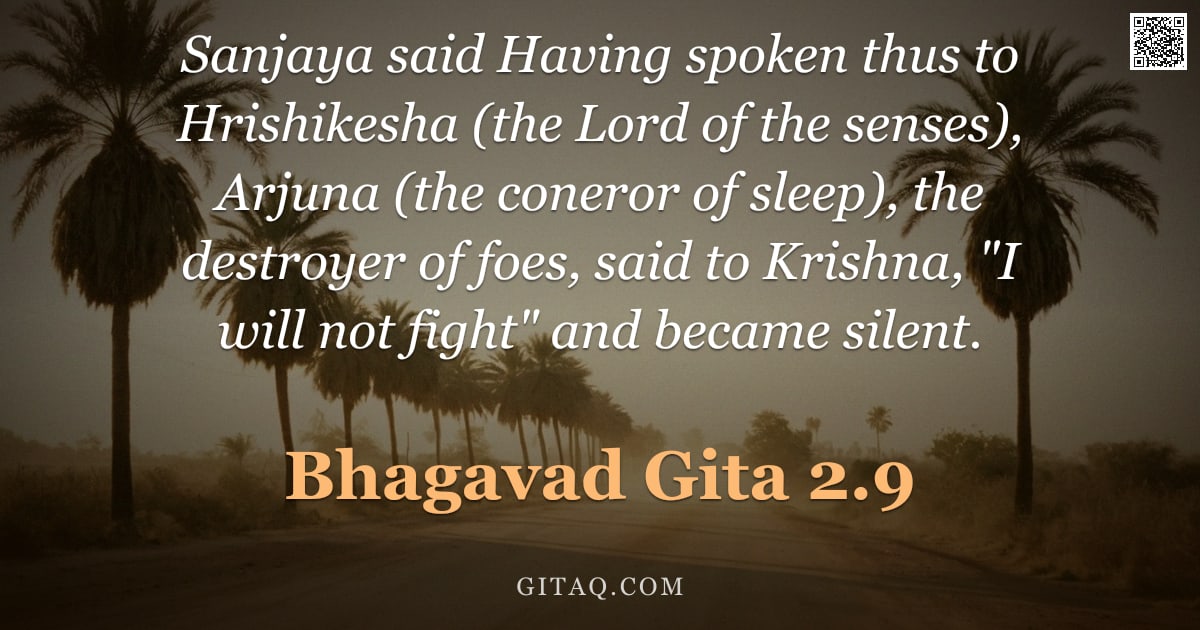
In this verse, the narrator Sanjaya describes Arjuna's immediate reaction after Krishna finishes his initial philosophical arguments about duty and the nature of the self. Despite understanding the logic presented to him as Hrishikesha and Govinda, Arjuna verbally declares he will not fight and then falls into a heavy silence. This moment captures the peak of human confusion where intellectual knowledge has been heard but emotional conviction is still missing. The key teaching here is that true spiritual progress often requires moving from mere hearing (shravana) to internalizing truth until one can act with clarity.
The Teaching Behind It
This verse belongs primarily to the context of Karma Yoga (the yoga of selfless action) as it illustrates the initial resistance that must be overcome before one can act without attachment. It highlights the gap between 'hearing' knowledge (shravana) and internalizing it until it transforms behavior, a concept central to the Sankhya philosophy discussed in this chapter. The silence represents the mind's struggle against deep-seated conditioning (samskaras), which is necessary for the transition from ignorance to enlightened action.
Word by Word
Where This Happens
This verse occurs in Chapter 2 immediately following Arjuna's emotional breakdown where he dropped his bow, Gandiva, and refused to fight the warriors on the other side. The narrator Sanjaya is reporting this scene to King Dhritarashtra from a divine perspective while the two armies stand ready for battle at Kurukshetra. At this precise moment, Krishna has just finished explaining that the soul cannot be killed or born, yet Arjuna remains paralyzed by grief and attachment to his relatives. The silence that follows marks a critical turning point where the ego's resistance must be confronted before higher wisdom can take root.
Living It Out Today
Consider a professional manager who is tasked with making an unpopular but necessary restructuring of their team to save the company from collapse. They have read all the reports and understand logically why it needs to happen, yet they feel such overwhelming anxiety about hurting people's feelings that they freeze and refuse to call the meeting or send the emails. Like Arjuna in this verse, the manager is stuck between knowing 'what should be done' and feeling an emotional blockage that prevents action. The solution lies not in repeating facts but in acknowledging the fear, taking a moment of silence to reset, and then acting with detachment from personal discomfort.
Explained for Children
Imagine you are playing a game, and your best friend tells you exactly why it's the right thing for everyone if you keep playing. Even though their words make sense in your head, your heart feels so heavy that you just say 'I don't want to play anymore' and sit down without saying another word. This is what Arjuna did; he heard his wise friend Krishna speak kindly but firmly about doing the right thing, yet he felt too sad to move forward at that moment. It shows us that sometimes we need a little time of quiet rest after hearing something big before our hearts can catch up with our minds.
Daily Reflection
You are not alone in feeling overwhelmed when facing a challenge that seems too great; even Arjuna paused right before his greatest battle. This verse reminds us that silence is sometimes our most honest prayer or preparation, a necessary stillness where we gather the courage to act later with clarity rather than fear.
A Practice for Today
Begin by noticing where your mind feels heavy with resistance or the urge to withdraw from a difficult task. Instead of acting on that impulse, sit quietly for a moment and acknowledge the pause as a sacred space rather than an escape.
Key Teachings
- The Sanctity of Pause
Arjuna's decision to stop fighting immediately after speaking reveals that true action requires a moment of deep internal processing before external movement. This pause is not weakness, but the necessary ground for discernment and alignment with one's higher purpose. - The Power of Surrender
By addressing Krishna as 'Govinda' and declaring his inability to fight, Arjuna demonstrates the first step of surrender: admitting human limitation. This admission clears the egoic barrier that often clouds our judgment in times of crisis. - Silence as Preparation
The verse highlights 'tushnim' (silence) not as a void, but as a state where the mind stops its chaotic chatter to listen for divine guidance. In our own lives, we must often choose silence over reactive speech to find the right path forward.
Themes
Related Verses
Read This Next
- 2.47 — To understand how Arjuna transitions from hesitation into the core teaching of performing duty without attachment to results.
- 3.30 — To see Krishna instructing on how to offer all actions and their fruits, which is the antidote to the paralysis Arjuna feels.
- 12.15 — To learn about the qualities of a devotee who finds peace in silence and does not disturb others through their own emotional turbulence.
Recommended Reading
GitaQ earns from qualifying purchases as an Amazon Associate.