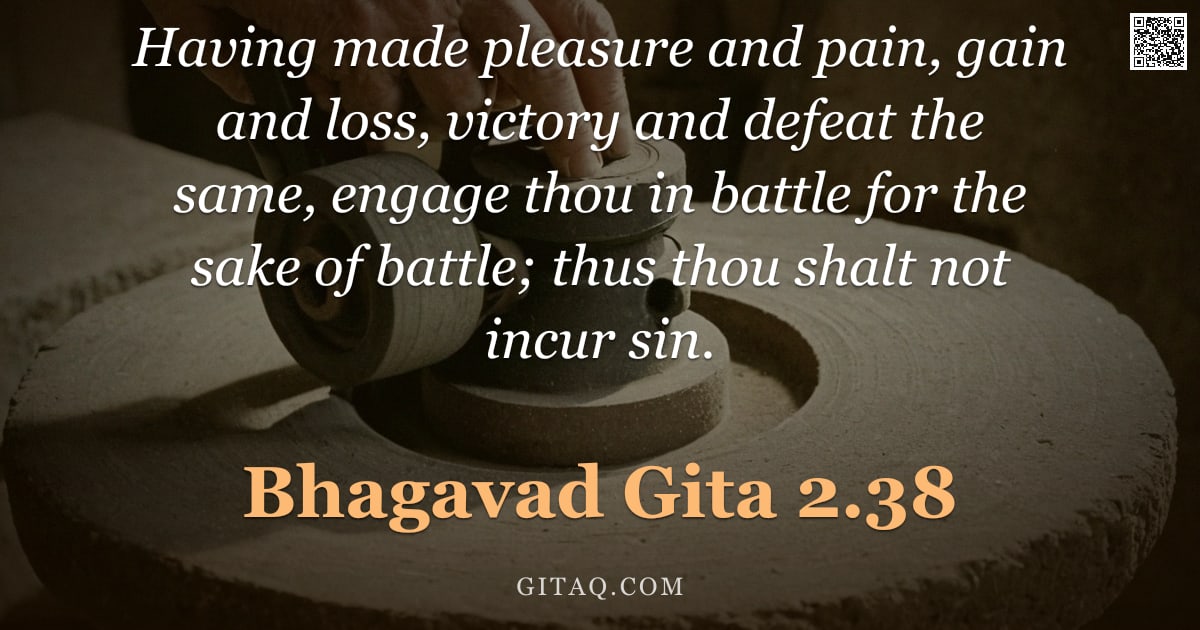
Bhagavad Gita 2.38
Sankhya Yoga · English Translation
सुखदुःखे समे कृत्वा लाभालाभौ जयाजयौ | ततो युद्धाय युज्यस्व नैवं पापमवाप्स्यसि ||२-३८||
sukhaduḥkhe same kṛtvā lābhālābhau jayājayau . tato yuddhāya yujyasva naivaṃ pāpamavāpsyasi ||2-38||
What Does This Verse Mean?
In this verse, Lord Krishna advises Arjuna to treat all dualities of life—such as pleasure and pain, success and failure—as equal states that do not disturb the mind's peace. He urges him to fight his duty without being driven by a desire for victory or fear of defeat. By maintaining such equanimity during action, one performs their responsibility without generating negative karmic reactions or sin.
The Teaching Behind It
This verse is a cornerstone of Karma Yoga (the yoga of selfless action) within the Sankhya philosophy framework taught in Chapter 2. It develops the concept of 'Samatvam' or equanimity, teaching that true spiritual progress comes from performing one's duty without attachment to the fruits of action.
Word by Word
Classical Commentary
Where This Happens
This verse occurs on the battlefield of Kurukshetra during the Mahabharata war, where Prince Arjuna has momentarily laid down his weapons in despair over fighting his own relatives. Lord Krishna, acting as his charioteer and spiritual guide, is concluding a profound discourse after explaining that the soul never dies and duty must be performed regardless of personal attachment. He speaks to an emotionally overwhelmed warrior who feels paralyzed by fear of sinning against his kin.
Living It Out Today
Consider a professional facing a high-stakes product launch where failure could cost their reputation, yet success is not guaranteed. Instead of freezing in anxiety or obsessing over the outcome, they focus entirely on executing every task with excellence and integrity, accepting that both winning and losing are part of the process. This mental shift allows them to act decisively under pressure without being paralyzed by fear of failure.
Explained for Children
Imagine you are playing your favorite video game where the goal is just to play with all your heart and do your best moves. If you win a round, you don't get too proud; if you lose, you don't cry because it's still fun to be in the game. Krishna says we should treat life like that: whether things go well or badly, stay calm and keep doing what needs to be done with a happy heart.
Daily Reflection
Today, I invite you to pause before any task where anxiety about winning or fear of losing might paralyze you. Imagine holding victory and defeat in equal balance; by releasing the need for a specific result, you free yourself from the heavy burden of expectation. This shift allows your actions to become pure offerings rather than desperate demands.
A Practice for Today
Close your eyes and visualize holding two opposite outcomes—success and failure—in the same hand, feeling their equal weight without reaching for one or rejecting the other. Breathe deeply as you silently affirm that your duty is to act with integrity regardless of which outcome arrives.
Key Teachings
- Equanimity as Spiritual Armor
True strength lies in treating pleasure and pain with equal indifference, preventing emotional turbulence from clouding judgment. By stabilizing the mind against dualities like gain or loss, one acts not out of fear but from a place of unwavering clarity. - Action for Action's Sake
Engaging in battle 'for the sake of battle' means performing duty as an end in itself, free from attachment to future rewards. This selfless engagement transforms mundane activities into sacred acts that purify the heart rather than bind it. - Freedom from Sin through Detachment
Sin arises not from the act of fighting or working, but from the egoistic desire for a specific outcome. When one performs their duty without craving success or fearing failure, they remain untouched by karmic reactions.
Themes
Related Verses
Read This Next
- 2.47 — This verse expands on the concept of acting without attachment to results, providing the philosophical foundation for performing duty.
- 3.30 — It offers a practical method of surrendering all actions and their fruits to the Divine, deepening the practice initiated in 2.38.
- 12.15 — This verse describes the qualities of the devotee who is dear to Krishna because they are free from envy and equally disposed to all beings.
Recommended Reading
GitaQ earns from qualifying purchases as an Amazon Associate.