Bhagavad Gita 2.37
Sankhya Yoga · English Translation
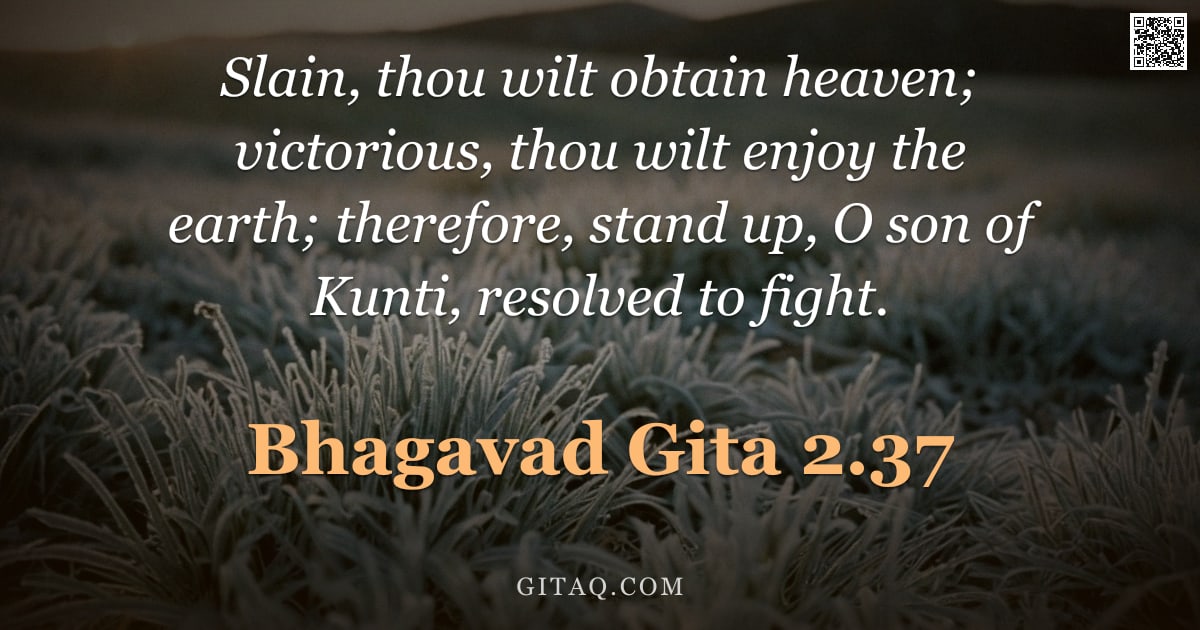
हतो वा प्राप्स्यसि स्वर्गं जित्वा वा भोक्ष्यसे महीम् | तस्मादुत्तिष्ठ कौन्तेय युद्धाय कृतनिश्चयः ||२-३७||
hato vā prāpsyasi svargaṃ jitvā vā bhokṣyase mahīm . tasmāduttiṣṭha kaunteya yuddhāya kṛtaniścayaḥ ||2-37||
What Does This Verse Mean?
In this verse, Lord Krishna urges Arjuna to rise and fight without hesitation or fear of the outcome. He explains that if Arjuna dies in battle, he will attain heaven for his courage, but if he wins, he will enjoy the earth as a victorious king. Since both possible results lead to a positive spiritual destination, there is no reason to be paralyzed by doubt; instead, one should act with full resolve.
The Teaching Behind It
This verse serves as a practical application of Karma Yoga, which emphasizes performing one's duty without attachment to the specific fruits of action. It bridges the theoretical knowledge of Sankhya (that the soul is indestructible) with active engagement in life, teaching that true peace comes from resolving to act rather than dwelling on potential outcomes.
Word by Word
Classical Commentary
Where This Happens
This verse occurs on the battlefield of Kurukshetra during the Mahabharata war, after Arjuna has laid down his bow and refused to fight due to grief over fighting his own relatives. Krishna has just finished explaining the eternal nature of the soul (Sankhya Yoga) in verses 2.1-36, showing that death is not the end for the self. Despite this philosophical explanation, Arjuna remains hesitant, so Krishna now shifts from teaching theory to issuing a direct command to rise and fulfill his duty as a warrior.
Living It Out Today
Consider a professional facing a difficult decision: launching a risky new project at work that could lead to either significant promotion or temporary failure. Instead of freezing in fear of the potential loss, you analyze the best-case scenario (success) and the worst-case scenario (learning from failure), realizing both outcomes contribute to your growth. This verse teaches you to act with clarity regardless of the immediate result, focusing on doing what is right rather than being paralyzed by anxiety over success or failure.
Explained for Children
Imagine you are playing a very important game where you must do your best because it's fair and right. If you win the game, you get great prizes on earth! But if things go wrong and you lose the round, people will still be proud of how brave you were to try your hardest. So, don't sit down scared or sad; stand up tall, play with all your heart, because being brave is always a victory.
Daily Reflection
Today, I invite you to examine the fears holding you back from taking necessary action in your own life. Just as Arjuna was called to rise beyond his hesitation about victory and defeat, you too can find freedom by focusing on duty rather than the results of that duty. When you release the heavy burden of needing a specific outcome, you discover an inner strength that allows you to stand firm regardless of what comes next.
A Practice for Today
Sit quietly and breathe deeply, imagining yourself standing at the threshold of a great responsibility where fear of loss or desire for gain has faded into clarity. Rest your mind on the simple truth that every outcome is sacred: whether you face difficulty with grace or success with humility, both are paths to liberation.
Key Teachings
- The Equanimity of Action
True courage arises when one acts without attachment to the dualities of victory and defeat. This verse teaches us that both success in this world and transcendence through sacrifice lead to spiritual fulfillment. - Duty Over Outcome
The call is not to fight for a specific result, but to rise because the action itself is right. By fixing one's resolve on duty rather than reward or fear of loss, the mind becomes steady and clear. - Divine Acceptance
Whether slain in battle or victorious on earth, both paths are acknowledged as divine gifts leading to heaven. This perspective removes anxiety by framing all possible outcomes as ultimately auspicious for the soul's journey.
Themes
Related Verses
Read This Next
- 2.47 — This verse expands on the principle of acting without attachment to results, which is the core mindset required by 2.37.
- 3.30 — Here Krishna instructs Arjuna to offer all actions and their fruits to Him, deepening the devotional aspect of fighting without ego.
- 12.15 — This verse describes the qualities of a devotee who is not disturbed by worldly dualities like honor or dishonor, embodying the spirit of 2.37.
Recommended Reading
GitaQ earns from qualifying purchases as an Amazon Associate.