Bhagavad Gita 2.36
Sankhya Yoga · English Translation
अवाच्यवादांश्च बहून्वदिष्यन्ति तवाहिताः | निन्दन्तस्तव सामर्थ्यं ततो दुःखतरं नु किम् ||२-३६||
avācyavādāṃśca bahūnvadiṣyanti tavāhitāḥ . nindantastava sāmarthyaṃ tato duḥkhataraṃ nu kim ||2-36||
What Does This Verse Mean?
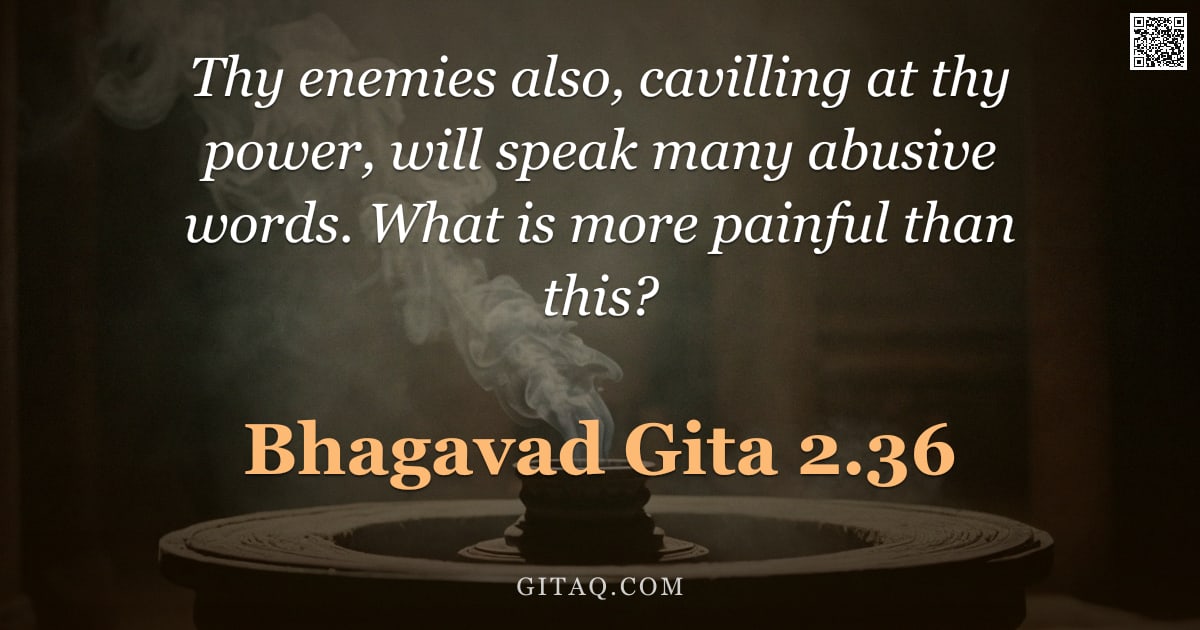
In this verse, Krishna warns Arjuna that his enemies will mock him and speak harshly about his power if he refuses to fight. These words of disrespect are considered more painful than physical death or battlefield injury for a warrior like Arjuna. The key teaching is that one must prioritize their duty (dharma) over the fear of public embarrassment or verbal abuse.
The Teaching Behind It
This teaching belongs primarily to Sankhya Yoga (Transcendental Knowledge) as it employs logical reasoning to dismantle the false identification with the body's sensations of pain and shame. It further supports Karma Yoga by establishing that action must be performed without attachment to 'Phala' (the fruits), including social approval or reputation.
Word by Word
Classical Commentary
Where This Happens
This verse occurs on the battlefield of Kurukshetra during the Bhagavad Gita's second chapter. Krishna has just finished explaining that Arjuna should fight for his duty as a warrior (Kshatriya dharma) rather than grieving over relatives, but he anticipates further hesitation from Arjuna regarding social reputation and pain. Speaking to the paralyzed prince who is overwhelmed by sorrow and fear of sin, Krishna presents this final logical argument: if you do not fight now, your enemies will taunt your honor in ways that are worse than death.
Living It Out Today
Consider a professional facing a critical career decision where they must deliver difficult feedback or make an unpopular choice; their colleagues may mock them as 'mean' or 'weak.' Instead of avoiding the hard conversation to preserve comfort, this verse teaches us to prioritize integrity and responsibility over temporary social embarrassment. The lesson applies whenever we fear criticism for doing what is right in our family or workplace.
Explained for Children
Imagine you have a very important job to do, but some bullies say mean things about how good you are at it because they think you won't start. Krishna tells Arjuna that hearing those unkind words is actually more scary than getting hurt in a fight. So, just like when you finish your homework or practice for the team game even if friends tease you, you should keep doing what is right and not stop because of mean talk.
Daily Reflection
When we feel attacked or mocked by others today, it often feels like a deep personal wound to our ego and reputation. Krishna reminds us that while words may cut through pride, they cannot harm the soul which stands beyond all judgment. Instead of retreating into anger or sorrow over these 'abusive words,' let this verse invite you to find strength in your unshakeable inner worth.
A Practice for Today
Sit quietly and imagine the sharp sting of harsh words from an adversary, then let that pain soften as you realize your true nature is beyond such verbal attacks. Rest your awareness in the silence beneath the noise, knowing that no external criticism can touch the eternal self.
Key Teachings
- The Nature of Enmity
Even the most powerful warriors face detractors who will attack their character and capabilities when they seek greater responsibilities. This verse acknowledges that social opposition is an inevitable part of stepping into one's true duty. - Transcending Reputation
The Gita teaches that a warrior must not be paralyzed by the fear of losing face or enduring verbal abuse from enemies. True valor lies in acting righteously regardless of how others perceive one's competence or character. - Pain as Opportunity
Krishna points out that while physical danger is severe, the pain of being slandered by those who know us best can be even more acute. This highlights the need to cultivate an internal stability that remains untouched by external validation or criticism. - The Limits of Speech
Words like 'abusive' and 'cavilling' are described as hollow because they cannot destroy one's inherent spiritual power. The verse encourages the seeker to look past the temporary nature of language to find lasting truth.
Themes
Related Verses
Read This Next
- 2.47 — This verse completes the thought by instructing you on how to act without attachment to the outcomes or criticism that Arjuna fears.
- 3.30 — Following this, 12:6 is recommended as it offers a method for dedicating all actions and their results to the Divine, freeing one from worldly judgment.
- 12.15 — Reading about how devotees who are dear to Krishna are those who do not disturb others will provide practical guidance on handling conflict with grace.
Recommended Reading
GitaQ earns from qualifying purchases as an Amazon Associate.