Bhagavad Gita 2.39
Sankhya Yoga · English Translation
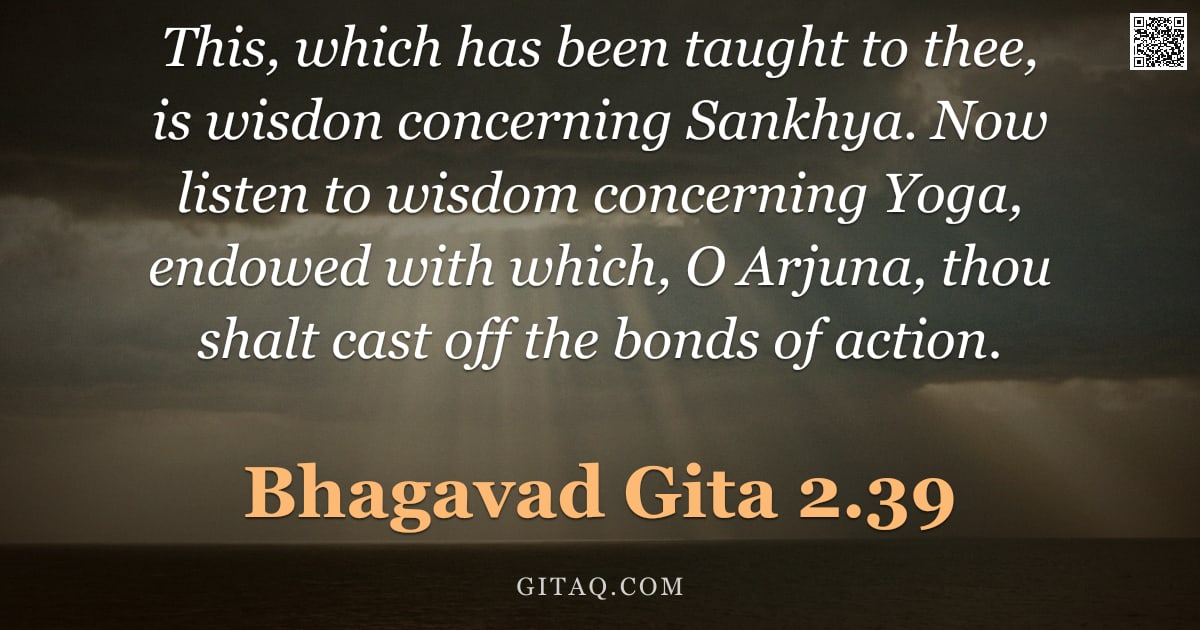
एषा तेऽभिहिता साङ्ख्ये बुद्धिर्योगे त्विमां शृणु | बुद्ध्या युक्तो यया पार्थ कर्मबन्धं प्रहास्यसि ||२-३९||
eṣā te.abhihitā sāṅkhye buddhiryoge tvimāṃ śṛṇu . buddhyā yukto yayā pārtha karmabandhaṃ prahāsyasi ||2-39||
What Does This Verse Mean?
In this verse, Lord Krishna transitions from teaching Arjuna about the nature of the soul (Sankhya) to explaining how to act in the world without creating new karmic debts (Yoga). He tells Arjuna that by applying wisdom and performing duties with a detached mindset, one can break free from the cycle of action and its consequences. The key teaching is that true freedom comes not from stopping work, but from changing your attitude while working.
The Teaching Behind It
This verse bridges Sankhya (intellectual knowledge) and Karma Yoga (the yoga of action), marking the shift from understanding the self to applying that wisdom. It develops the concept of Buddhi-yoga, where intelligent detachment is used as a tool to sever the binding chains of karma without renouncing physical activity.
Word by Word
Classical Commentary
Where This Happens
This verse occurs on the battlefield of Kurukshetra in Chapter 2, where Arjuna has just expressed deep confusion and reluctance to fight his relatives. Krishna has spent previous verses explaining that the soul is eternal and cannot be killed, a teaching known as Sankhya or spiritual knowledge. Having cleared Arjuna's intellectual doubts about death, Krishna now pivots to practical application in this verse, promising that acting with this wisdom will end Arjuna's mental bondage.
Living It Out Today
Consider a professional facing a high-stakes project deadline where the outcome could define their career trajectory or lead to layoffs. Instead of being paralyzed by fear of failure or obsessing over praise for success, they apply this verse by focusing entirely on executing each task with excellence and integrity. By detaching from the anxiety about 'what if' scenarios and trusting in the process of doing their duty, they complete the work effectively without burning out.
Explained for Children
Imagine you are playing a video game where every move you make counts toward your score or penalty. Usually, if you lose focus, you get stuck in the 'game over' screen because of mistakes. Krishna is like a coach telling Arjuna that he can play the big battle perfectly without getting stressed about winning or losing. If you do exactly what needs to be done and don't worry about the result, you stay happy and free from being trapped by your own moves.
Daily Reflection
Today, you carry a heavy load of anxiety about outcomes and past mistakes. Krishna reminds us that true freedom comes not from escaping action, but from changing how we engage with it through wisdom. When you shift your focus from 'what I will gain' to 'the purity of my intent,' the invisible chains binding you begin to loosen.
A Practice for Today
Pause and acknowledge that your current duties are not merely burdens, but the very ground for your spiritual growth. Visualize performing your actions as an offering of wisdom rather than a chase for results, allowing the weight of expectation to dissolve into stillness.
Key Teachings
- The Two Streams: Sankhya and Yoga
Krishna first establishes intellectual clarity (Sankhya) before introducing practical application (Yoga). This teaches that true spiritual liberation requires both theoretical understanding of the self and active engagement in duty. - Wisdom as a Weapon Against Bondage
Action itself is not the chain; it is our attachment to the fruits of action that binds us. By performing duties with discernment (buddhi), one transforms ordinary work into a tool for spiritual release. - The Transition from Theory to Practice
Knowledge alone is insufficient without the application of Yoga in daily life. The verse marks a pivotal moment where Arjuna moves from hearing about duty to actively practicing it with equanimity.
Themes
Related Verses
Read This Next
- 2.47 — This verse defines the specific method of action (Karma Yoga) mentioned in 2.39 as the practical means to cast off bondage.
- 3.30 — Continues the theme of offering all actions to the Divine, expanding on how wisdom transforms duty into devotion.
- 12.15 — Describes the qualities of a beloved devotee who has successfully transcended the dualities and bonds discussed in earlier chapters through steady practice.
Recommended Reading
GitaQ earns from qualifying purchases as an Amazon Associate.