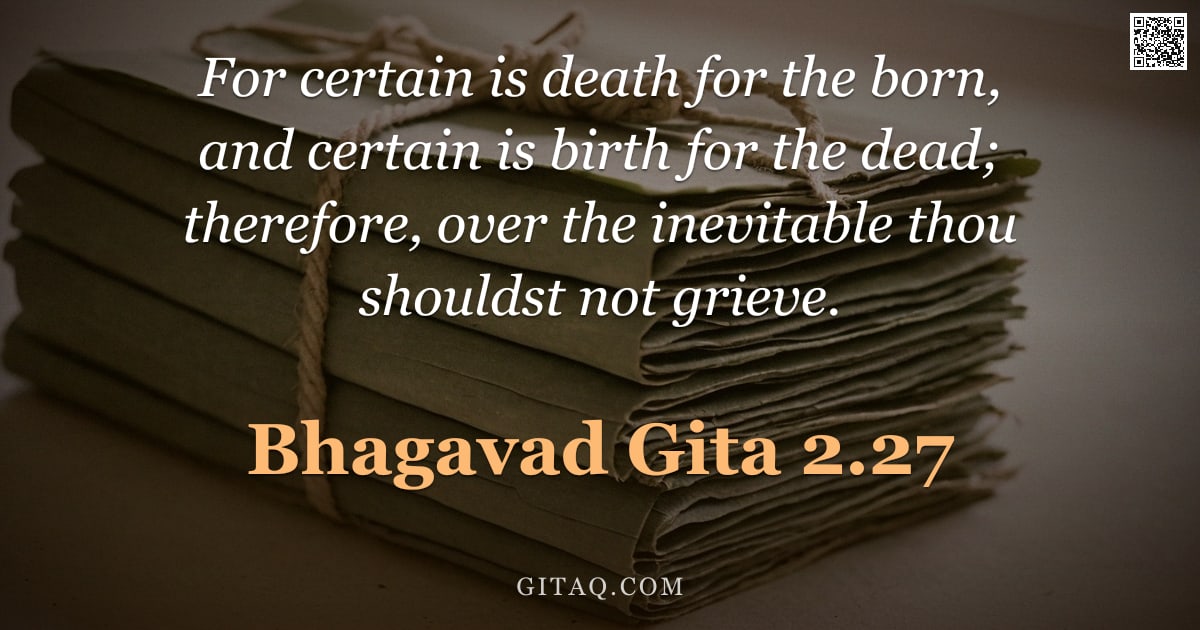
Bhagavad Gita 2.27
Sankhya Yoga · English Translation
जातस्य हि ध्रुवो मृत्युर्ध्रुवं जन्म मृतस्य च | तस्मादपरिहार्येऽर्थे न त्वं शोचितुमर्हसि ||२-२७||
jātasya hi dhruvo mṛtyurdhruvaṃ janma mṛtasya ca . tasmādaparihārye.arthe na tvaṃ śocitumarhasi ||2-27||
What Does This Verse Mean?
In this verse, Lord Krishna speaks to the grieving Arjuna on the battlefield of Kurukshetra. He explains that death is an inevitable certainty for anyone who has been born, just as birth follows after death; it is a continuous cycle governed by natural law. Therefore, since this change cannot be avoided or stopped, there is no reason for Arjuna to indulge in sorrow over what he sees happening.
The Teaching Behind It
This teaching is a cornerstone of Sankhya Yoga (Transcendental Knowledge) within Chapter 2, which focuses on distinguishing between the eternal self (Atman) and the temporary body. It develops the concept that since death is an inherent characteristic of birthed matter, emotional distress over it stems from ignorance regarding one's true nature as a timeless spirit.
Word by Word
Classical Commentary
Where This Happens
This verse occurs in Chapter 2 during the initial dialogue between Lord Krishna and Arjuna on the battlefield of Kurukshetra, just after Arjuna has dropped his bow and arrows. Overwhelmed by attachment to his relatives and teachers who stand as enemies, Arjuna is paralyzed by grief and refuses to fight. Krishna uses this verse to gently dismantle Arjuna's emotional paralysis by pointing out that mourning a natural law like death is illogical.
Living It Out Today
Imagine you are a project manager whose team has just been downsized due to market changes; while the loss of colleagues brings sadness, recognizing that organizational shifts and personnel changes are inevitable allows you to stop dwelling on 'what if' scenarios. Instead of grieving the past structure endlessly, this perspective empowers you to focus your energy on adapting the remaining resources and planning for the next phase with clarity rather than despair.
Explained for Children
Imagine you are watching leaves fall off trees in autumn and new buds growing on the branches next spring; nature has a rule that things must end so they can begin again. When someone dies, it's like a seed turning into a flower or a caterpillar becoming a butterfly—it is just part of how life works. Krishna tells us not to cry too hard when we lose someone because death and birth are promises the universe makes forever.
Daily Reflection
You are invited today to release the heavy burden of trying to control outcomes you cannot change, much like a river does not fight its journey to the ocean. When anxiety rises about loss or uncertainty, remember that birth and death are simply two ends of the same eternal thread connecting all souls. By embracing this certainty with peace rather than fear, you free yourself from grief and make space for deeper love in your present moment.
A Practice for Today
Sit quietly and visualize the cycle of day turning to night, accepting that just as darkness is inevitable after light, death follows birth naturally without malice. Let this rhythm settle your mind, releasing any resistance to the changing seasons of life by acknowledging them as sacred laws rather than random tragedies.
Key Teachings
- The Inevitability of Transition
Just as dawn must follow night, death is the absolute certainty for every being who takes birth. This verse establishes that mortality is not a punishment but a natural law governing all physical existence. - The Cyclic Nature of Existence
Death is merely the doorway through which the soul passes to be born again in new forms. Understanding this cycle transforms death from an end into a necessary stage of spiritual progression. - Freedom Through Acceptance
Grief arises only when we resist what cannot be changed; true peace comes from aligning with the divine order. By accepting the inevitable, you free your heart to focus on duty and love rather than sorrow.
Themes
Related Verses
Read This Next
- 2.47 — Read next to understand how Arjuna applies this knowledge of inevitability to perform his duty without attachment to results.
- 3.30 — This verse follows up by instructing the devotee to surrender all actions and their fruits, deepening the theme of non-attachment discussed in 2.27.
- 12.15 — Complete your study with a description of the qualities of one who has transcended grief and duality through this very knowledge.
Recommended Reading
GitaQ earns from qualifying purchases as an Amazon Associate.