Bhagavad Gita 2.28
Sankhya Yoga · English Translation
अव्यक्तादीनि भूतानि व्यक्तमध्यानि भारत | अव्यक्तनिधनान्येव तत्र का परिदेवना ||२-२८||
avyaktādīni bhūtāni vyaktamadhyāni bhārata . avyaktanidhanānyeva tatra kā paridevanā ||2-28||
What Does This Verse Mean?
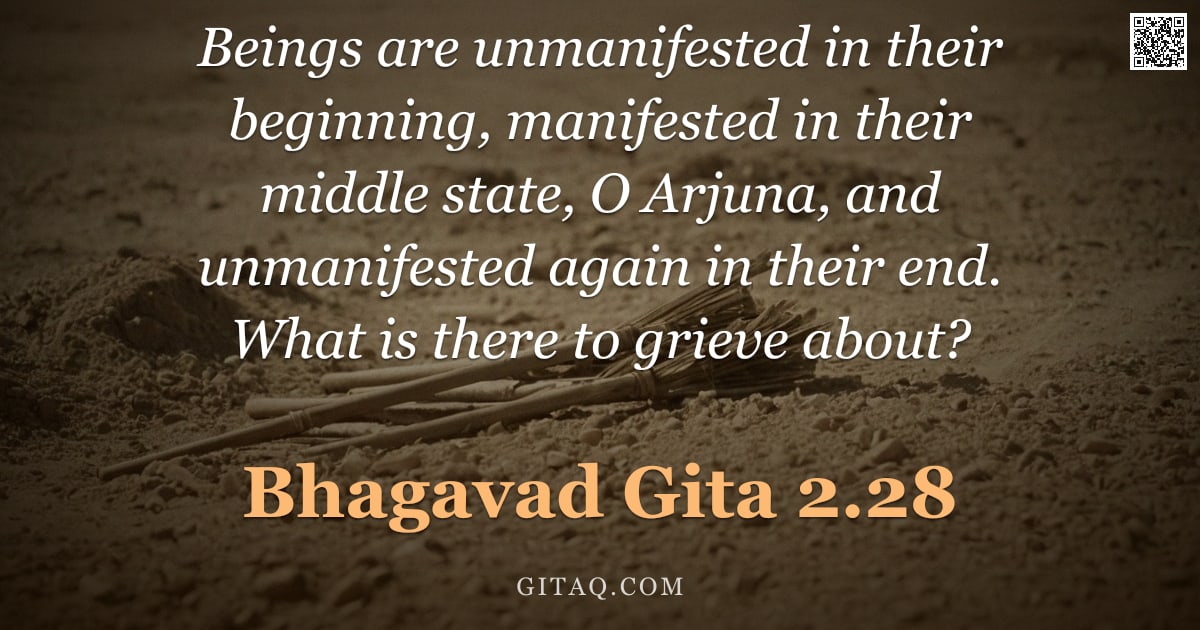
In this verse, Lord Krishna is speaking to Arjuna on the battlefield of Kurukshetra to console his friend's grief over impending war and death. He explains that all living beings exist in an unmanifested state before birth, take a visible form during life, and return to an unmanifested state after death. The core teaching is that since this cycle of coming into being and disappearing is natural for everyone, there is no logical reason to mourn or grieve over it.
The Teaching Behind It
This verse belongs primarily to Sankhya Yoga (the yoga of knowledge) and Jnana Yoga, which focuses on discerning reality. It develops the fundamental Vedantic concept that the individual soul (Atman) is eternal and distinct from the body, which undergoes a continuous cycle of coming into existence and dissolving back into its unmanifested source.
Word by Word
Classical Commentary
Where This Happens
This verse appears in Chapter 2 during the Kurukshetra war, where Arjuna has dropped his bow and fallen into deep despair upon seeing his relatives on the opposing side. Krishna has already begun explaining the distinction between the temporary body and the eternal soul (Atman) to lift Arjuna's confusion. Arjuna is overwhelmed by fear of sinning against family and losing their loved ones, but he is struggling to accept that death might be inevitable for them. Krishna uses this specific verse to dismantle Arjuna's emotional attachment to physical forms by pointing out the universal nature of birth and death.
Living It Out Today
Consider a professional who has just been laid off from a company they worked at for fifteen years, feeling their identity is shattered. Instead of spiraling into grief over losing this 'manifested' chapter of their career, they can apply this wisdom to realize that the job was only a temporary state in their larger journey as an individual. Understanding that every role we play—parent, employee, student—is a phase between birth and death allows them to detach from the immediate pain and focus on rebuilding with resilience rather than mourning what is gone.
Explained for Children
Imagine you are watching a cloud change shape in the sky. At first, you can't see it (unmanifested), then it turns into a big fluffy white bear that you can clearly see and touch for a while (manifested), and finally, it floats away until you can't see it again (unmanifested). Just like the cloud isn't sad to disappear because it was there before as mist, we don't need to be scared or sad when our life ends. It is just part of how everything in nature works.
Daily Reflection
You may feel overwhelmed by loss or fear when things you cherish seem to vanish from your view today. Remember that just as a seed must leave its shell to become a plant, every ending holds the promise of a new beginning in this eternal cycle. Instead of grieving what has passed into invisibility, trust that it simply returns to its unmanifest source where no harm can touch it.
A Practice for Today
Close your eyes and visualize a cloud forming, dissolving into rain that nourishes the earth, then evaporating back into mist; notice how each stage is natural yet distinct. Sit with this rhythm of appearing and disappearing in your own life, acknowledging that change is not an end but merely another phase of existence.
Key Teachings
- The Three Stages of Existence
All beings pass through three distinct phases: they emerge from the unmanifested, take form in this world, and eventually return to the unmanifest state. Recognizing these stages removes the illusion that our current circumstances are permanent or final. - The Futility of Grief
Since every manifestation is destined to dissolve back into its source, mourning what returns to invisibility is logically and spiritually unnecessary. True wisdom lies in accepting the natural law that nothing truly disappears; it only changes form. - The Eternal Nature of the Soul
While bodies and forms undergo this cycle of birth, life, and death, the essential self remains untouched by these transformations. Understanding this distinction allows us to face change with equanimity rather than despair.
Themes
Related Verses
Read This Next
- 2.47 — This verse follows up on duty by instructing us to act without attachment to results, which flows naturally from accepting impermanence.
- 3.30 — It expands the concept of surrender and offering actions to the Divine as a practical way to navigate the cycle of birth and death mentioned in 2.28.
- 12.15 — This verse describes the qualities of one who has mastered such detachment, serving as an inspiring portrait of the person living by these truths.
Recommended Reading
GitaQ earns from qualifying purchases as an Amazon Associate.