Bhagavad Gita 2.26
Sankhya Yoga · English Translation
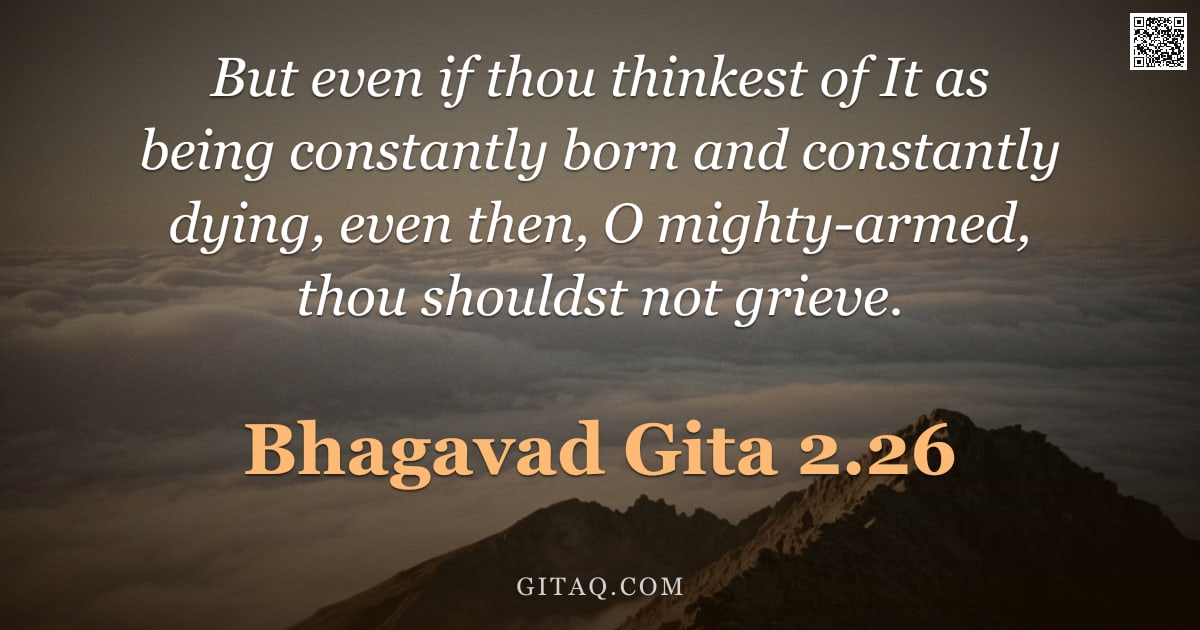
अथ चैनं नित्यजातं नित्यं वा मन्यसे मृतम् | तथापि त्वं महाबाहो नैवं शोचितुमर्हसि ||२-२६||
atha cainaṃ nityajātaṃ nityaṃ vā manyase mṛtam . tathāpi tvaṃ mahābāho naivaṃ śocitumarhasi ||2-26||
What Does This Verse Mean?
In this verse, Lord Krishna continues his teaching to Arjuna by addressing the argument that if one believes the soul is born and dies repeatedly, there is still no reason for grief. Krishna argues that even from the perspective of a cycle of birth and death (samsara), which seems terrifying or tragic, sorrow is unnecessary because this process is natural and inevitable. The core message is to stop grieving over what cannot be changed by accepting the eternal nature of existence versus temporary physical changes.
The Teaching Behind It
This verse belongs to the Jnana Yoga (path of knowledge) strand within Sankhya philosophy, specifically developing the concept that grief is a product of ignorance regarding the true nature of reality. It refutes the fear of death by establishing that even if one accepts dualistic views like birth and decay as real, they are still transient phenomena that do not touch the core consciousness.
Word by Word
Classical Commentary
Where This Happens
This verse occurs on the battlefield of Kurukshetra during the Mahabharata war, where Prince Arjuna has laid down his weapons and fallen into deep despair. After Krishna had explained that the soul is eternal (2.13-25), Arjuna attempts to argue a counter-point: perhaps if he views life as a continuous cycle of birth and death, then grief might be justified due to the pain involved in dying repeatedly. In response, Krishna gently rebukes this line of thinking by telling the 'mighty-armed' warrior that even under such a grim assumption, sorrow is illogical.
Living It Out Today
Consider a modern professional who has just lost their job and feels like they have failed because their career identity seems to be dying. They might grieve over the loss of stability and fear for the future, but applying this verse's wisdom means recognizing that while one 'chapter' or role ends, it is merely a transition in life rather than an absolute end. Instead of wasting energy on despair, they can accept the change as part of the natural flow and focus their mind on preparing for the next opportunity.
Explained for Children
Imagine you are wearing an old t-shirt that gets small as you grow; eventually, it doesn't fit anymore, so you put on a new one. You don't cry because your favorite shirt is gone forever, right? Lord Krishna says the same thing about our bodies: they might seem to be born and then die like changing clothes or seasons, but the real 'you' inside never really changes or goes away. So, even if we think life ends when a body dies, there's no need to cry because something new is just starting.
Daily Reflection
Imagine how heavy your heart feels when you cling to the idea that this life ends with the body; it is like mourning a shadow while ignoring the light casting it. Krishna invites you to loosen your grip on the transient timeline of birth and death, realizing that what truly matters cannot be born or destroyed by time. By shifting your focus from the fleeting form to the timeless essence within, you find a quiet strength that no loss can ever shake.
A Practice for Today
Sit quietly and visualize your essential nature not as the body that breathes or fades, but as a silent witness to every birth and death you observe around you. When thoughts of loss arise, gently remind yourself that even if existence were merely a cycle of beginning and ending, true grief has no place for what is eternal.
Key Teachings
- The Paradox of Permanence
Even if we hypothetically accept death as an inevitable cycle, the wise soul recognizes that grief is irrational for something eternal. This teaching challenges us to examine whether our sorrow stems from a misunderstanding of reality's true nature. - The Futility of Grief
Krishna asserts that grieving over what is either immortal or subject to natural cycles serves no purpose for the mighty-armed warrior. True wisdom lies in accepting the law of existence without being paralyzed by emotional attachment to outcomes. - The Perspective of the Eternal
Whether one views life as a continuous rebirth or a single death, the conclusion remains that grief is misplaced for the indestructible Self. This verse calls us to transcend personal attachments and act from a place of spiritual clarity.
Themes
Related Verses
Read This Next
- 2.47 — To learn the practical application of non-attachment to results after understanding why one should not grieve.
- 3.30 — To explore how surrendering actions and their fruits is a natural progression from mastering emotional detachment.
- 12.15 — To discover the characteristics of those who have transcended grief, pain, and attachment to material existence.
Recommended Reading
GitaQ earns from qualifying purchases as an Amazon Associate.