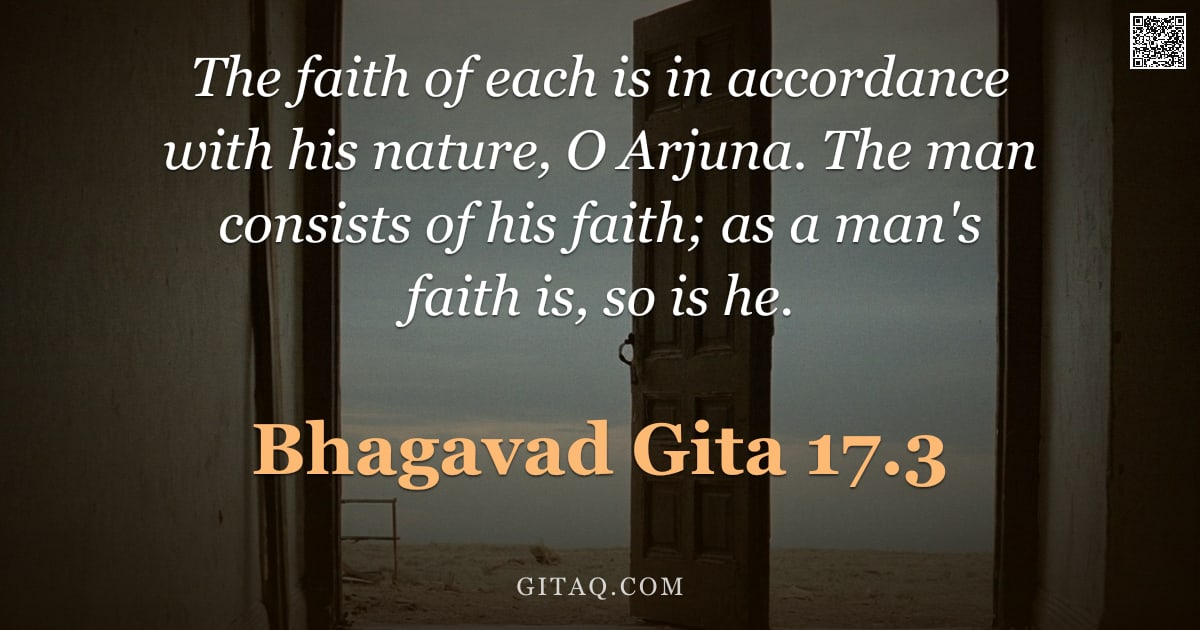
Bhagavad Gita 17.3
Shraddhatraya Vibhaga Yoga · English Translation
सत्त्वानुरूपा सर्वस्य श्रद्धा भवति भारत | श्रद्धामयोऽयं पुरुषो यो यच्छ्रद्धः स एव सः ||१७-३||
sattvānurūpā sarvasya śraddhā bhavati bhārata . śraddhāmayo.ayaṃ puruṣo yo yacchraddhaḥ sa eva saḥ ||17-3||
What Does This Verse Mean?
Lord Krishna explains to Arjuna that a person's faith is never random; it naturally aligns with their inner nature or character. He teaches the profound principle that a human being truly consists of what they believe in, meaning your beliefs shape your very identity and actions. If you have pure faith, your life reflects purity, but if your faith is unstable, your life will mirror that instability.
The Teaching Behind It
This verse bridges Sankhya philosophy regarding the three gunas (modes of nature) with Bhakti Yoga, establishing that faith is not an abstract concept but the active expression of one's spiritual constitution. It develops the core Vedantic teaching that consciousness shapes reality, where the inner state determines external perception and behavior.
Word by Word
Classical Commentary
Where This Happens
This verse appears in Chapter 17 during the dialogue on the battlefield of Kurukshetra, where Lord Krishna is responding to Arjuna's confusion after describing the three modes of nature (goodness, passion, and ignorance). Just before this, Arjuna asked how people who do not follow Vedic rituals but still worship with devotion should be classified. The listener, Prince Arjuna, is feeling overwhelmed by the complexity of duty versus personal inclination in a moment of deep moral crisis.
Living It Out Today
Consider someone facing a career change: if their faith (belief system) is rooted in fear of failure and scarcity, they will instinctively choose safe but unfulfilling paths that reinforce those fears. Conversely, an individual whose faith is anchored in growth and service might take the same risky step with courage, seeing it as a necessary evolution rather than a threat. Your current anxiety or excitement about a difficult decision often reveals exactly what you believe to be true about yourself and your future.
Explained for Children
Imagine two seeds: one planted by someone who loves water and sunlight, and another dropped on a rocky road where nothing grows. The plants they become depend entirely on the conditions of their planting, just like people grow into what they believe in most deeply. If you love kindness and honesty every day, your heart becomes kind; if you only think about being angry or greedy, those feelings take over who you are.
Daily Reflection
Today, I invite you to look closely at what fills your heart with trust and hope. You are discovering that who you truly are is shaped by where you place your faith—whether in higher truths or fleeting distractions. As you align your inner belief with something pure and enduring, you will find yourself transforming into the very essence of that devotion.
A Practice for Today
Sit quietly and observe the quality of your thoughts and actions today; ask yourself if they arise from clarity, restlessness, or dullness. Recognize that your current state is not a temporary accident but a reflection of the deep roots within you.
Key Teachings
- Faith Mirrors Nature
The verse establishes a direct causal link between one's inherent nature (svabhava) and their object of faith. A person does not choose belief in isolation; rather, they gravitate toward what resonates with the fundamental quality—Sattva, Rajas, or Tamas—that defines them. - Identity is Faith
The profound declaration 'yo yacchraddhaḥ sa eva saḥ' teaches that a human being's essence is defined by their faith. It suggests that our spiritual reality and moral character are not abstract concepts but the living expression of what we deeply trust. - The Path to Purification
Understanding this verse reveals that changing one's life requires transforming one's nature, which begins with redirecting faith. By consciously cultivating faith in divine wisdom and goodness, a person can gradually elevate their inherent qualities from darkness or passion toward illumination.
Themes
Related Verses
Read This Next
- 2.47 — Read this next to understand how one performs duty without attachment while maintaining a steady mind amidst changing faiths.
- 3.30 — This verse offers the practical method of surrendering all actions and their fruits, which is essential for purifying the nature that drives our faith.
- 12.15 — Read this to see how a devotee who has cultivated pure Sattvic faith becomes dear to Krishna, illustrating the fruit of transformed belief.
Recommended Reading
GitaQ earns from qualifying purchases as an Amazon Associate.