Bhagavad Gita 17.2
Shraddhatraya Vibhaga Yoga · English Translation
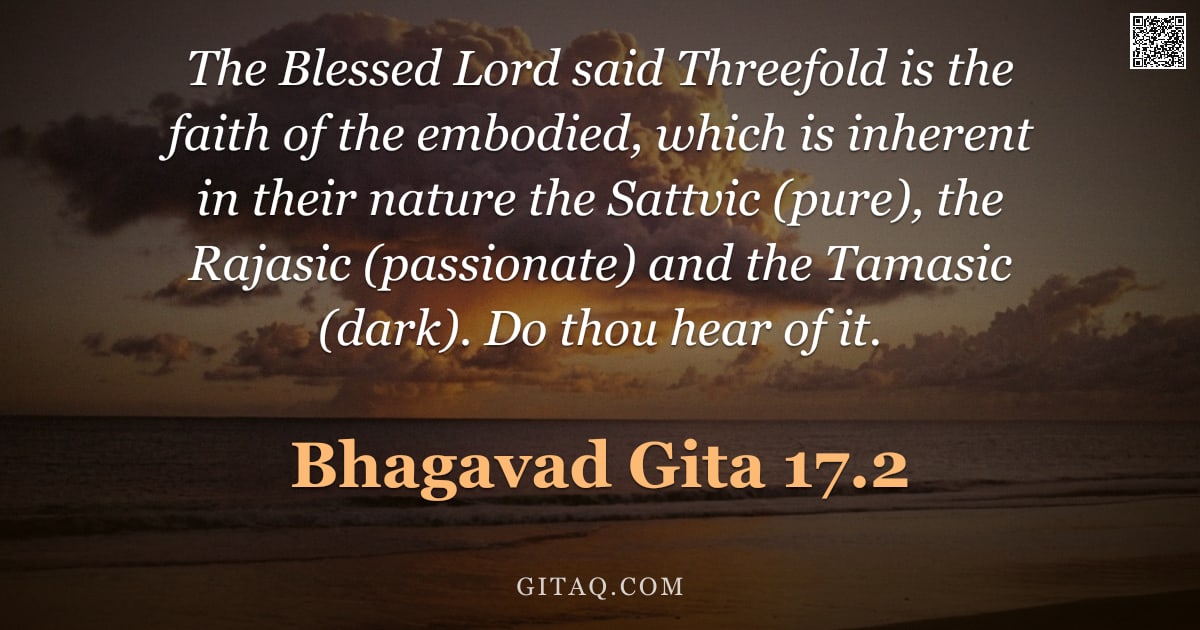
श्रीभगवानुवाच | त्रिविधा भवति श्रद्धा देहिनां सा स्वभावजा | सात्त्विकी राजसी चैव तामसी चेति तां शृणु ||१७-२||
śrībhagavānuvāca . trividhā bhavati śraddhā dehināṃ sā svabhāvajā . sāttvikī rājasī caiva tāmasī ceti tāṃ śṛṇu ||17-2||
What Does This Verse Mean?
In this verse, Lord Krishna addresses Arjuna to explain that faith is not a single uniform quality but exists in three distinct forms based on one's inherent nature: Sattvic (pure and harmonious), Rajasic (passionate and active), or Tamasic (dark and ignorant). The key teaching here is that your beliefs, how you worship, and the way you approach life are direct reflections of your internal state of mind. Krishna invites Arjuna to listen closely so he can understand which type of faith governs his actions.
The Teaching Behind It
This verse is foundational to Gita's psychology and sits within the framework of Sankhya philosophy, which classifies all material existence through three gunas (modes of nature). It establishes that spiritual practice cannot be separated from one's innate constitution; therefore, different paths are prescribed for those dominated by purity, passion, or ignorance. This prepares the student for the subsequent chapters where Krishna details how these modes affect diet, sacrifice, charity, and meditation.
Word by Word
Classical Commentary
Where This Happens
This conversation takes place on the battlefield of Kurukshetra during the Mahabharata, where Prince Arjuna has just fallen into a deep state of despair and confusion about fighting his own relatives. After Krishna explains various spiritual concepts in previous chapters, he begins Chapter 17 to provide specific details on how human nature dictates behavior. Speaking as the Supreme Divine Teacher (Bhagavan), Krishna transitions from abstract philosophy to practical psychology by addressing Arjuna's need to understand his own mindset before making decisions.
Living It Out Today
Consider a team member who is anxious about an upcoming project deadline; their reaction depends entirely on their dominant nature: if they are Sattvic, they will calmly organize tasks and seek help constructively. If they are Rajasic, they might panic, work obsessively without sleep to prove themselves, or blame others for delays. A Tamasic response would be to ignore the email completely, procrastinate until the last minute, or give up in frustration. Recognizing these patterns helps you offer the right kind of support rather than generic advice.
Explained for Children
Imagine three different types of seeds: one grows into a beautiful flower with lots of sunshine (pure), another grows fast and loud like a wild vine that takes over everything (active but messy), and the last one stays stuck in dark dirt without growing much at all. Just like these seeds, every person has their own special 'faith seed' inside them when they are born. This verse teaches us to check which kind of seed we have so we can help it grow into something good.
Daily Reflection
You might notice how deeply your faith shapes every action you take, often before you even realize it. Sometimes this shows up as confusion when we act without purpose, or restlessness when driven only by personal gain. The good news is that you are not bound forever to whatever nature currently holds sway over you; with awareness and practice, the dark can lighten into a steady clarity.
A Practice for Today
Pause and notice your current state of mind as you approach your next task; is it driven by clarity, a desire for reward, or simply inertia? Imagine this inherent quality not as a fixed label but as a seed that can be nurtured toward purity. Breathe into the intention to transform any darkness or agitation in your heart toward steady light today.
Key Teachings
- Faith Reflects Inner Nature
The Lord teaches that faith is not merely an intellectual belief but flows directly from one's inherent nature (svabhava). This means our spiritual orientation—whether pure, passionate, or dull—is a mirror of our current internal state. - The Three Gunas in Action
Every soul operates under the influence of three modes: Sattva (purity and balance), Rajas (activity and desire), and Tamas (inertia and darkness). Understanding which mode dominates helps us diagnose why our faith feels stable or chaotic. - The Path to Transformation
While nature dictates our starting point, the Gita implies that this quality is not static but can be cultivated through conscious practice. By recognizing these tendencies, we gain the power to elevate ourselves from Tamasic or Rajasic faith toward Sattvic purity.
Themes
Related Verses
Read This Next
Recommended Reading
GitaQ earns from qualifying purchases as an Amazon Associate.