Bhagavad Gita 17.4
Shraddhatraya Vibhaga Yoga · English Translation
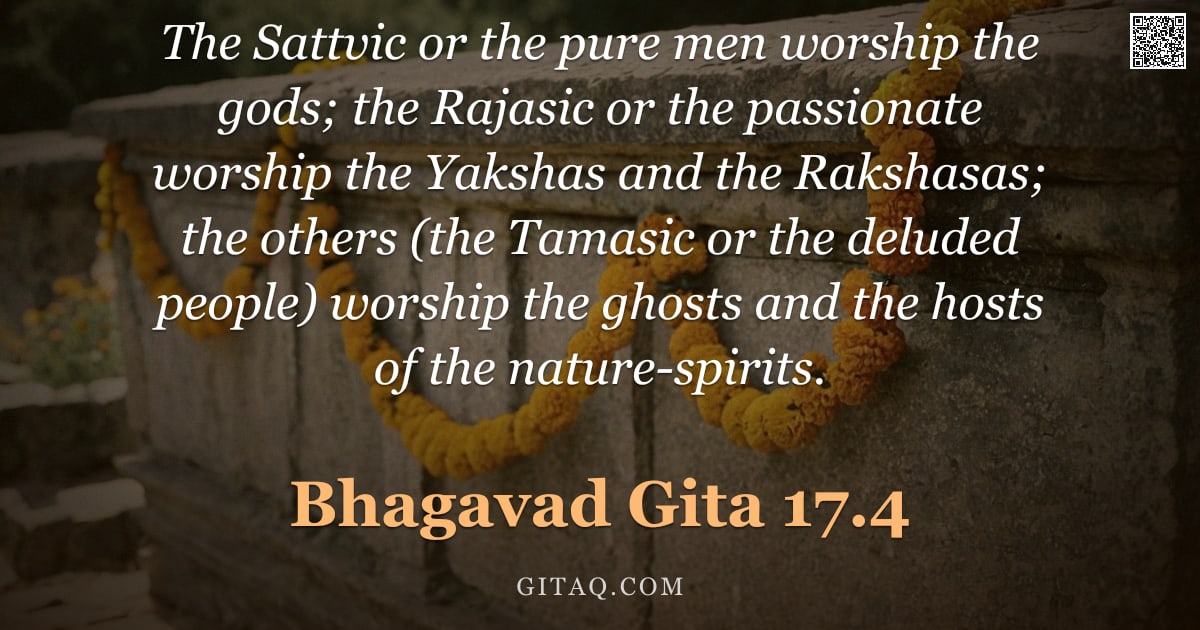
यजन्ते सात्त्विका देवान्यक्षरक्षांसि राजसाः | प्रेतान्भूतगणांश्चान्ये यजन्ते तामसा जनाः ||१७-४||
yajante sāttvikā devānyakṣarakṣāṃsi rājasāḥ . pretānbhūtagaṇāṃścānye yajante tāmasā janāḥ ||17-4||
What Does This Verse Mean?
In this verse, Lord Krishna explains to Arjuna that a person's faith naturally reflects their inner nature or temperament. Those with a pure and calm mind (Sattvic) worship divine beings known as gods; those driven by passion and desire for power (Rajasic) seek support from celestial guardians like Yakshas and Rakshasas; while those clouded by ignorance or fear (Tamasic) tend to worship spirits of the deceased. The core teaching is that our spiritual choices are not random but mirror our current state of consciousness.
The Teaching Behind It
This verse belongs to the teachings of Sankhya Yoga and Karma Yoga, focusing on how human action is driven by the three Gunas (modes of material nature). It develops the concept that external rituals are meaningless unless they align with an internal state of purity; true devotion requires transforming one's consciousness from Rajasic or Tamasic agitation into a calm, Sattvic clarity.
Word by Word
Classical Commentary
Where This Happens
This verse appears in Chapter 17 during Lord Krishna's dialogue with Arjuna on the battlefield of Kurukshetra, following his explanation of how faith manifests differently based on one's nature. It occurs after a long discourse where Krishna has been categorizing human qualities into Sattva (goodness), Rajas (passion), and Tamas (ignorance) to guide Arjuna out of his confusion. The listener, Arjuna, is in a state of deep emotional turmoil and moral doubt about fighting his kinsmen, making this classification crucial for understanding how their current mental states dictate their spiritual outlooks.
Living It Out Today
Consider a professional facing a high-stakes job decision where they feel overwhelmed by the fear of failure. Instead of panicking or seeking 'quick fixes' from unverified gurus (Tamasic reaction), or trying to bribe/cheat for success through aggressive networking (Rajasic reaction), they should pause and align their actions with ethical principles and long-term growth (Sattvic approach). By recognizing that their anxiety is driving them toward fear-based shortcuts, they can choose instead to perform the work diligently without attachment to the immediate outcome.
Explained for Children
Imagine you have three different types of friends: one who loves playing with kind animals, another who wants to win big games and needs a lucky charm, and a third who is scared in the dark and looks for monsters under the bed. This verse says that people are like those friends; if your heart feels calm and good, you naturally look up to loving heroes (gods). If you want excitement or power, you might ask special helpers to win for you. But if you feel confused or afraid, you might end up looking at scary shadows instead of the light.
Daily Reflection
Today, you are invited to look gently at what truly motivates your devotion in life. Are you seeking connection through purity and truth, driven by passionate desire for results, or perhaps lost in fear and tradition without understanding? Recognizing this pattern is not a verdict but an invitation to align your heart with the light of sincerity.
A Practice for Today
Sit quietly and observe your current inclination toward worship or spiritual practice without judgment, asking yourself if it arises from clarity, passion, or confusion. Allow this moment of self-observation to become a bridge between your actions and the deeper quality of faith that drives them.
Key Teachings
- The Quality of Faith Determines the Object
This verse teaches that what we worship is a direct reflection of our internal state, or 'gunas'. A mind steeped in clarity naturally gravitates toward divine principles, while one clouded by passion seeks power. - Faith as the Mirror of Consciousness
Our worship acts as a mirror revealing whether our consciousness is dominated by goodness, activity, or ignorance. The external ritual matters less than the internal purity that animates it. - The Spectrum from Devotion to Delusion
Spiritual practice exists on a spectrum ranging from Sattvic worship of the divine to Tamasic rituals rooted in fear or superstition. True growth involves moving through these layers by refining our own nature.
Themes
Related Verses
Read This Next
- 2.47 — To understand how to act without attachment while cultivating the Sattvic faith described in this verse.
- 3.30 — This chapter continues the discussion on action and dedication, offering context for dedicating one's work to the divine.
- 12.15 — To see the qualities of a devotee who has transcended passion and ignorance, embodying the Sattvic ideal fully.
Recommended Reading
GitaQ earns from qualifying purchases as an Amazon Associate.