Bhagavad Gita 17.24
Shraddhatraya Vibhaga Yoga · English Translation
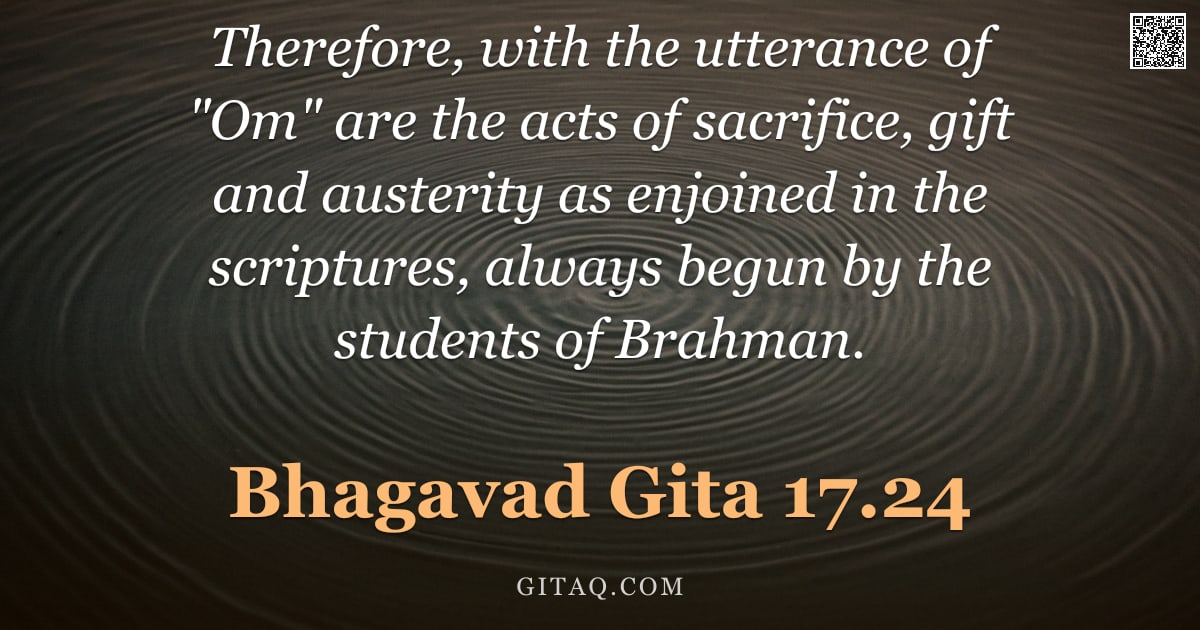
तस्मादोमित्युदाहृत्य यज्ञदानतपःक्रियाः | प्रवर्तन्ते विधानोक्ताः सततं ब्रह्मवादिनाम् ||१७-२४||
tasmādomityudāhṛtya yajñadānatapaḥkriyāḥ . pravartante vidhānoktāḥ satataṃ brahmavādinām ||17-24||
What Does This Verse Mean?
Lord Krishna concludes the discussion on faith by stating that all spiritual practices—such as sacrifice, charity, and austerities—are traditionally initiated with the sacred syllable 'Om'. This verse instructs those who seek to understand Brahman (the ultimate reality) to begin their good deeds with this holy sound. It emphasizes that performing actions without divine connection is incomplete; the intention must be sanctified by acknowledging the Supreme. The core teaching is that every righteous act should start with a spiritual consciousness to ensure it aligns with cosmic order.
The Teaching Behind It
This verse belongs to the synthesis of Karma Yoga and Jnana Yoga, teaching that action must be performed as an offering rather than for personal reward. It develops the concept of 'Ishvara Pranidhana' (surrender to the divine) by establishing a link between ritualistic precision in Vedic traditions and internal spiritual awareness. The utterance of 'Om' signifies that all actions are part of Brahman, turning mundane duties into sacred worship.
Word by Word
Classical Commentary
Where This Happens
This verse appears in the seventeenth chapter of the Bhagavad Gita during Krishna's discourse on the battlefield of Kurukshetra, where Prince Arjuna has just received instructions on different types of faith and food. After explaining how three modes of nature (goodness, passion, and ignorance) influence a person's beliefs, Krishna is now summarizing the proper method for conducting spiritual duties regardless of which mode one operates in. The listener, Arjuna, who was previously confused about his duty as a warrior, is being guided toward seeing every action as an offering to the divine rather than just personal effort.
Living It Out Today
Consider a professional setting where you are leading a difficult project that involves tight deadlines and team conflicts (a form of austerity or sacrifice). Before making your first move or sending that crucial email, take a moment to silently set an intention with 'Om'—focusing on the well-being of the whole team rather than just personal gain. This simple mental shift transforms the work from a stressful obligation into a disciplined practice of service (karma yoga), reducing anxiety and aligning your effort with higher values.
Explained for Children
Imagine you are about to build a very important block tower, and before you place even one brick, you say 'Let's do this for something good.' In the Gita, Lord Krishna says that whenever we want to do something kind like helping others or being brave (called sacrifice), giving gifts, or practicing self-control, we should start by saying 'Om'. This is like a special magic word that connects our actions to God. So, just like you say hello before starting a game, students of wisdom always begin their good deeds with this holy sound.
Daily Reflection
Today, notice how often you start tasks without a conscious anchor or purposeful intent. When you pause to invoke 'Om' or hold a higher awareness before acting, even simple duties like giving or studying become acts of devotion rather than mere chores. This small shift in your beginning turns the mundane into the sacred and reconnects you with the timeless wisdom of Brahman.
A Practice for Today
Begin your practice by silently chanting 'Om' to align your consciousness with the divine before any action arises. Visualize this sacred sound as the thread that transforms ordinary deeds into spiritual offerings, infusing them with purity and intention.
Key Teachings
- The Sanctity of Invocation
The syllable 'Om' is not merely a sound but the divine seed that consecrates all spiritual activities. It serves as the necessary bridge between human effort and divine will, ensuring actions are rooted in truth. - Integration of Core Duties
Sacrifice (Yajna), charity (Dana), and austerity (Tapas) form the triad of righteous action that sustains spiritual life. These acts, when performed without attachment but with devotion, purify the heart and mind. - The Path of Truth-Seekers
Only those devoted to realizing Brahman consistently begin their duties through this sacred framework. It signifies that for a seeker of truth, every action is an opportunity to remember the Absolute.
Themes
Related Verses
Read This Next
- 2.47 — To understand the principle of performing duty without attachment to results before adding sacred intent.
- 3.9 — To explore how all action should be performed as Yajna (sacrifice) for purification and liberation.
- 12.15 — To see the qualities of a devotee who is dear to Krishna, embodying the spirit of Brahman-vadins mentioned in 17.24.
Recommended Reading
GitaQ earns from qualifying purchases as an Amazon Associate.