Bhagavad Gita 15.14
Purushottama Yoga · English Translation
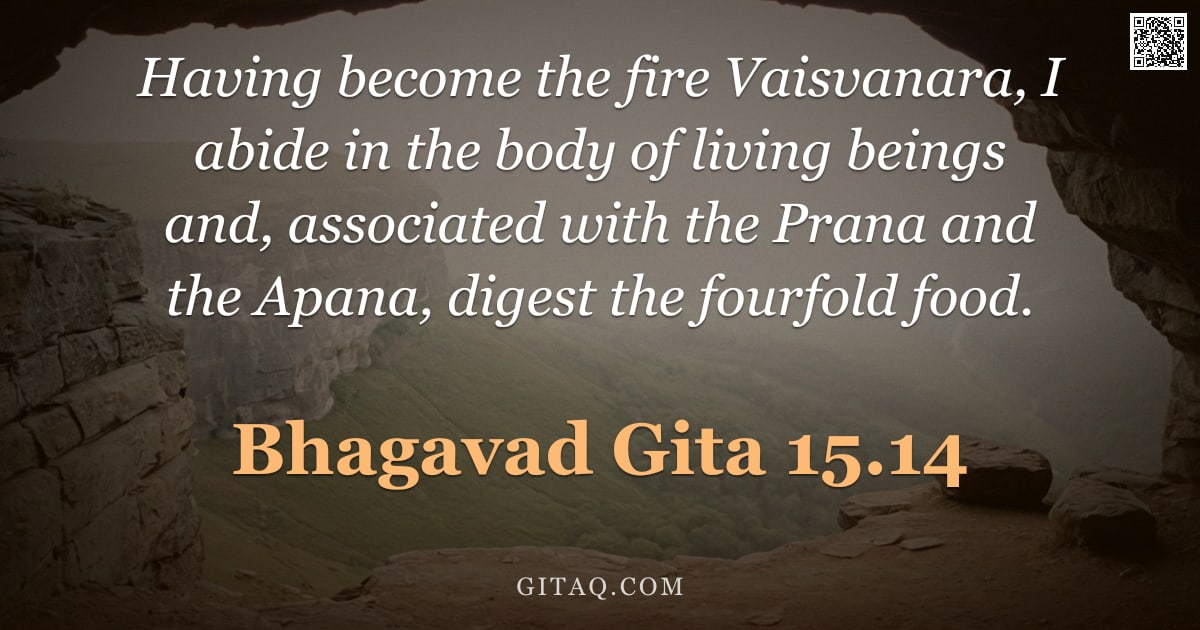
अहं वैश्वानरो भूत्वा प्राणिनां देहमाश्रितः | प्राणापानसमायुक्तः पचाम्यन्नं चतुर्विधम् ||१५-१४||
ahaṃ vaiśvānaro bhūtvā prāṇināṃ dehamāśritaḥ . prāṇāpānasamāyuktaḥ pacāmyannaṃ caturvidham ||15-14||
What Does This Verse Mean?
In this verse, Lord Krishna explains that He resides within every living being as the internal fire of digestion known as Vaisvanara. By uniting with our breath—specifically the upward-moving Prana and downward-moving Apana—He helps process all forms of food into energy for survival. The key teaching is that the divine presence is not distant but actively sustains our biological life, turning physical nourishment into vitality.
The Teaching Behind It
This verse bridges Bhakti Yoga and Jnana (Knowledge) Yoga by revealing the immanent nature of God in biological processes. It develops the concept that the Supreme Being is not just the transcendent creator but also the immediate sustainer within every atom, including the physiological mechanisms of life.
Word by Word
Classical Commentary
Where This Happens
This verse appears in Chapter 15 of the Bhagavad Gita during the intense dialogue on the battlefield of Kurukshetra. Lord Krishna is speaking to Arjuna, who has just been overwhelmed by confusion about his duty and the reality of life after death. In this section of 'Purushottama Yoga,' Krishna transitions from explaining His supreme nature as an all-pervading force that sustains even the basic biological functions like digestion.
Living It Out Today
When you are facing a stressful workday or family obligation, remember that your ability to function is sustained by a divine energy within your own breath and metabolism. Instead of viewing hunger or fatigue merely as physical annoyances, see them as opportunities to feel that inner fire keeping you going through the challenge. This perspective transforms mundane tasks like eating into a sacred connection with the source of all life's strength.
Explained for Children
Imagine your body has a tiny, invisible stove inside it that works even while you sleep. Lord Krishna says He lives right there in your tummy as this special fire to help digest the food you eat so you can grow strong and play all day. Just like how a campfire needs wood (food) and air (breath) to stay lit, your body uses breath and food together with His help to keep you alive.
Daily Reflection
In this quiet moment, realize that even the simple act of eating is a profound connection to the Divine; He has become the fire within you to sustain your life. When you feel hunger or fullness, know that you are never alone in these sensations, for the Supreme Person dwells right there with you as Vaisvanara. Let this awareness turn every meal into an act of gratitude and a reminder of His intimate care for your existence.
A Practice for Today
Sit quietly and imagine the fire of digestion not as mere biology, but as a divine presence residing within your chest. Visualize that sacred light transforming every meal you eat into energy for your body and spirit, acknowledging it as Krishna's own action.
Key Teachings
- The Divine Immanence
Krishna reveals that the Supreme is not distant but resides intimately within every living being as the vital fire. This teaching dissolves the separation between the creator and creation, showing God's presence in our most basic biological functions. - Sacred Transformation
The fourfold food we consume is not destroyed but transformed by this internal fire into life-sustaining energy for body and mind. This process signifies that all physical sustenance is ultimately a gift of divine grace, managed personally by the Lord. - Unity in Diversity
Just as one fire manifests differently to digest various types of food, the One Supreme adapts His presence within countless bodies and species. This highlights how the singular Divine energy orchestrates the diverse needs of all living beings simultaneously.
Themes
Related Verses
Read This Next
- 2.47 — To understand how to perform this daily action of living without attachment to the results.
- 3.30 — To learn how to offer all actions and their fruits back to Krishna, deepening your surrender.
- 12.15 — To explore the qualities of a devotee who is dear to God because they are free from selfish desire.
Recommended Reading
GitaQ earns from qualifying purchases as an Amazon Associate.