Bhagavad Gita 15.15
Purushottama Yoga · English Translation
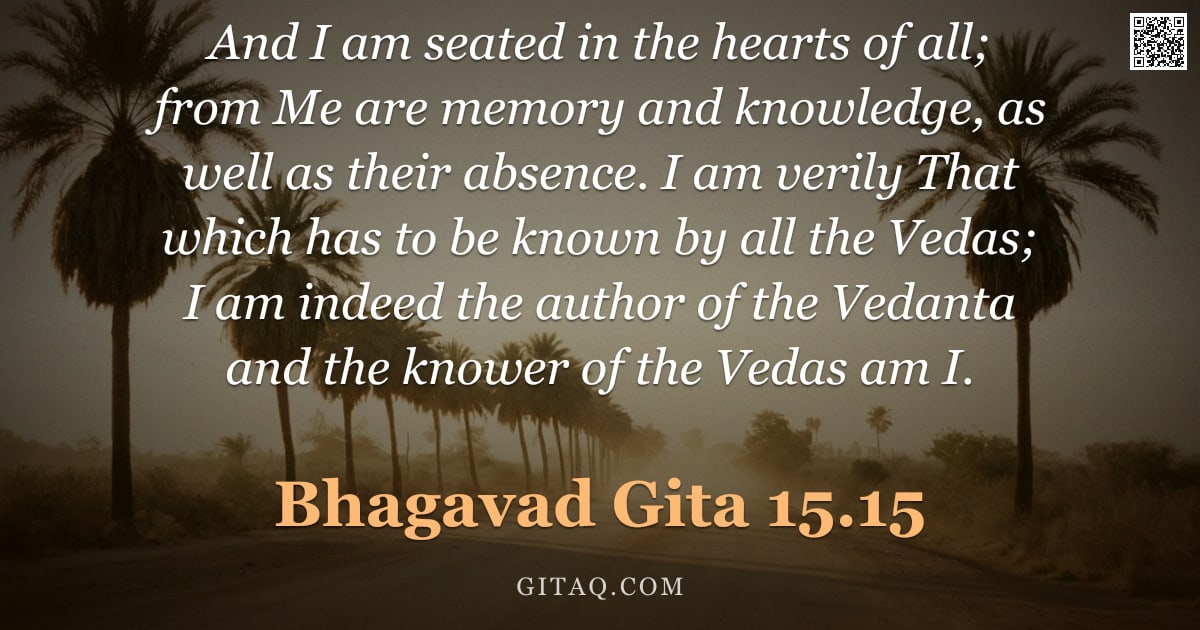
सर्वस्य चाहं हृदि सन्निविष्टो मत्तः स्मृतिर्ज्ञानमपोहनञ्च | वेदैश्च सर्वैरहमेव वेद्यो वेदान्तकृद्वेदविदेव चाहम् ||१५-१५||
sarvasya cāhaṃ hṛdi sanniviṣṭo mattaḥ smṛtirjñānamapohanañca . vedaiśca sarvairahameva vedyo vedāntakṛdvedavideva cāham ||15-15||
What Does This Verse Mean?
In this verse, Lord Krishna reveals to Arjuna that He resides within the heart of every living being as their inner guide. From His presence alone arise our ability to remember past experiences and gain true knowledge, while also explaining why we sometimes forget or feel ignorant. Krishna further declares that He is the ultimate truth revealed in all Vedic scriptures, the one who authored the Vedanta philosophy, and the very knower behind all spiritual wisdom.
The Teaching Behind It
This verse is a cornerstone of Jnana Yoga (the path of knowledge) and Bhakti Yoga (devotion), bridging them by establishing that intellectual understanding and divine love originate from the same Supreme Source. It develops the concept of 'Antaryami' (the Inner Controller), teaching that all individual consciousness is an expansion or reflection of the one universal consciousness, making self-knowledge identical to knowing God.
Word by Word
Classical Commentary
Where This Happens
This verse appears during Chapter 15 of the Bhagavad Gita, set on the battlefield of Kurukshetra where Prince Arjuna is paralyzed by grief over fighting his own relatives. Krishna has already explained the nature of the material world as a banyan tree and has begun discussing the Supreme Personality (Purushottama) who transcends both this perishable world and the imperishable soul. As Arjuna listens to these profound metaphysical descriptions, he is being prepared for the final instruction on surrender; Krishna here establishes His authority not just as a charioteer, but as the source of all intelligence and spiritual realization.
Living It Out Today
When you face a difficult decision at work where logic seems contradictory or your mind feels foggy with anxiety, remember that true clarity comes from turning inward rather than seeking external validation. By pausing to quiet your thoughts and asking for inner wisdom (prayer or meditation), you connect with the 'source' of knowledge Krishna describes, allowing solutions to surface naturally without forced mental strain. This shifts your approach from panic-driven analysis to a state where intuition guides you toward the right action.
Explained for Children
Imagine you have a special light switch inside your brain that helps you remember things like your friend's birthday or how to ride a bike. Lord Krishna says He is that inner light for everyone! Just as a teacher writes books about their subject and knows everything about it, God wrote the ancient wisdom stories (the Vedas), explains them in deep ways (Vedanta), and also holds all the answers inside your heart if you just listen.
Daily Reflection
Today, remember that the very knowledge you seek and the memories shaping your story come from a divine source residing within you. It is easy to feel lost or forgetful when the world gets loud, but know that the silence where true understanding lives is already present inside your chest. You do not need to search far away for answers; simply turning inward reveals that wisdom has been waiting there all along.
A Practice for Today
Close your eyes and gently turn your awareness inward to the quiet space within your heart, acknowledging that you are never alone there. Visualize a radiant presence seated right at this center of consciousness, silently offering clarity from memory and wisdom in every moment.
Key Teachings
- The Inner Dweller
Krishna declares He resides in the heart of every being, acting as the silent witness and source of all consciousness. This teaching dismantles the illusion that divinity is distant or external, placing it instead at the very core of your existence. - The Source of Intellect
Memory, knowledge, and even their absence are rooted in this Supreme Self within. We do not generate our own understanding independently; rather, we receive clarity through His grace when we align with that inner light. - The Ultimate Goal of Veda
All scriptural study and philosophical inquiry ultimately point to the realization of this Supreme Person as the final truth. He is both the author of the Vedanta's conclusion and the one who knows its deepest meaning, making Him the sole object of true knowledge.
Themes
Related Verses
Read This Next
- 2.47 — To learn how to act with dedication while remaining rooted in this inner knowledge without attachment to results.
- 3.30 — To understand the practice of surrendering all actions and fruits to the Divine who dwells within as the Supreme Self.
- 12.15 — To explore how a devotee who is satisfied with this inner presence becomes dear to Krishna, reflecting His own nature of contentment.
Recommended Reading
GitaQ earns from qualifying purchases as an Amazon Associate.