Bhagavad Gita 15.16
Purushottama Yoga · English Translation
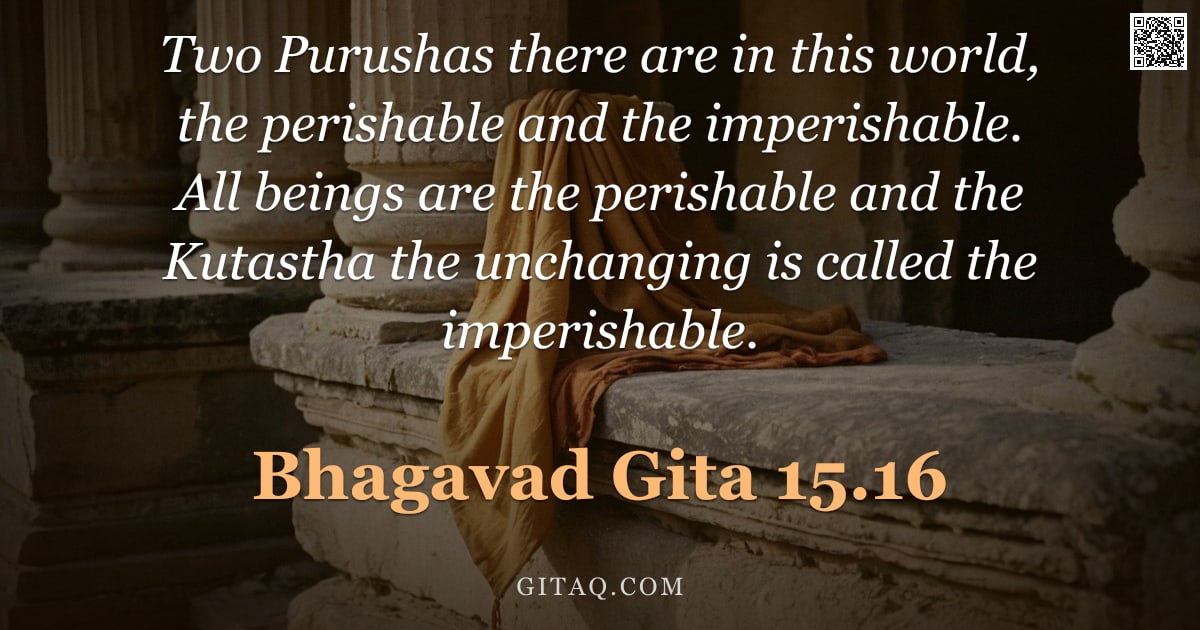
द्वाविमौ पुरुषौ लोके क्षरश्चाक्षर एव च | क्षरः सर्वाणि भूतानि कूटस्थोऽक्षर उच्यते ||१५-१६||
dvāvimau puruṣau loke kṣaraścākṣara eva ca . kṣaraḥ sarvāṇi bhūtāni kūṭastho.akṣara ucyate ||15-16||
What Does This Verse Mean?
In this verse, Lord Krishna explains to Arjuna that there are two types of beings or 'Purushas' in the universe: those that change and perish (like all living creatures) and one who is eternal and unchanging. While every individual soul undergoes birth and death as part of nature's cycle, there exists a higher principle called 'Kutastha'—the immutable self—that remains untouched by time or destruction. The core teaching here is to distinguish between the temporary physical world we inhabit and our true spiritual identity that never fades.
The Teaching Behind It
This verse belongs primarily to Jnana Yoga (the path of knowledge) and Sankhya philosophy, which focuses on discriminative wisdom between the real and the unreal. It develops the fundamental concept of 'Kshara' (perishable matter/souls bound by nature) versus 'Akshara' (the immutable spirit), establishing the ontological basis for realizing one's true Self beyond material existence.
Word by Word
Classical Commentary
Where This Happens
This teaching occurs during Chapter 15 of the Bhagavad Gita, set on the battlefield of Kurukshetra where Prince Arjuna has just laid down his weapons in despair. Krishna is responding to a question about how one can attain the Supreme by first explaining that there are two distinct realities: the changing world and the unchanging spirit. At this specific moment, Arjuna feels overwhelmed by grief and confusion regarding duty versus attachment, prompting Krishna to provide a metaphysical framework to help him see beyond his temporary sorrow.
Living It Out Today
When you face a sudden job loss or a family crisis that causes intense anxiety about your future security, remember that while the external situation (the 'perishable') is changing rapidly and may feel unstable, your core ability to adapt and your inner worth (the 'imperishable') remain intact. Instead of identifying solely with the temporary setback as if it defines you entirely, use this perspective to ground yourself in a deeper sense of stability that isn't dependent on external circumstances.
Explained for Children
Imagine you are playing with clay dolls; sometimes they break, get painted over, or turn into different shapes, just like people who grow old and change. But think about the empty space in a room where those toys sit—the space itself doesn't break when the doll breaks; it stays exactly the same no matter what happens to the toys. This verse teaches us that while our bodies and feelings are like the dolls that change or end, there is something inside you, like that quiet space, which never changes, gets old, or disappears.
Daily Reflection
You often feel defined by your changing moods, roles, and circumstances, but today remember there is a deeper part of you that never shifts. Like the unchanging sky witnessing passing clouds, your true nature (Kutastha) stands steady behind every experience. You do not need to fight these changes; simply rest in the awareness that observes them without being touched by them.
A Practice for Today
In your breath, notice how every thought and sensation arises and passes away like the perishable beings of this world. Then, gently rest your awareness on that silent space within you—the Kutastha—that remains unchanged regardless of what comes or goes.
Key Teachings
- The Duality of Existence
Krishna distinguishes between two realities: Kshara (the perishable) comprising all changing beings, and Akshara (the imperishable), the eternal Witness. This classification helps us stop mistaking our temporary physical form for our true spiritual identity. - The Nature of Kutastha
Kutastha refers to that which remains fixed and unmoved even as everything else transforms around it, representing the unchanging Self. It is not a distant god but your own innermost consciousness that witnesses birth and death without ever participating in them. - Transcending Identification
By recognizing that all beings are Kshara while our essence is Akshara, we cease to identify with the fleeting nature of life. This realization frees us from the cycle of grief and attachment, anchoring us in stability amidst chaos.
Themes
Related Verses
Read This Next
- 2.47 — This verse introduces the principle of Karma Yoga and performing duty without attachment to results, which relies on understanding one's true nature beyond perishable outcomes.
- 3.30 — Following this with 15.16 requires dedicating all actions to Krishna (Ishvara), recognizing the supreme reality that encompasses both Kshara and Akshara purushas.
- 12.15 — This verse describes the qualities of a devotee who is dear to God, showing how one who understands these truths naturally becomes compassionate and untroubled by worldly fluctuations.
Recommended Reading
GitaQ earns from qualifying purchases as an Amazon Associate.