Bhagavad Gita 14.2
Gunatraya Vibhaga Yoga · English Translation
इदं ज्ञानमुपाश्रित्य मम साधर्म्यमागताः | सर्गेऽपि नोपजायन्ते प्रलये न व्यथन्ति च ||१४-२||
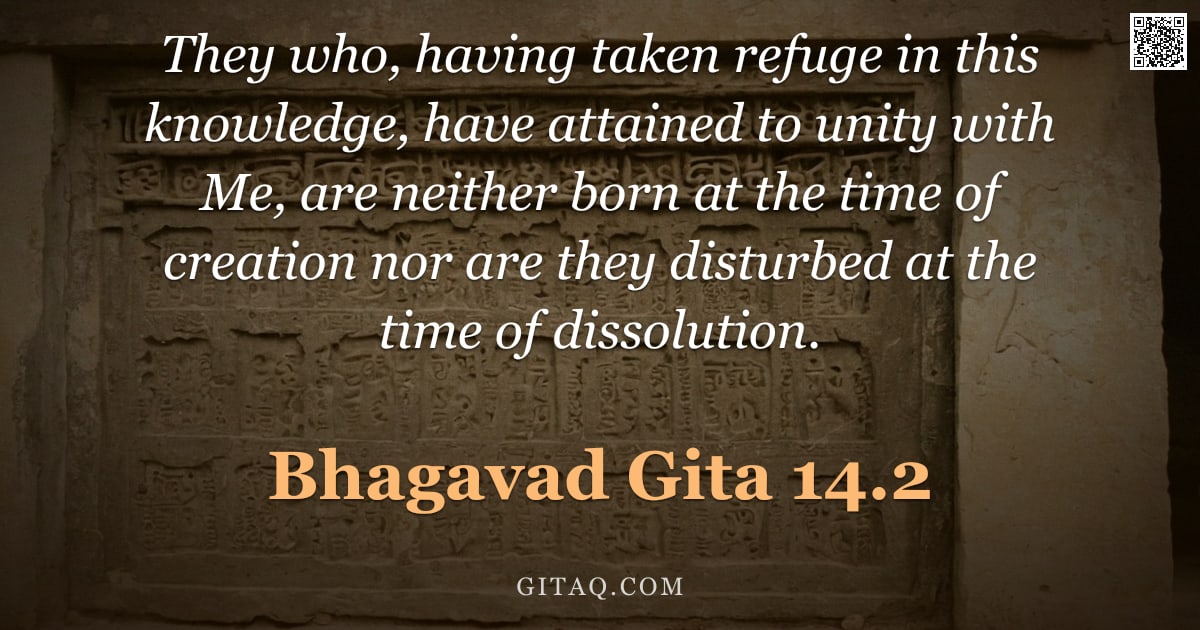
idaṃ jñānamupāśritya mama sādharmyamāgatāḥ . sarge.api nopajāyante pralaye na vyathanti ca ||14-2||
What Does This Verse Mean?
In this verse, Lord Krishna explains the ultimate result of mastering spiritual knowledge and surrendering to Him: a state of unity with the Divine. Those who achieve this connection transcend the cycle of birth at creation and remain undisturbed during universal dissolution. The core teaching is that true refuge in divine wisdom liberates one from fear and the repetitive process of reincarnation.
The Teaching Behind It
This verse synthesizes Jnana Yoga (the path of knowledge) with Bhakti Yoga (devotion), asserting that true wisdom naturally leads to surrender and unity. It develops the concept of liberation (Moksha) as a state beyond the dualities of birth and death, where one transcends the binding effects of the three Gunas.
Word by Word
Classical Commentary
Where This Happens
This verse appears in Chapter 14, where Lord Krishna has just finished explaining the three modes of material nature (goodness, passion, and ignorance) to Arjuna. It serves as the conclusion to his detailed teaching on how these invisible forces bind living entities to the cycle of life and death. Spoken by Krishna amidst the battlefield of Kurukshetra, it offers hope to a confused warrior who is overwhelmed by grief and fear about fighting his own relatives.
Living It Out Today
Imagine you are facing an uncertain job market where layoffs could happen at any moment, causing deep anxiety about your future security. By applying this verse's principle, instead of fearing the loss (dissolution) or obsessing over career climbing (creation), you anchor your self-worth in a deeper purpose and integrity that cannot be taken away by external events. This shift allows you to make clear decisions without being paralyzed by the fear of failure or the pressure of constant achievement.
Explained for Children
Imagine you are playing a video game where characters keep getting reset when they lose, over and over again. This verse says that if you truly understand how to play with God's help, you step out of the game entirely! Instead of having to start new levels (births) or worrying about losing everything at the end (dissolution), you become like a permanent player who is safe forever because they are united with the Game Creator.
Daily Reflection
Today, consider how often your sense of self feels threatened by change, much like a leaf tossed on a stormy sea. When you anchor yourself deeply in the knowledge that your true nature is one with the Divine, external events lose their power to disturb or define you. You are not born at creation nor destroyed at dissolution; you remain as timeless and unshakeable peace.
A Practice for Today
Close your eyes and visualize yourself not as a separate entity undergoing birth or death, but as an infinite wave returning to the ocean of consciousness. Rest in this awareness that just by knowing the truth of who you are, you step out of the cycle of fear regarding creation and destruction.
Key Teachings
- Refuge in Knowledge
True liberation begins when one fully surrenders to the wisdom of this verse, accepting it not merely as an idea but as a shelter. This refuge is not passive; it actively transforms your identity from a limited body-mind complex into unity with the Divine. - Transcending Birth and Death
The soul that realizes its oneness with God ceases to be subject to the mechanical laws of sarga (creation) or pralaya (dissolution). Such a being exists beyond the dualities of coming into existence and passing away. - Freedom from Disturbance
Even amidst cosmic dissolution, those established in this unity remain completely undisturbed because their identity is no longer tied to transient forms. This state represents the ultimate peace where fear of non-existence is entirely eradicated.
Themes
Related Verses
Read This Next
- 2.16 — Read this to understand the fundamental distinction between the unreal (changing matter) and the real (eternal spirit), which is the foundation of verse 14.2.
- 3.30 — This verse explains the practical method of surrendering all actions to Krishna, showing how one actively takes refuge in Him as mentioned in 14.2.
- 15.6 — Read this description of the supreme abode where there is no return to birth and death, which perfectly complements the state described in verse 14.2.
Recommended Reading
GitaQ earns from qualifying purchases as an Amazon Associate.