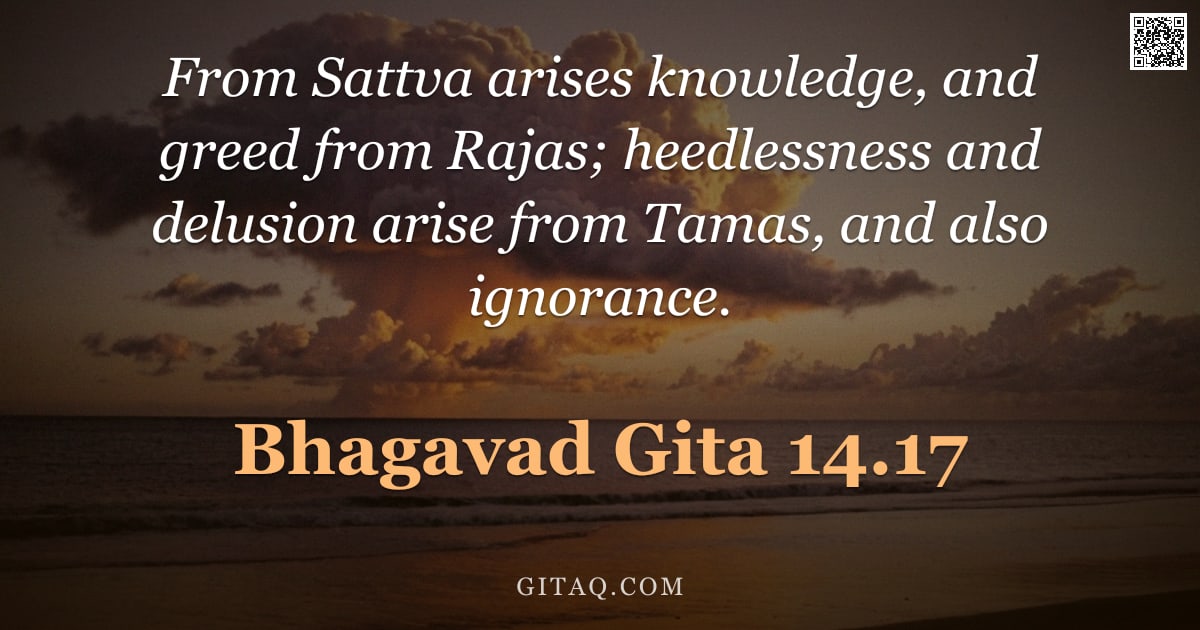
Bhagavad Gita 14.17
Gunatraya Vibhaga Yoga · English Translation
सत्त्वात्सञ्जायते ज्ञानं रजसो लोभ एव च | प्रमादमोहौ तमसो भवतोऽज्ञानमेव च ||१४-१७||
sattvātsañjāyate jñānaṃ rajaso lobha eva ca . pramādamohau tamaso bhavato.ajñānameva ca ||14-17||
What Does This Verse Mean?
In this verse, Lord Krishna explains to Arjuna how our inner state is shaped by the three qualities of nature: goodness (Sattva), passion (Rajas), and ignorance (Tamas). When we act from a place of clarity and purity, knowledge naturally arises. However, when driven by intense desire or agitation, greed takes over, while confusion, laziness, and deep ignorance stem from inactivity and darkness.
The Teaching Behind It
This verse is central to Samkhya philosophy as applied within Karma Yoga, specifically detailing the mechanism of how material nature (Prakriti) influences consciousness. It establishes that human experience—whether it be wisdom or delusion—is not random but a direct result of which mode of nature currently dominates an individual's psyche.
Word by Word
Classical Commentary
Where This Happens
This verse occurs in Chapter 14 of the Bhagavad Gita during a critical moment on the battlefield of Kurukshetra. Lord Krishna has just finished explaining that all living beings are bound by these three modes (gunas) which dictate their behavior and destiny, leaving Arjuna confused about how to transcend them. Spoken directly to Prince Arjuna who is paralyzed by doubt and emotional turmoil before a massive war, this teaching clarifies the source of human suffering versus wisdom.
Living It Out Today
Consider a professional facing a high-stakes deadline where they must decide between cutting corners for quick profit or doing thorough work that takes longer. If their mind is dominated by Rajas (greed and agitation), they will likely rush, cut ethical corners, and feel intense stress about the outcome. However, if they cultivate Sattva through calm preparation and focus on duty rather than reward, clarity emerges, leading to a better decision and peace of mind even under pressure.
Explained for Children
Imagine your mind is like a room with three different lights: bright white, flashing orange, and dim blue. When the bright white light (Sattva) shines on you, you see everything clearly and learn new things easily. If the flashing orange light (Rajas) turns on, you feel super excited but also want to take everything for yourself, which is like feeling greedy. But if only the dim blue light (Tamas) is on, it's hard to think straight, and you might get confused or fall asleep when you need to do something important.
Daily Reflection
Today, notice how quickly your mind shifts between seeking gain, feeling confused, or experiencing moments of pure understanding. When you feel the pull of desire, remember that this is just the energy of Rajas passing through; it does not define who you truly are. By simply observing these states rather than identifying with them, you begin to find a stillness beneath the shifting modes.
A Practice for Today
Sit quietly and observe the quality of your current thoughts, asking if they bring clarity or confusion. Acknowledge without judgment whether you are driven by greed, lost in delusion, or resting in a state of gentle knowledge.
Key Teachings
- The Source of Knowledge
True wisdom and clarity naturally emerge when we cultivate Sattva through purity in our thoughts and actions. This mode illuminates reality, allowing us to see things as they are without the distortion of personal bias. - The Trap of Greed
Rajas is characterized by intense activity driven by desire and attachment, which inevitably births greed. When we act from this mode, our focus narrows to acquisition rather than understanding or service. - The Fog of Ignorance
Tamas creates a heavy veil of heedlessness and delusion that obscures truth and leads to spiritual ignorance. In this state, the mind becomes inert or chaotic, unable to discern right from wrong.
Themes
Related Verses
Read This Next
Recommended Reading
GitaQ earns from qualifying purchases as an Amazon Associate.