Bhagavad Gita 14.15
Gunatraya Vibhaga Yoga · English Translation
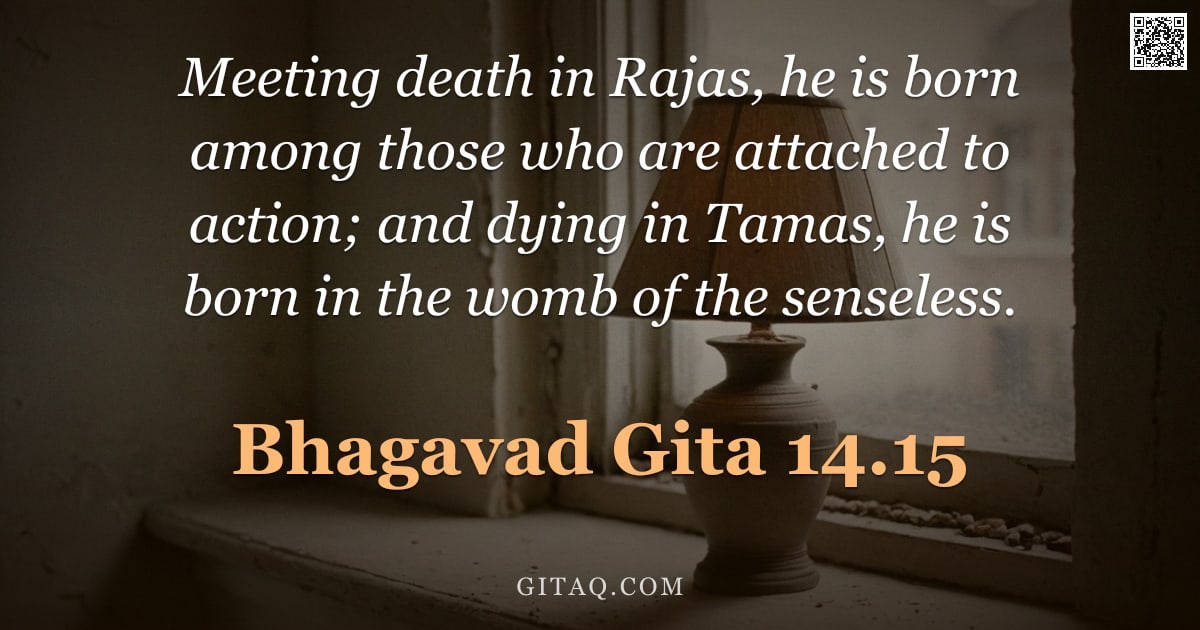
रजसि प्रलयं गत्वा कर्मसङ्गिषु जायते | तथा प्रलीनस्तमसि मूढयोनिषु जायते ||१४-१५||
rajasi pralayaṃ gatvā karmasaṅgiṣu jāyate . tathā pralīnastamasi mūḍhayoniṣu jāyate ||14-15||
What Does This Verse Mean?
In this verse, Lord Krishna explains the law of rebirth based on one's mental state at the time of death. If a person dies while dominated by Rajas (passion and intense desire), they are born into circumstances where others are similarly attached to action and results. Conversely, if someone dies in Tamas (ignorance or inertia), they take birth among those who lack wisdom or spiritual awareness. The core teaching is that the state of mind at death determines your next life's environment.
The Teaching Behind It
This verse is central to the Sankhya philosophy presented in the Gita, specifically detailing the mechanics of Pralaya (dissolution) and Janma (birth). It develops the concept that consciousness does not vanish at death but carries its dominant impression (Samskara), which acts as a seed for future existence based on the three Gunas.
Word by Word
Classical Commentary
Where This Happens
This verse appears in Chapter 14 of the Bhagavad Gita, part of the epic Mahabharata on the battlefield of Kurukshetra. Lord Krishna has just finished explaining how his divine energy binds the universe through three modes: goodness (Sattva), passion (Rajas), and ignorance (Tamas). He is speaking to Arjuna, who is overwhelmed by grief and confusion; this specific verse serves as a warning about the urgency of spiritual practice before death determines one's future birth.
Living It Out Today
Consider a high-pressure professional facing a major career crisis or burnout. If they make their final decision or meet an end while driven purely by greed, fear, and attachment to status (Rajas), they will likely attract similar chaotic environments in the next phase of life or struggle with recurring anxiety loops. Instead, consciously cultivating calmness and detachment during stressful moments ensures that even if a difficult situation arises at death, it leads to a more peaceful existence rather than one of endless toil.
Explained for Children
Imagine you fall asleep after playing a very loud video game with lots of excitement; when you wake up in a dream, you might be back on that gaming level again! But if you fell asleep while feeling sleepy and confused, like staring blankly at the wall, your next dream would probably be quiet or confusing too. Krishna teaches us that what we are thinking about right before we go to sleep (or die) is like a magnet pulling our soul toward a similar place in our next adventure.
Daily Reflection
You might find yourself constantly busy or driven by ambition because you are born into Rajas, yet this verse reminds us that such a state leads only to further entanglement if we die without awareness. When our minds become heavy with confusion and inertia (Tamas), we risk losing touch with our true potential for many lifetimes. The beautiful news is that death is not the end of your story; it simply determines where you begin next based on how fully you lived this moment.
A Practice for Today
Sit with your breath and observe where your mind currently rests: are you driven by the restless urge to achieve, or clouded by confusion? Visualize dying not as an end, but as a moment of transition that reveals which mode has been holding your attention. Resolve today to let go of attachment to the results of action, anchoring yourself in stillness rather than agitation.
Key Teachings
- The Nature of Transitional Death
Death acts as a catalyst for rebirth, with the dominant mode of nature at the moment of passing determining the soul's future trajectory. The verse illustrates that one does not move into a new existence by choice alone, but through the subtle imprint left by their current state. - Rajas Leads to Karmic Entanglement
Those who depart life dominated by Rajas—characterized by passion and fruitive activity—are reborn into environments that perpetuate a cycle of attachment. This ensures they remain engaged in the relentless pursuit of action without finding true liberation. - Tamas Results in Ignorant Rebirth
Dying while immersed in Tamas, or ignorance and inertia, leads to birth among beings who lack spiritual intelligence or clarity. This rebirth traps the soul in a state of confusion where the light of self-knowledge is obscured.
Themes
Related Verses
Read This Next
- 2.47 — This verse provides the essential antidote to Rajas by teaching how to act without being attached to results.
- 3.30 — It expands on surrendering all actions to the Divine, offering a path out of karmic entanglement described in 14.15.
- 12.15 — This verse describes the qualities of one who is beloved by Krishna and has transcended the modes, serving as an aspirational goal beyond Tamas and Rajas.
Recommended Reading
GitaQ earns from qualifying purchases as an Amazon Associate.