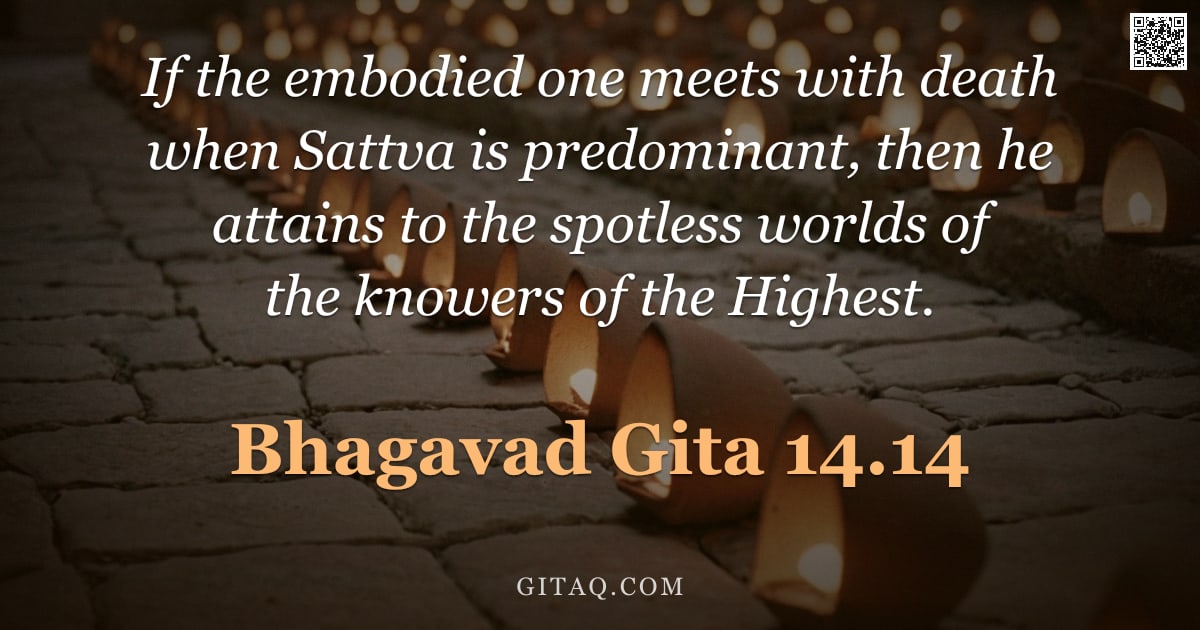
Bhagavad Gita 14.14
Gunatraya Vibhaga Yoga · English Translation
यदा सत्त्वे प्रवृद्धे तु प्रलयं याति देहभृत् | तदोत्तमविदां लोकानमलान्प्रतिपद्यते ||१४-१४||
yadā sattve pravṛddhe tu pralayaṃ yāti dehabhṛt . tadottamavidāṃ lokānamalānpratipadyate ||14-14||
What Does This Verse Mean?
Lord Krishna explains to Arjuna that the state of mind one has at the moment of death determines their next journey. If a person dies while in the mode of goodness (Sattva), characterized by clarity and peace, they attain higher spiritual realms. This verse teaches that our current mental habits shape our future existence after leaving the physical body.
The Teaching Behind It
This verse belongs to the Sankhya-Yoga strand of teaching within the Gita, which analyzes the three gunas (modes of material nature) as distinct from the eternal soul. It develops the concept of 'karma-phala' regarding rebirth, establishing that the quality of consciousness at death is the primary determinant for one's post-mortem destination.
Word by Word
Classical Commentary
Where This Happens
This teaching occurs on the battlefield of Kurukshetra during the Mahabharata war, as Lord Krishna imparts spiritual wisdom to Prince Arjuna. Just before this verse, Krishna has been explaining how the three modes of nature (goodness, passion, and ignorance) bind the soul to different types of births. Arjuna is listening intently while preparing for a righteous battle he finds morally confusing.
Living It Out Today
Consider facing a high-stakes job interview or a family crisis where your mind feels chaotic; take five minutes beforehand to breathe deeply and recall only positive, truthful memories to shift into 'Sattva.' By consciously cultivating clarity and calm before making difficult decisions, you ensure that the energy of goodness guides your choices rather than fear or anger.
Explained for Children
Imagine your mind is like a garden. If you plant seeds for kindness and learning all day long, when evening comes (or life ends), those good flowers will grow into a beautiful place to stay. This verse says that if we live with clear, happy thoughts until the very end, we go to special peaceful worlds where everyone knows the truth.
Daily Reflection
When death comes while you are in a state of clarity, it does not feel like an end but rather a return to the source of all light. You might wonder if today's choices were driven by passion or ignorance, and how they shape where your consciousness will go next. The beauty lies in knowing that even now, cultivating this quality of purity allows you to touch those higher realms while still breathing.
A Practice for Today
Close your eyes and visualize the lightness of clarity that arises when your mind is free from heavy agitation or dullness. Imagine a pure, spotless path opening before you as this state of balance deepens within your heart.
Key Teachings
- The Power of Predominant Mode
Our final state at death is determined by which mode—sattva, rajas, or tamas—is most active in our consciousness. If Sattva (goodness/clarity) prevails when the body falls away, it acts as a direct bridge to higher realms. - Attainment of Spotless Worlds
Dying in a state of purity leads one to 'amalān' or spotless worlds where spiritual knowledge is undisturbed by material illusion. These are the abodes of those who have realized the Highest, free from the dust of ignorance. - The Path of Knowledge
This verse highlights that a life lived in clarity naturally culminates in union with the knower of the Absolute. It suggests that ethical and mental purity is not just for social harmony, but a prerequisite for spiritual liberation.
Themes
Related Verses
Read This Next
- 2.47 — Understand how one should act without attachment to results while cultivating a Sattvic mindset.
- 3.30 — Learn the practice of surrendering all actions and their fruits, which stabilizes the mind in goodness.
- 12.15 — See how a person who is not disturbed by others' pain or joy becomes dear to Krishna and attains peace.
Recommended Reading
GitaQ earns from qualifying purchases as an Amazon Associate.