Bhagavad Gita 14.10
Gunatraya Vibhaga Yoga · English Translation
रजस्तमश्चाभिभूय सत्त्वं भवति भारत | रजः सत्त्वं तमश्चैव तमः सत्त्वं रजस्तथा ||१४-१०||
rajastamaścābhibhūya sattvaṃ bhavati bhārata . rajaḥ sattvaṃ tamaścaiva tamaḥ sattvaṃ rajastathā ||14-10||
What Does This Verse Mean?
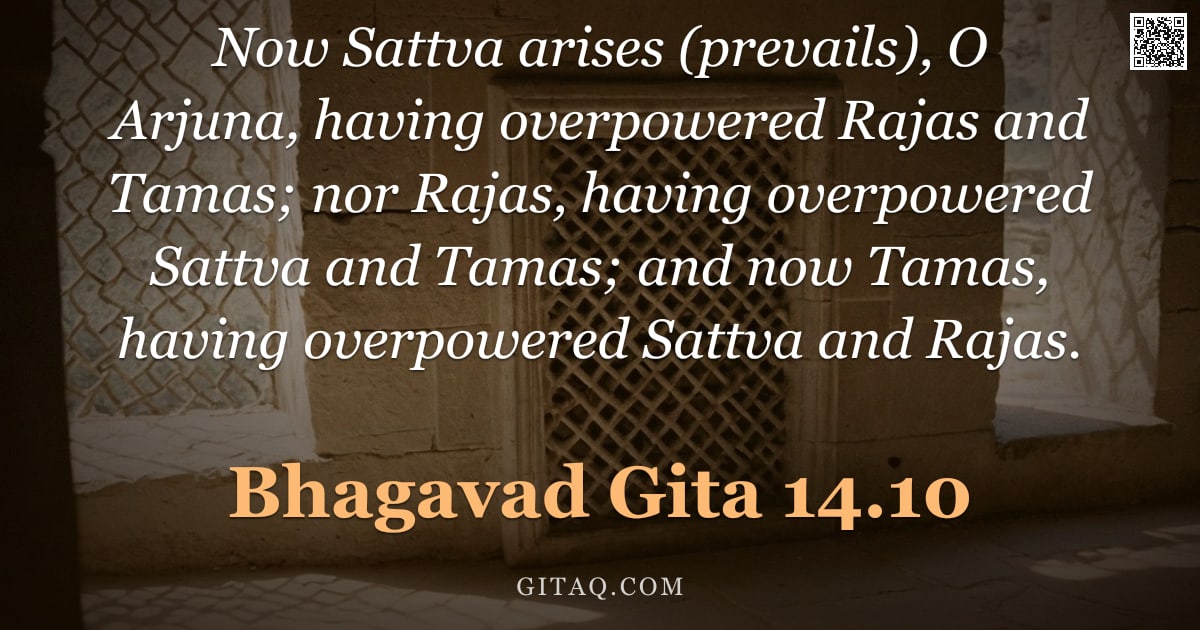
In this verse, Lord Krishna describes the constant struggle between three qualities of nature within every human being: purity and balance (Sattva), activity and passion (Rajas), and inertia or darkness (Tamas). He explains to Arjuna that these forces are dynamic; at any given moment, one quality can overpower the other two, determining a person's current state of mind. The key teaching is that our mental landscape shifts continuously as different modes dominate us throughout life.
The Teaching Behind It
This verse belongs to the framework of Sankhya philosophy as presented in the Gita, specifically developing the concept of Triguna (the three modes of material nature). It establishes that all human behavior and psychological states are temporary interactions of these forces, not fixed characteristics of the eternal Self.
Word by Word
Classical Commentary
Where This Happens
This dialogue takes place on the battlefield of Kurukshetra between Lord Krishna and Prince Arjuna, who has just fallen into a state of deep despair after witnessing his kinsmen readying themselves for war. Having explained that he is not speaking to them as friends but as enemies in their duty-bound role, Krishna now delves deeper into the psychology of action by introducing the three Gunas (modes of nature). Arjuna, feeling overwhelmed and confused about how to act without attachment, listens intently as Krishna begins to map out the forces that drive human behavior.
Living It Out Today
Consider a project manager facing a critical deadline who suddenly feels paralyzed by anxiety. Initially, they might be in 'Tamas' (inertia), avoiding emails due to fear of failure. As stress builds, they shift into 'Rajas' (agitation), sending frantic messages and working frantically without focus. The goal is to recognize these shifts consciously; the manager can pause their panic, breathe deeply, and intentionally cultivate 'Sattva' by creating a calm, prioritized plan rather than reacting to emotions.
Explained for Children
Imagine your mind is like a playground with three friends playing tag: Sattva (the calm friend), Rajas (the energetic runner), and Tamas (the sleepy one). Sometimes, the energetic friend runs so fast they take over the whole park. Then later, the sleepy friend might get to rest while everyone else gets tired. This verse teaches that it is normal for your feelings or energy levels to change because different friends are winning at different times.
Daily Reflection
Today, notice how often one quality tries to dominate your day: perhaps Rajas pushing you into frantic action or Tamas pulling you toward lethargy. When Sattva arises, remember that this is a moment of clarity where wisdom can flow more freely, though it too will eventually shift as life moves on. Instead of clinging to these changing states, cultivate the steady witness within who sees them all come and go.
A Practice for Today
Sit quietly and observe which of the three qualities—clarity, activity, or inertia—is currently dominating your thoughts without judgment. Visualize this dominant mode not as a permanent trait but as a cloud that has temporarily obscured the sun of your true self. Rest in the awareness that you are the sky, distinct from the shifting weather patterns within it.
Key Teachings
- The Fluidity of Nature
This verse teaches that the three gunas are never static; they constantly vie for supremacy over one another in a dynamic cycle. Just as day follows night, no single mode holds permanent power unless we consciously anchor ourselves beyond them. - The Illusion of Permanence
We often mistake our current mood or state of mind for our true identity, but the Gita reveals these are merely temporary conditions. Recognizing that Rajas can turn into Tamas and Sattva can fade helps us detach from the volatility of worldly existence. - The Witness Consciousness
Arjuna is reminded to see himself as distinct from these modes, capable of observing them rise and fall like waves. True liberation comes when one realizes they are not the clouds (the gunas) but the vast sky that holds them.
Themes
Related Verses
Read This Next
- 2.47 — Read this next to understand how to perform action without attachment when Rajas and Tamas try to dictate your outcomes.
- 3.30 — This verse offers the practical method of surrendering all actions to the Divine, helping one transcend the pull of the three modes.
- 12.15 — Read this final selection to see how a person who has transcended the gunas appears in their conduct toward others and the world.
Recommended Reading
GitaQ earns from qualifying purchases as an Amazon Associate.