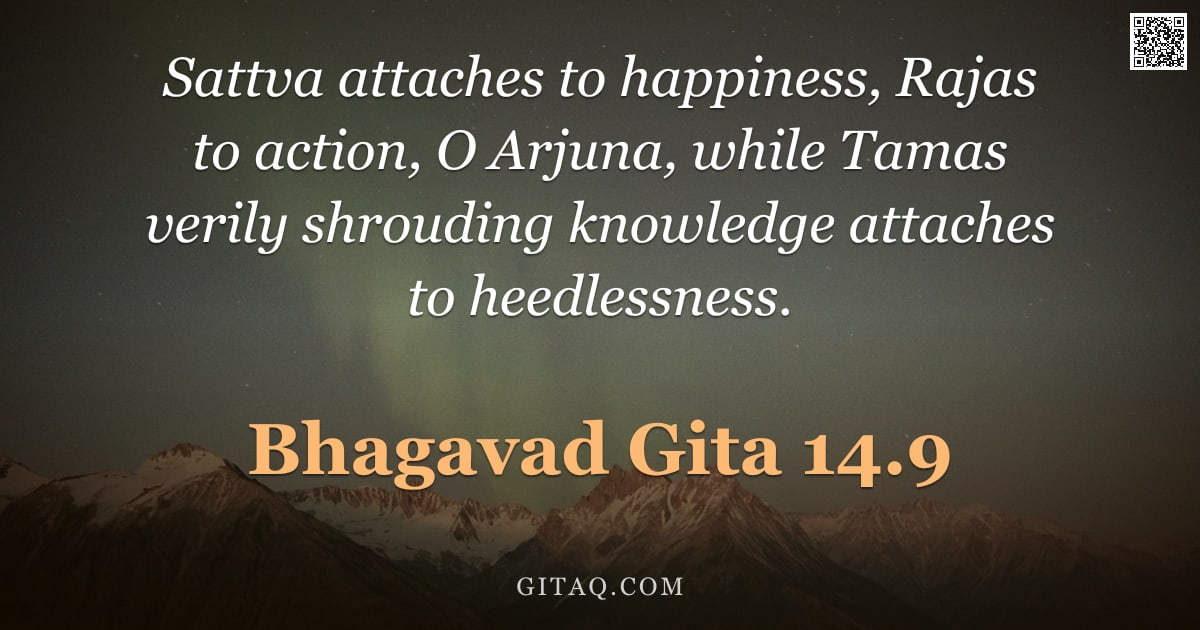
Bhagavad Gita 14.9
Gunatraya Vibhaga Yoga · English Translation
सत्त्वं सुखे सञ्जयति रजः कर्मणि भारत | ज्ञानमावृत्य तु तमः प्रमादे सञ्जयत्युत ||१४-९||
sattvaṃ sukhe sañjayati rajaḥ karmaṇi bhārata . jñānamāvṛtya tu tamaḥ pramāde sañjayatyuta ||14-9||
What Does This Verse Mean?
In this verse, Lord Krishna explains how the three qualities of nature influence human behavior by attaching us to specific outcomes. He teaches that when we are in a state of purity and clarity (Sattva), we naturally seek happiness; when driven by passion or desire for results (Rajas), we become attached to constant action; and when overwhelmed by ignorance or inertia (Tamas), our knowledge is covered, leading to carelessness and sleepiness. This distinction helps Arjuna understand that every human mind operates under one of these three modes at any given time.
The Teaching Behind It
This verse is central to the Samkhya-Yoga framework of the Gita, which analyzes the material world through the three gunas. It develops the concept that human behavior and consciousness are not random but are dictated by these qualities, serving as a prerequisite for understanding how one can eventually transcend them (gunatitah) to achieve liberation.
Word by Word
Classical Commentary
Where This Happens
This verse occurs during the Bhagavad Gita's conversation on the battlefield of Kurukshetra, where Lord Krishna is instructing his friend Arjuna. It falls within Chapter 14, following a detailed explanation of how the three gunas (modes) bind the soul to the material world through birth and death. At this moment, Arjuna has just accepted his duty as a warrior but remains confused about the nature of the self versus the body; Krishna is now breaking down the psychological forces that keep humans trapped in cycles of action and reaction.
Living It Out Today
Consider a professional facing a critical deadline: if driven by Rajas (passion), they might work late into the night obsessing over promotions or outcomes, losing their health. If overwhelmed by Tamas (inertia), they may procrastinate, ignore emails due to mental fog, and make careless errors in judgment. However, approaching the same situation with Sattva allows them to focus on doing the right task with clarity and calmness, seeking a balanced solution rather than getting lost in anxiety or avoidance.
Explained for Children
Imagine your brain has three different moods like weather patterns in a day. When the sun shines bright (Sattva), you feel happy, clear, and want to play nicely with friends; when you are excited about winning a game or getting a toy (Rajas), you can't stop moving and running around; but sometimes it gets foggy and cloudy (Tamas), making you feel sleepy, confused, and maybe even forgetful of what you should do. Krishna is teaching us that we all have these three moods inside us, and knowing which one is in charge helps us make better choices.
Daily Reflection
Today, take a moment to notice how your mind seeks out pleasure and avoids discomfort, perhaps mistaking temporary joy for lasting fulfillment. You might find yourself shrouded in heedlessness when knowledge feels too difficult or uncomfortable to face directly. Remember that this veil is not permanent; by gently turning toward awareness even when it's hard, you begin to dissolve the darkness of tamas.
A Practice for Today
Sit quietly and observe where your attention rests right now, noticing if you are drawn to the stillness of peace or the rush of activity. Ask yourself: is this state clouding my true nature with a veil of ignorance, or illuminating it? Gently release any attachment to the current mood, recognizing that happiness without clarity can be just as binding as action born of desire.
Key Teachings
- The Allure of Sattva
Even pure goodness (Sattva) can bind us if we cling solely to its pleasant feelings rather than using them as a stepping stone. Happiness, while desirable, becomes a trap when it is the only goal, preventing one from seeking higher truth. - The Trap of Rajas
Rajas drives us into constant action and struggle, binding us through endless desire for results rather than the joy of duty itself. This mode keeps the mind agitated, making it difficult to find the stillness required for true wisdom. - The Veil of Tamas
Tamas acts as a heavy blanket over our innate knowledge, leading us into heedlessness and delusion. It is not merely laziness but an active force that obscures the light of consciousness when we resist growth.
Themes
Related Verses
Read This Next
Recommended Reading
GitaQ earns from qualifying purchases as an Amazon Associate.