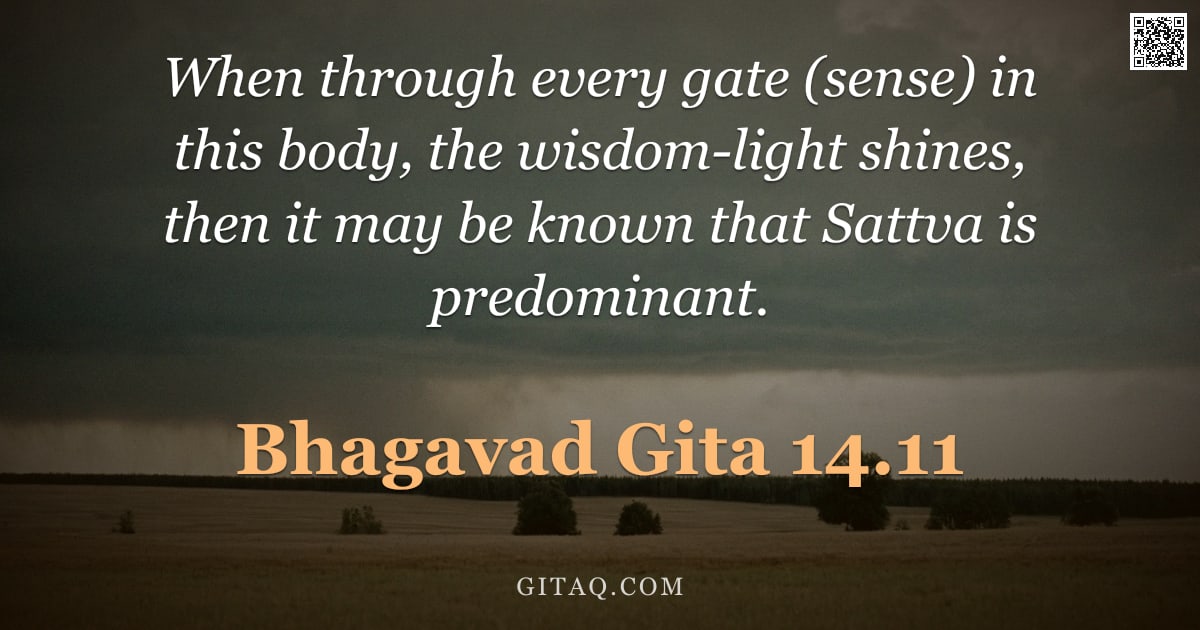
Bhagavad Gita 14.11
Gunatraya Vibhaga Yoga · English Translation
सर्वद्वारेषु देहेऽस्मिन्प्रकाश उपजायते | ज्ञानं यदा तदा विद्याद्विवृद्धं सत्त्वमित्युत ||१४-११||
sarvadvāreṣu dehe.asminprakāśa upajāyate . jñānaṃ yadā tadā vidyādvivṛddhaṃ sattvamityuta ||14-11||
What Does This Verse Mean?
In this verse, Lord Krishna explains the sign of Sattva (purity and clarity) becoming dominant within a person to Arjuna. He states that when wisdom shines brightly through all ten senses—eyes, ears, mouth, hands, and so on—it indicates that the mind is clear and free from confusion. This state represents an inner light where knowledge flows naturally without obstruction or distortion.
The Teaching Behind It
This verse belongs to the Sankhya philosophy integrated into the Gita, which classifies existence based on the three Gunas (Sattva, Rajas, and Tamas). It develops the concept of 'laksanam' or diagnostic signs, teaching that spiritual progress is not just an abstract feeling but can be objectively observed through the behavior of one's senses.
Word by Word
Classical Commentary
Where This Happens
This verse appears in the Bhagavad Gita during the intense battlefield of Kurukshetra, where Prince Arjuna is paralyzed by grief and moral confusion about fighting his own relatives. Lord Krishna has just begun explaining that all beings are composed of three modes of nature (Gunas) and starts detailing how to identify which mode is currently dominant in a person's consciousness. At this specific moment, Arjuna is listening intently, seeking the spiritual clarity needed to overcome his despair and fulfill his duty as a warrior.
Living It Out Today
Consider a manager facing a high-stakes business crisis; when they feel Sattva predominant, their decision-making isn't clouded by panic or greed. Instead of reacting with anger towards staff (Rajas) or avoiding the problem entirely due to fear (Tamas), they see every angle clearly and communicate with calm wisdom through all interactions. This clarity allows them to solve complex problems effectively while maintaining peace in a chaotic environment.
Explained for Children
Imagine your body has ten little windows (your eyes, ears, nose, etc.) looking out into the world. When you feel calm, happy, and know exactly what to do because everything feels clear inside, that means a special 'light of wisdom' is shining through all those windows at once! It's like when you finish a big puzzle; your brain sparkles with understanding, and you can see things clearly without feeling confused or scared.
Daily Reflection
Notice how often you feel confused or heavy because your senses are overwhelmed by noise and desire rather than truth. When a moment comes where everything feels clear and peaceful, recognize it as the gentle hand of Sattva guiding you home to yourself. This clarity is not something new that needs to be created, but an old light waiting for the dust of distraction to settle.
A Practice for Today
Sit quietly and turn your awareness to one of your senses, such as sight or hearing, noticing if it is clouded by agitation or clarity. Observe the moment when a sense perceives without distortion, allowing wisdom-light to shine through that gate. Rest in this feeling of luminous presence for three minutes.
Key Teachings
- The Gates of Perception
Every sense organ acts as a gateway through which our internal state projects outward and receives input from the world. The quality of what we perceive depends entirely on whether these gates are clouded by passion or ignorance, or purified by goodness. - Wisdom-Light as a Sign
True spiritual progress is not measured solely by rituals but by the sudden appearance of clarity and understanding in daily life. When wisdom illuminates our senses without effort, it signals that the mode of goodness has temporarily mastered the mind. - The Predominance of Sattva
Sattva is not a permanent state but a dynamic quality that can become predominant enough to reveal its nature. The verse teaches us to recognize this specific signal as an invitation to deepen our connection with the divine light within.
Themes
Related Verses
Read This Next
- 2.47 — To understand how to act in the world while maintaining this inner clarity without attachment to results.
- 3.30 — For a practical instruction on surrendering actions and thoughts to offer them up, sustaining the mode of goodness.
- 12.15 — To see how Krishna describes one who has become dear to Him by embodying these very qualities of clarity and non-agitation.
Recommended Reading
GitaQ earns from qualifying purchases as an Amazon Associate.