Bhagavad Gita 13.27
Kshetra Kshetrajna Vibhaga Yoga · English Translation
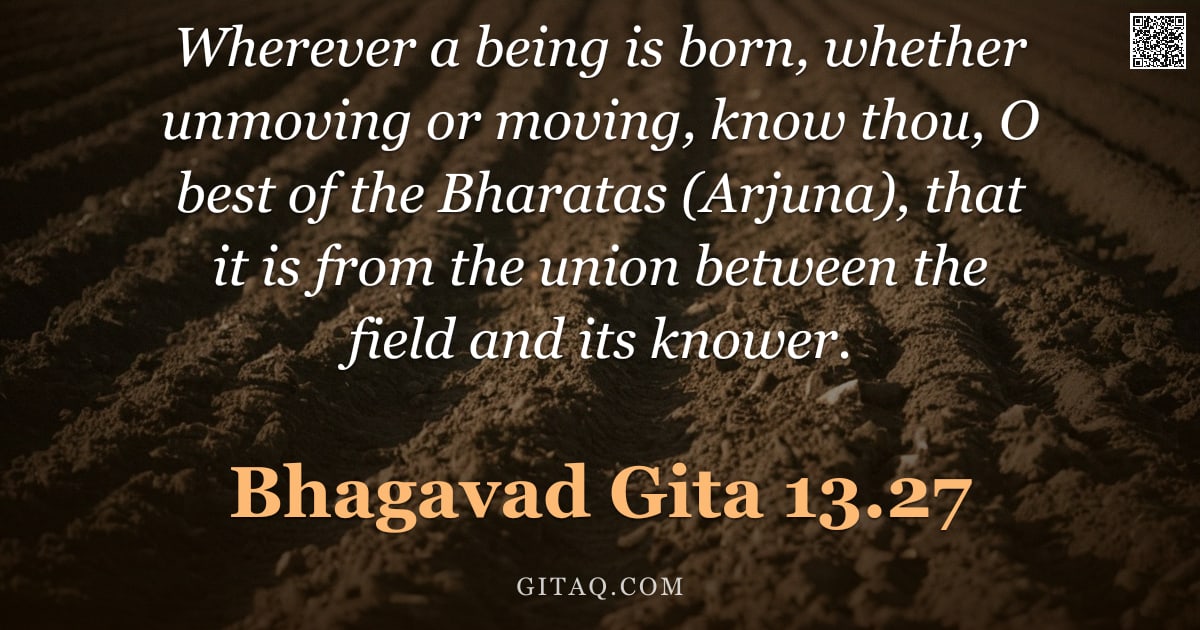
यावत्सञ्जायते किञ्चित्सत्त्वं स्थावरजङ्गमम् | क्षेत्रक्षेत्रज्ञसंयोगात्तद्विद्धि भरतर्षभ ||१३-२७||
yāvatsañjāyate kiñcitsattvaṃ sthāvarajaṅgamam . kṣetrakṣetrajñasaṃyogāttadviddhi bharatarṣabha ||13-27||
What Does This Verse Mean?
In this verse, Lord Krishna tells Arjuna that every living being in the universe, whether it is a stationary plant or a moving animal (and by extension all sentient life), comes into existence through the union of two principles: 'Kshetra' (the body and material world) and 'Kshetrajna' (the conscious soul). Krishna emphasizes that without this specific combination of matter and consciousness, no birth can occur. The key teaching is that understanding this relationship helps one distinguish between the temporary physical form and the eternal observer within.
The Teaching Behind It
This verse belongs to the core of Jnana Yoga (the yoga of knowledge) and Sankhya philosophy, which emphasizes discriminative wisdom between matter and spirit. It develops the fundamental concept of 'Dvaita' in practice—distinguishing the temporary field (body/mind) from the eternal Knower (Atman)—which is essential for liberation.
Word by Word
Classical Commentary
Where This Happens
This verse appears on the battlefield of Kurukshetra within Chapter 13, where Krishna has just finished explaining that the physical world is a field for action while the individual self is the knower. Arjuna, overwhelmed by grief and confusion about fighting his kin, is listening to these deep philosophical distinctions intended to clarify the nature of reality before he must act. By addressing him as 'Bharatarshabha' (best of the Bharatas), Krishna gently guides a confused warrior toward a higher understanding that will dissolve his attachment to the physical outcomes of war.
Living It Out Today
When you face a difficult decision at work where your team is in conflict, remember that this verse teaches separation between the 'field' and the 'knower.' You can view the stressful meeting or project deadlines as just the temporary field (the situation), while your true self remains the calm observer untouched by the chaos. Instead of getting lost in the drama of the outcome, focus on acting with clarity from within, knowing that your worth is not defined by this specific union of circumstances and reactions.
Explained for Children
Imagine a magic video game character; for them to appear on your screen, you need both the special toy controller (the body) and the player's mind behind it (your soul). Krishna is teaching Arjuna that just like in the game, every living thing needs two things to exist: a physical body to hold life and an inner spark of consciousness called the 'Knower' inside. Without this team-up between the body and the soul, no one could be born or move around.
Daily Reflection
When you feel overwhelmed by movement or stagnation today, remember that your true nature is not merely the field where life happens, but the eternal knower observing it all. This verse invites you to stop identifying solely with the struggles of motion and stillness, seeing them instead as natural sprouts arising from a deeper source. You are invited to rest in the awareness behind every thought, knowing that your essence remains untouched by the changing seasons of existence.
A Practice for Today
Sit quietly and visualize your body as a vast field, observing the thoughts and sensations arising within it without attachment. Recognize that just as crops grow from soil meeting seeds, every living experience is born from the union of this physical existence with the silent consciousness witnessing it.
Key Teachings
- The Interplay of Field and Knower
Every living entity, whether moving like an animal or stationary like a tree, emerges from the dynamic interaction between matter (the field) and consciousness (the knower). Without this union, life as we know it cannot manifest in any form. - Universality of Consciousness
The verse explicitly includes both 'moving' and 'unmoving' beings to teach that the same divine principle animates all creation equally. This dissolves hierarchy, showing that a flower and a human are born from the same fundamental cosmic mechanism. - Transcending Identification
By understanding that our birth is a result of this union rather than an isolated event, we begin to distinguish ourselves from mere physical existence. This knowledge helps us see beyond the temporary body to realize our identity as the eternal witness.
Themes
Related Verses
Read This Next
- 2.47 — To understand how to act within the 'field' without attachment to results.
- 3.30 — To learn the practice of offering all actions and their fruits back to the Divine, deepening the relationship with the Knower.
- 12.15 — To see how a devotee who embodies this understanding becomes dear to Krishna by being free from agitation in the field of life.
Recommended Reading
GitaQ earns from qualifying purchases as an Amazon Associate.