Bhagavad Gita 13.10
Kshetra Kshetrajna Vibhaga Yoga · English Translation
असक्तिरनभिष्वङ्गः पुत्रदारगृहादिषु | नित्यं च समचित्तत्वमिष्टानिष्टोपपत्तिषु ||१३-१०||
asaktiranabhiṣvaṅgaḥ putradāragṛhādiṣu . nityaṃ ca samacittatvamiṣṭāniṣṭopapattiṣu ||13-10||
What Does This Verse Mean?
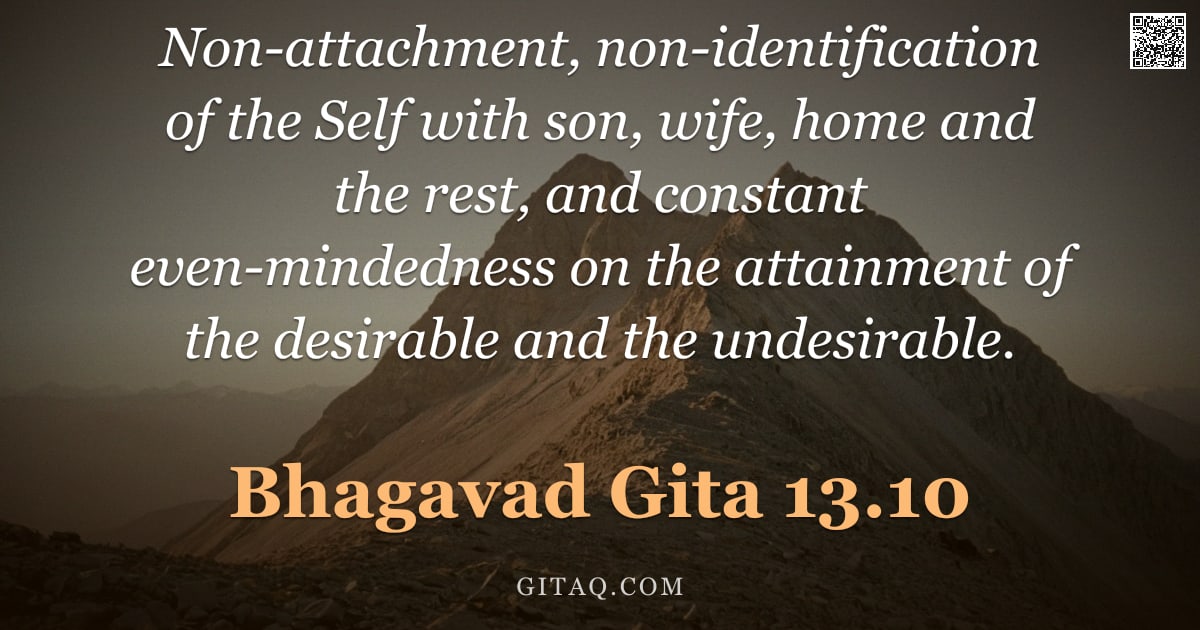
In this verse, Lord Krishna instructs Arjuna on the essential qualities of a wise person who seeks liberation. He teaches that true wisdom involves remaining unattached to loved ones like children and spouses, as well as one's home, without identifying the Self with these temporary relationships. Furthermore, he emphasizes maintaining an equal state of mind regardless of whether desirable or undesirable events occur in life. This balance allows the individual to remain steady on their spiritual path amidst the chaos of worldly existence.
The Teaching Behind It
This verse is a cornerstone of Jnana Yoga and the Sankhya philosophy presented in Chapter 13, focusing on 'Viveka' (discrimination) between the eternal Self and the temporary world. It develops the concept that liberation arises when one ceases to identify with transient relationships and material possessions, viewing them as external fields rather than the core identity. By cultivating this detachment and equanimity, the seeker aligns their consciousness with the 'Kshetrajna' (Knower of the Field), moving beyond dualities.
Word by Word
Classical Commentary
Where This Happens
This verse appears during the Bhagavad Gita's discourse on the battlefield of Kurukshetra, where Lord Krishna is guiding Prince Arjuna out of his paralyzing grief and confusion. Just before this, Krishna has explained the distinction between the physical body (the field) and the conscious self (the knower), helping Arjuna realize he is not merely a soldier or a kinsman but an eternal soul. Arjuna feels overwhelmed by the prospect of fighting his own relatives; in response to his emotional turmoil regarding family duties, Krishna outlines practical mental disciplines like non-attachment as necessary tools for action without bondage.
Living It Out Today
Consider a professional facing a sudden corporate restructuring where their department is merged or dissolved; this creates intense uncertainty and potential loss. Instead of spiraling into anxiety about losing their specific role or identifying their entire self-worth with that job title, they practice even-mindedness by accepting the outcome as part of life's flow. They maintain their emotional stability whether a colleague gets promoted (desirable) or let go (undesirable), allowing them to make clear-headed decisions rather than reacting out of fear or greed.
Explained for Children
Imagine you are playing a very exciting game where your score keeps changing—sometimes you win big, and sometimes you lose points. Krishna says that being wise is like being a calm player who doesn't get too crazy when winning or sad when losing because they know the game isn't everything about them. It also means loving your family deeply but understanding that just as toys can be broken or moved around, our bodies and homes change, so we shouldn't feel lost if things shift. Being 'even-minded' is like being a steady tree in the wind; you sway with the breeze of life's good and bad days without falling over.
Daily Reflection
Today, notice how often your peace depends on having your children behave well or your home remain perfect; this verse invites you to step back and see that the true Self is untouched by these changing circumstances. When things go wrong, try not to spiral into despair, knowing that just as easily they can turn for the better without altering who you truly are at the core. Embrace a quiet joy today by practicing detachment from outcomes, allowing your heart to remain steady whether facing gain or loss.
A Practice for Today
Close your eyes and gently release any identification with your roles as parent, spouse, or homeowner; acknowledge that you are the witness of these relationships, not defined by them. Invite a state of equal-mindedness to settle within you, observing both pleasant surprises and challenging events without shifting from your inner center.
Key Teachings
- Detachment in Relationships
True love exists without possession; we can care deeply for our family and home while realizing the Self is distinct from these temporary associations. Non-identification prevents suffering when relationships change or end, as your worth remains independent of external connections. - Equanimity in Success and Failure
The wise person maintains a balanced mind regardless of whether desirable results are achieved or undesirable events occur. This constant even-mindedness is the hallmark of spiritual maturity, ensuring that joy does not become arrogance nor sorrow becomes despair. - Witnessing Consciousness
The verse teaches us to shift from being a participant entangled in outcomes to becoming the silent witness who observes life's play. By recognizing yourself as the Knower of the field, you stop identifying with the transient experiences of the body and mind.
Themes
Related Verses
Read This Next
- 2.56 — This verse explicitly defines the characteristics of a person with 'steady wisdom' who is not disturbed in sorrow and rejoices not in happiness.
- 3.19 — It reinforces the practice of performing action without attachment to results, complementing the theme of non-identification found here.
- 6.7 — This verse describes how one who has attained mental equilibrium becomes a master over their mind and finds peace in all situations.
Recommended Reading
GitaQ earns from qualifying purchases as an Amazon Associate.