Bhagavad Gita 12.12
Bhakti Yoga · English Translation
श्रेयो हि ज्ञानमभ्यासाज्ज्ञानाद्ध्यानं विशिष्यते | ध्यानात्कर्मफलत्यागस्त्यागाच्छान्तिरनन्तरम् ||१२-१२||
śreyo hi jñānamabhyāsājjñānāddhyānaṃ viśiṣyate . dhyānātkarmaphalatyāgastyāgācchāntiranantaram ||12-12||
What Does This Verse Mean?
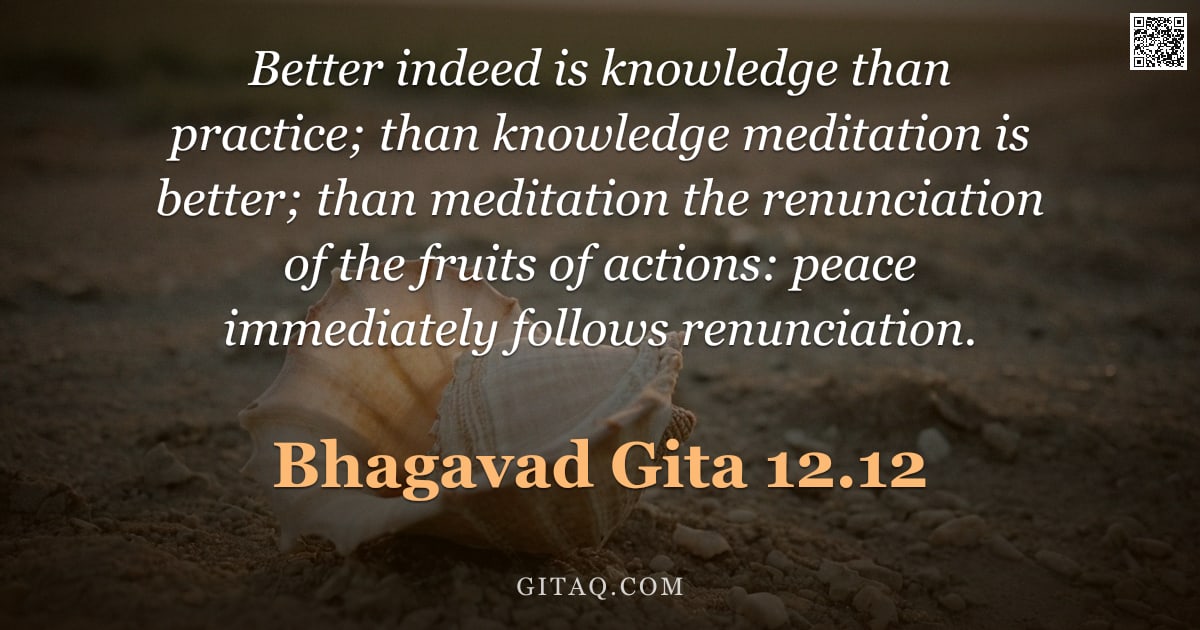
In this verse, Lord Krishna tells Arjuna that while performing spiritual practices is good, cultivating true knowledge of the self is even better. He explains a clear hierarchy: meditation on that knowledge surpasses mere practice, and renouncing the desire for rewards from one's actions goes beyond meditation. The ultimate result of letting go of attachment to results is immediate inner peace.
The Teaching Behind It
This verse synthesizes Karma Yoga (renunciation of fruits) and Jnana Yoga (knowledge), presenting them as sequential stages within Bhakti Yoga. It establishes that while action is necessary, it must be purified by knowledge, which in turn is deepened through meditation to reach the state of selfless renunciation.
Word by Word
Classical Commentary
Where This Happens
This verse occurs in Chapter 12 of the Bhagavad Gita during a conversation between Lord Krishna and Arjuna on the battlefield of Kurukshetra. After discussing various forms of devotion, Arjuna asks which path is superior: practicing meditation or cultivating knowledge. In this specific moment, Krishna is refining his teaching to guide Arjuna toward the most efficient method for achieving spiritual liberation in a time of great emotional turmoil.
Living It Out Today
Consider a professional who works long hours on a critical project; they can start by simply putting in the effort (practice), but true mastery comes from understanding the deeper purpose and strategy behind their work. Instead of constantly worrying about promotions or bonuses, they focus entirely on doing the task with excellence right now. When that person stops tying their self-worth to the outcome, they experience a profound sense of calm even amidst high-pressure deadlines.
Explained for Children
Imagine you are playing your favorite game; doing it every day (practice) helps you get better, but understanding how the game works perfectly and why you play it (knowledge) makes you a true expert. Even knowing the rules isn't enough if you just want to win for the trophy; the best part is enjoying the game itself without worrying about winning or losing (renunciation). When you stop caring only about the prize, your heart becomes calm and happy right away.
Daily Reflection
You often feel the weight of needing to control every outcome in your day, but today Krishna invites a lighter way forward through this beautiful progression of inner work. Start by noticing how much energy you spend on 'doing,' then gently shift to simply knowing what is true about yourself and the world around you. As that knowledge deepens into quiet meditation, watch as the heavy burden of demanding specific results melts away, leaving behind a profound calm that no external circumstance can disturb.
A Practice for Today
Close your eyes and visualize the journey from effort to ease described by Krishna, tracing a path from active practice to still knowledge, then to deep meditation, and finally to total surrender of results. As you breathe out any attachment to outcomes, allow that release to settle into an immediate, unshakeable peace within your own heart.
Key Teachings
- The Hierarchy of Sadhana
Krishna establishes a clear ladder where disciplined practice is valuable, but knowledge (jnana) elevates it further. This wisdom then matures into meditation, which itself transcends action by revealing the futility of attachment to results. - Renunciation as Freedom
The ultimate goal highlighted here is not just doing good deeds but letting go of the craving for their fruits. This specific form of renunciation (tyaga) acts as a direct gateway, dissolving anxiety and granting immediate inner peace. - Peace as an Immediate Consequence
Unlike other spiritual goals that may require eons to achieve, the verse promises that true tranquility follows renunciation without any delay. This teaches us that freedom from mental turbulence is accessible right now through a shift in our relationship with action.
Themes
Related Verses
Read This Next
- 2.47 — This verse establishes the foundational principle of performing duty without attachment to results, which is the practical application of the renunciation mentioned in 12.12.
- 3.30 — It expands on this concept by instructing one to offer all actions and their fruits to the Divine, deepening the understanding of surrender required for peace.
- 12.15 — Reading this next reveals how a devotee who has achieved such renunciation becomes naturally dear to Krishna, completing the picture of the Bhakti path's fruit.
Recommended Reading
GitaQ earns from qualifying purchases as an Amazon Associate.