Bhagavad Gita 11.33
Vishvarupa Darshana Yoga · English Translation
तस्मात्त्वमुत्तिष्ठ यशो लभस्व जित्वा शत्रून् भुङ्क्ष्व राज्यं समृद्धम् | मयैवैते निहताः पूर्वमेव निमित्तमात्रं भव सव्यसाचिन् ||११-३३||
tasmāttvamuttiṣṭha yaśo labhasva jitvā śatrūn bhuṅkṣva rājyaṃ samṛddham . mayaivaite nihatāḥ pūrvameva nimittamātraṃ bhava savyasācin ||11-33||
What Does This Verse Mean?
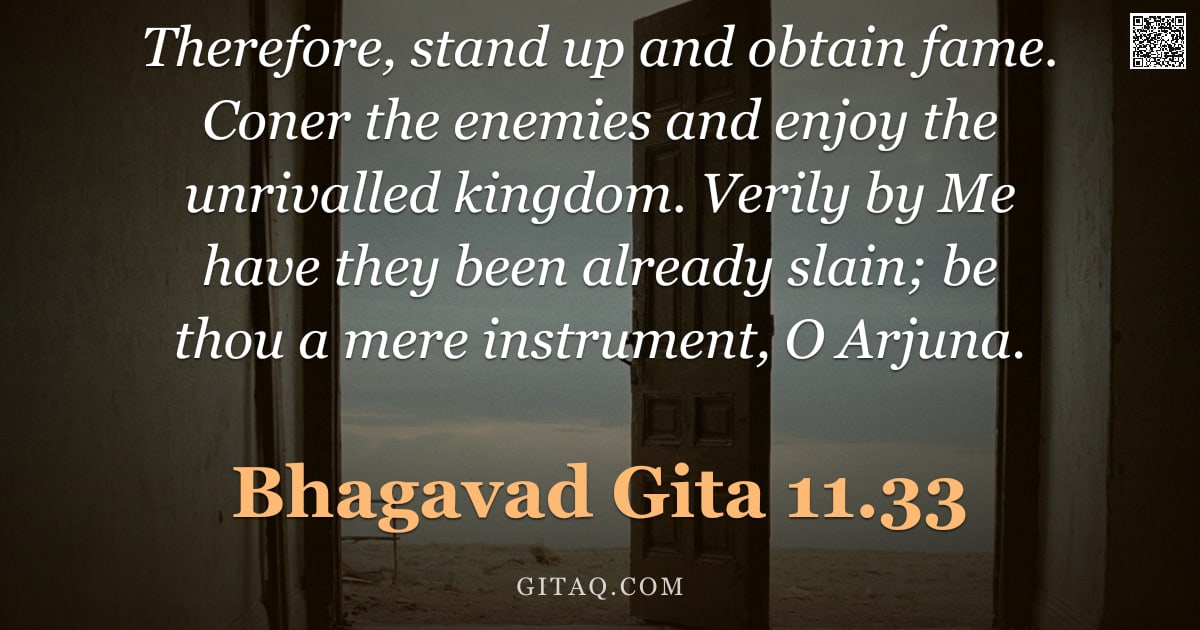
In this verse, Lord Krishna urges Arjuna to rise from his sorrow and fight the battle ahead. He assures him that victory is already assured because he has been granted fame and a prosperous kingdom by taking action against his enemies. The core teaching is that while God's will ensures the outcome of events in time, human beings must still step forward as active instruments or agents to perform their duty.
The Teaching Behind It
This verse is a cornerstone of Karma Yoga, specifically illustrating the concept of Nishkama Karma (action without attachment to results). It harmonizes Jnana Yoga's realization that God controls time and outcomes with Bhakti Yoga by instructing the devotee to act as 'nimittamatra' or a mere instrument while maintaining total surrender.
Word by Word
Classical Commentary
Where This Happens
This verse occurs during Chapter 11 after Arjuna has witnessed Krishna's terrifying and magnificent Universal Form (Vishvarupa), leaving him overwhelmed by awe, fear, and confusion. The scene takes place on the battlefield of Kurukshetra just before the great war begins between the Pandavas and Kauravas. Having revealed his divine nature as time that destroys all beings, Krishna now reassures Arjuna to overcome his hesitation and fulfill his role as a warrior.
Living It Out Today
Consider a project manager leading a high-stakes product launch where they are paralyzed by fear of failure despite having strong support from stakeholders. Instead of dwelling on the potential negative outcome or waiting for permission, this verse teaches them to take decisive action immediately while trusting that their preparation and guidance have set up success. They can view themselves not as the sole creators of results but as a vital instrument in a larger process, allowing them to work without the heavy burden of personal anxiety.
Explained for Children
Imagine you are playing a game where your team has already won before you even start because your coach and all your teammates believe in you. Even though the win is guaranteed by God's plan, Krishna tells Arjuna that he still needs to stand up, run onto the field, and do his part just like a player who must make moves to cross the finish line. You don't need to worry about losing because the result is already set; your job is simply to play with confidence and joy.
Daily Reflection
My dear friend, it is often exhausting when we feel entirely responsible for every victory and failure in our lives today. Krishna invites you to take up your position with confidence because He has already secured the ultimate outcome through His grace. When you realize that success or defeat ultimately belongs to a higher will, your hands are freed from anxiety to simply act with clarity.
A Practice for Today
Close your eyes and visualize yourself standing firm on the battlefield of life, not relying solely on your own strength but resting in a divine presence behind you. Silently repeat the phrase 'I am an instrument' to release the heavy burden of being the sole author of outcomes.
Key Teachings
- The Divine as Pre-Slayer
Krishna reveals that the enemies were already slain by His divine will before Arjuna even moved his bow. This teaches us that the outcome is never truly uncertain, but rather a matter of timing and alignment with cosmic law. - Acting as an Instrument
The human role shifts from being the doer to becoming a mere instrument or channel for divine action. This removes egoistic pride while simultaneously empowering us to act without fear of failure. - Duty and Divine Kingship
One must still stand up, fight their battles, and earn fame through righteous duty rather than passively waiting for miracles. True devotion involves vigorous action performed with the awareness that we are serving a higher purpose.
Themes
Related Verses
Read This Next
- 2.47 — To understand the foundational principle of acting on duty without attachment to results before Krishna reveals the pre-slain enemies.
- 3.30 — To explore the specific instruction of surrendering all actions and their fruits entirely to God as a practical application of being an instrument.
- 12.15 — To reflect on how one who is free from ego and disturbance, like Arjuna after this vision, becomes dear to the Divine.
Recommended Reading
GitaQ earns from qualifying purchases as an Amazon Associate.