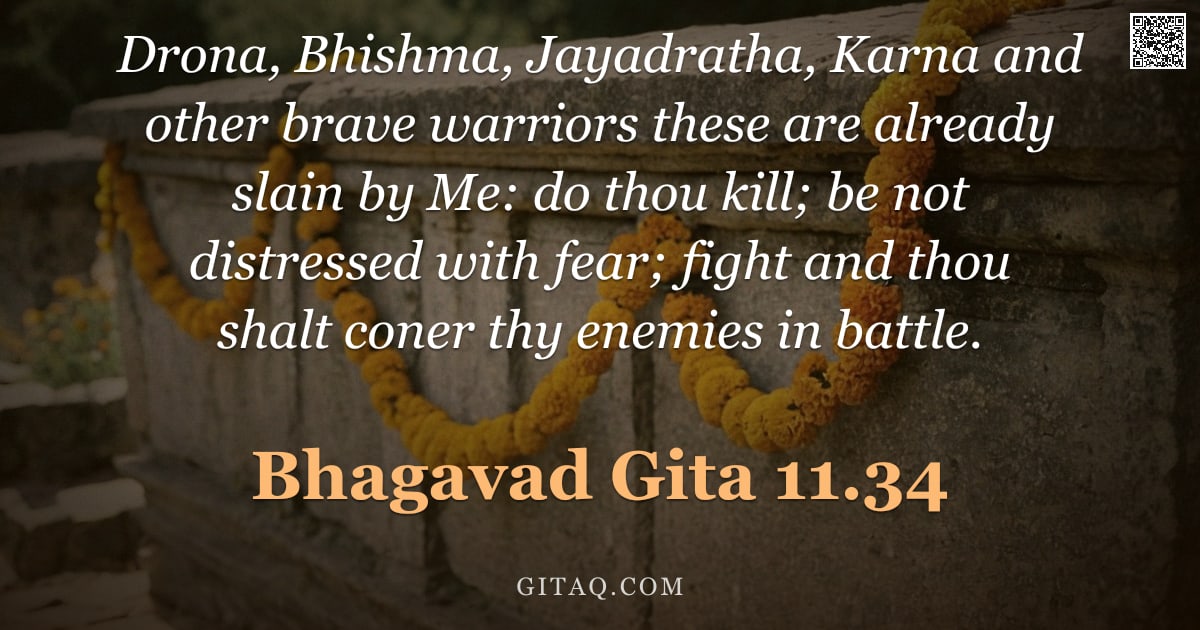
Bhagavad Gita 11.34
Vishvarupa Darshana Yoga · English Translation
द्रोणं च भीष्मं च जयद्रथं च कर्णं तथान्यानपि योधवीरान् | मया हतांस्त्वं जहि मा व्यथिष्ठा युध्यस्व जेतासि रणे सपत्नान् ||११-३४||
droṇaṃ ca bhīṣmaṃ ca jayadrathaṃ ca karṇaṃ tathānyānapi yodhavīrān . mayā hatāṃstvaṃ jahi mavyathiṣṭhā yudhyasva jetāsi raṇe sapatnān ||11-34||
What Does This Verse Mean?
In this verse, Lord Krishna speaks to Arjuna during the revelation of his Cosmic Form. He reveals that he has already destroyed all major warriors like Bhishma and Karna through his divine will before they even fall in battle today. Krishna instructs Arjuna not to feel sorrow or fear but simply to act as an instrument by fighting, assuring him that victory is inevitable because the outcome is already decided.
The Teaching Behind It
This verse is a cornerstone of Karma Yoga (the yoga of action) combined with Ishvara Arpana Buddhi (offering actions to God). It teaches that while humans must act according to their duty, the ultimate power over results belongs solely to the Divine, allowing one to perform necessary duties without attachment or anxiety.
Word by Word
Classical Commentary
Where This Happens
This verse occurs in Chapter 11 after Krishna has revealed his terrifying Universal Form (Vishvarupa) to Arjuna, who is overwhelmed with awe and fear. The context is the moment on the Kurukshetra battlefield where Arjuna realizes that all key Pandava enemies have already been fated for destruction by divine time. Speaking as the Supreme Controller of Fate, Krishna urges a terrified Arjuna to stand up from his despair and fulfill his royal duty without hesitation.
Living It Out Today
When you face a high-stakes work project or family crisis that feels impossible to solve, remember that your role is not to control every outcome but to do your part with full effort. Like the warriors whose defeat was already written by time, focus on executing your specific tasks rather than worrying about the final result or fearing failure. By trusting in a larger plan and acting without anxiety, you remove the paralysis of fear and move forward with confidence.
Explained for Children
Imagine you are playing a video game where your super-powerful boss character has already defeated all the bad guys in the background before the screen even changes. Lord Krishna tells Arjuna something similar: 'I have already won this fight for everyone, so don't be scared or sad.' He just wants Arjuna to pick up his sword and finish playing the game because he knows exactly how it ends.
Daily Reflection
You often feel paralyzed by the size of your current challenges, believing you must fight them alone through sheer willpower. Yet, Krishna reminds us that the outcome is not solely dependent on our frantic effort but on surrendering the fruits and trusting the Divine's grace to clear the path. When you shift from fear-based action to devoted participation, even the most daunting battles become opportunities for growth rather than sources of distress.
A Practice for Today
Close your eyes and visualize the fearsome warriors of doubt, anger, and ego standing as enemies within you. Whisper to yourself that these obstacles have already been vanquished by a power greater than your own mind, allowing you to rise with courage in this moment.
Key Teachings
- Divine Agency in Action
Krishna identifies Himself as the ultimate agent who has already destroyed these warriors, shifting the focus from personal prowess to divine grace. This teaches that true success comes from recognizing a higher power working through and behind our efforts. - Overcoming Spiritual Paralysis
The command 'do not be distressed' addresses the paralysis of fear that often accompanies high-stakes situations or moral dilemmas. By releasing anxiety about the outcome, one can act with clarity and efficiency rather than hesitation. - Courageous Surrender
The verse calls for fighting while simultaneously surrendering the results to the Divine, a paradox that defines true yoga in action. It invites the practitioner to engage fully in their duty without attachment to fear or egoistic desire for victory. - Cultivating Fearlessness
The instruction to 'be not distressed' is an invitation to replace anxiety with a steady, unshakeable confidence rooted in faith. This state of mind allows one to face adversaries and difficulties without the clouding influence of personal fear.
Themes
Related Verses
Read This Next
- 2.47 — Read this next to understand the foundational principle of performing duty without attachment to results, which supports Krishna's call to fight.
- 3.30 — This verse expands on surrendering all actions and their fruits to God, deepening your understanding of acting with divine reliance.
- 12.15 — Explore this description of a devotee who is free from fear and distress to see the ideal state Krishna encourages you to embody.
Recommended Reading
GitaQ earns from qualifying purchases as an Amazon Associate.