Bhagavad Gita 11.32
Vishvarupa Darshana Yoga · English Translation
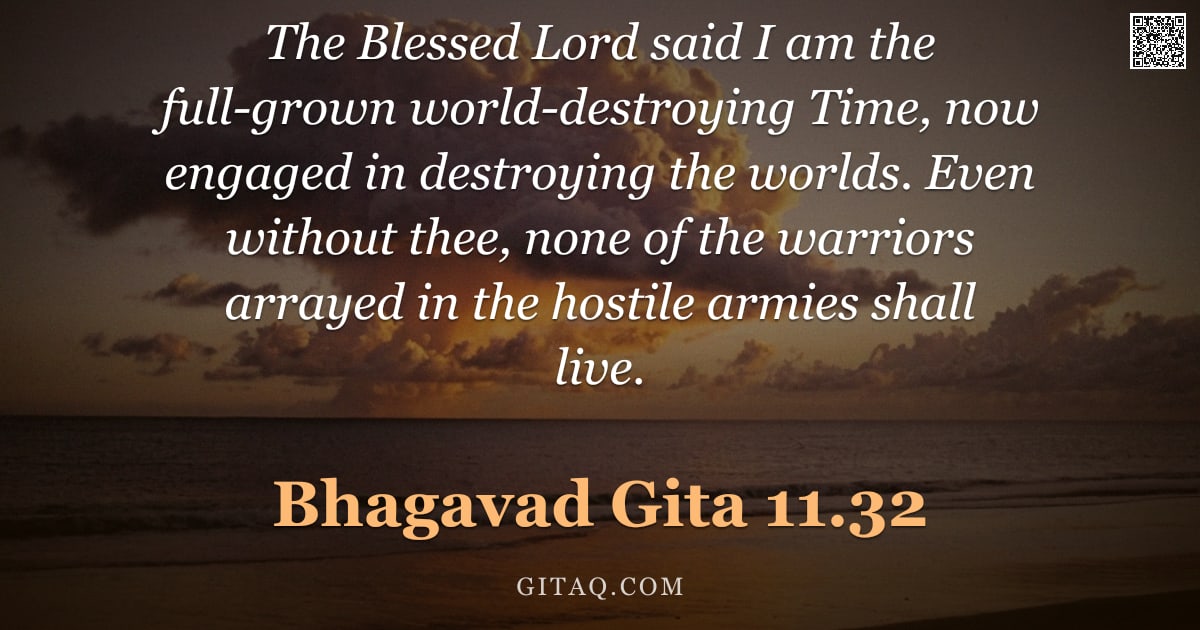
श्रीभगवानुवाच | कालोऽस्मि लोकक्षयकृत्प्रवृद्धो लोकान्समाहर्तुमिह प्रवृत्तः | ऋतेऽपि त्वां न भविष्यन्ति सर्वे येऽवस्थिताः प्रत्यनीकेषु योधाः ||११-३२||
śrībhagavānuvāca . kālo.asmi lokakṣayakṛtpravṛddho lokānsamāhartumiha pravṛttaḥ . ṛte.api tvāṃ na bhaviṣyanti sarve ye.avasthitāḥ pratyanīkeṣu yodhāḥ ||11-32||
What Does This Verse Mean?
In this verse, Lord Krishna reveals to Arjuna that He is the all-consuming force of Time (Kala), which inevitably destroys everything in its path. Even if Arjun were not present on the battlefield, every warrior in both armies would still perish because their destruction was already ordained by divine time. The key teaching here is that human effort alone cannot alter destiny; one must act as a willing instrument while surrendering the outcome to the Divine.
The Teaching Behind It
This verse is central to the concept of Ishvara Pradhana, where God acts as the ultimate cause (Karana) behind all events, integrating the teachings of Sankhya with Bhakti. It develops the principle that while individual agency exists in performing duty, the fruits and timing of results are ultimately governed by Time (Kala), a manifestation of the Divine will.
Word by Word
Classical Commentary
Where This Happens
This verse occurs in Chapter 11 of the Bhagavad Gita during the 'Vishvarupa Darshana Yoga' (Vision of the Cosmic Form), where Krishna reveals his terrifying universal form to Arjuna. At this specific moment, Arjuna is overwhelmed with fear and awe after witnessing billions of faces entering mouths that are devouring warriors from both armies on the battlefield of Kurukshetra. Having just seen the cosmic destruction, Krishna uses this statement to explain that he himself is the agent of Time who has already set these events in motion.
Living It Out Today
Consider a professional facing an unavoidable company restructuring or layoff; despite working hard and trying every strategy to save their position, the decision may still happen due to larger market forces beyond individual control. Instead of spiraling into anxiety about 'what if' this doesn't work out, one can accept that they have done their part (duty) while surrendering the outcome to a higher logic or timing in life. This mindset shifts focus from futile resistance against inevitable change to maintaining inner peace and readiness for what comes next.
Explained for Children
Imagine you are watching a sunset where the sun slowly goes down, and eventually, it gets dark for everyone—no matter how much we wish for the light to stay. Krishna tells Arjuna that He is like that powerful night-time force called 'Time' which always moves forward. Just as trees fall when winter comes no matter what they try to do, all these soldiers will leave their homes because Time has decided it's time for them to go.
Daily Reflection
Today you may feel overwhelmed by forces larger than yourself or anxious about changes that seem unstoppable. Remember that just as the sun rises and sets without asking for permission, Time acts with impartial necessity to clear space for new growth. You are invited to surrender your fear of loss and stand firm in the knowledge that your true self remains untouched by these shifting tides.
A Practice for Today
Sit quietly and imagine Time not as an abstract clock, but as the living breath that dissolves all forms into their source. Invite this awareness to release your attachment to outcomes, trusting that even in apparent destruction, there is a profound order at work.
Key Teachings
- Time as the Ultimate Agent
Krishna reveals that He is not merely a witness but the active force of Time (Kala) driving history and natural cycles. This shifts our perspective from viewing events as random or purely human-made to seeing them as part of divine timing. - The Necessity of Dissolution
Creation is impossible without destruction; Time destroys existing forms so that new possibilities can emerge. This teaching encourages us to accept endings with grace, understanding they are prerequisites for renewal. - Surrender in Action
Even the greatest warriors cannot alter their fate if it is not yet due; thus, one must act without attachment to results. This empowers us to perform our duty with full effort while releasing anxiety over who lives or dies.
Themes
Related Verses
Read This Next
- 2.47 — To immediately apply Krishna's lesson on performing duty without attachment to results after hearing about divine timing.
- 3.30 — To deepen the understanding of dedicating all actions and their fruits as an offering to the Divine.
- 12.15 — To learn how a devotee who is free from fear, anger, and anxiety becomes dear to Krishna after witnessing His cosmic form.
Recommended Reading
GitaQ earns from qualifying purchases as an Amazon Associate.