Bhagavad Gita 11.16
Vishvarupa Darshana Yoga · English Translation
अनेकबाहूदरवक्त्रनेत्रं पश्यामि त्वां सर्वतोऽनन्तरूपम् | नान्तं न मध्यं न पुनस्तवादिं पश्यामि विश्वेश्वर विश्वरूप ||११-१६||
anekabāhūdaravaktranetraṃ paśyāmi tvāṃ sarvato.anantarūpam . nāntaṃ na madhyaṃ na punastavādiṃ paśyāmi viśveśvara viśvarūpa ||11-16||
What Does This Verse Mean?
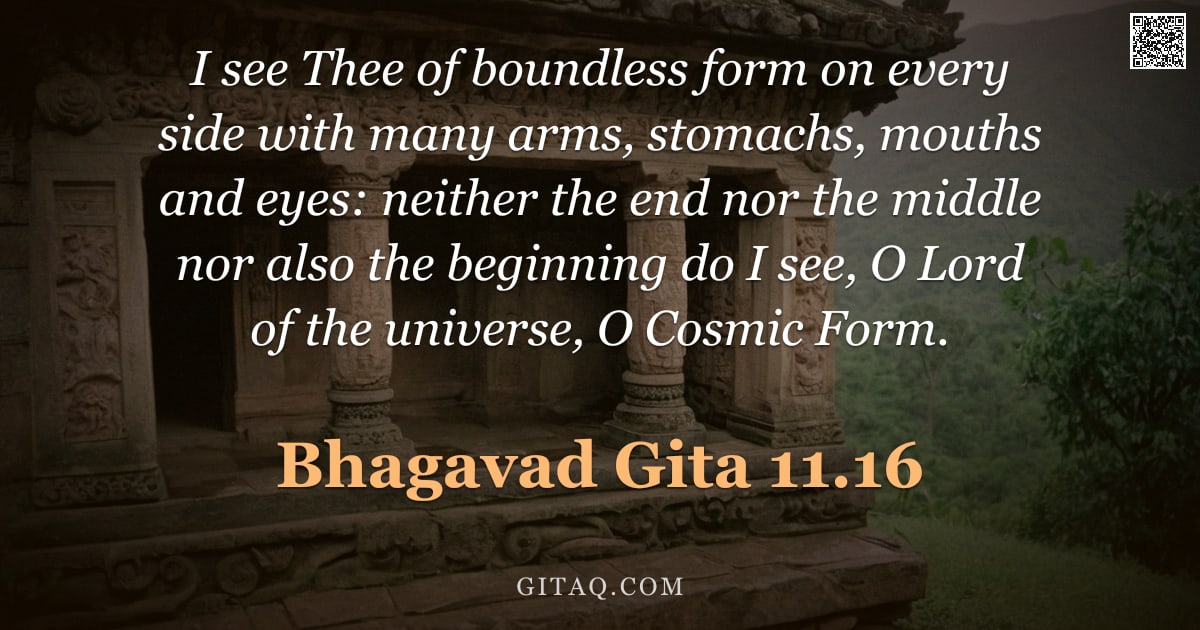
In this verse, Arjuna speaks to Lord Krishna after witnessing his terrifying and magnificent Cosmic Form (Vishvarupa). He describes seeing countless arms, stomachs, mouths, and eyes everywhere he looks, signifying a form that is infinite and boundless. Arjuna realizes there is no beginning, middle, or end to this divine presence, expressing awe at the Lord's omnipotence. The key teaching is that the Divine transcends all physical limitations of time and space.
The Teaching Behind It
This verse belongs primarily to Jnana Yoga (the path of knowledge) as it reveals the nature of Brahman as infinite, without form or limit. It develops the concept of Nirguna Brahman—the aspect of the Absolute that is beyond all attributes like birth and death—while simultaneously serving Bhakti Yoga by deepening Arjuna's surrender through awe.
Word by Word
Classical Commentary
Where This Happens
This verse occurs in Chapter 11 of the Bhagavad Gita during the intense battle on the battlefield of Kurukshetra. After Krishna grants Arjuna divine vision to see his universal form (Vishvarupa), a terrified and overwhelmed Arjuna begins this description as he gazes into the infinite cosmic body. The listener, Arjuna, is experiencing profound shock and awe after realizing that all beings are being dissolved within this terrifying yet beautiful manifestation of time itself.
Living It Out Today
When facing an overwhelming problem at work or a complex family crisis where you feel trapped with no clear exit strategy, remember that the situation exists within a larger context beyond your immediate view. Just as Arjuna saw no beginning or end in the Cosmic Form, recognize that anxiety often stems from trying to control outcomes we cannot see; trust that there is a divine order and purpose extending far beyond the current moment's chaos.
Explained for Children
Imagine if you could see a giant superhero who has thousands of arms, faces, and eyes all over his body! That is what Arjuna saw when he looked at Krishna in this special vision. It was like looking into an endless ocean where there are no walls or edges to stop the view. This teaches us that God is so big and powerful that we can't find a starting point, a middle part, or an ending place for Him.
Daily Reflection
In a world where we often feel trapped by our past regrets or future anxieties, Arjuna's realization reminds us that the Divine has neither a start nor an finish. You are held within this eternal presence, even when your own perspective feels limited to just 'here' and 'now'. Let go of the need to define God as small enough for you to understand; instead, simply trust in His infinite capacity to hold all things together.
A Practice for Today
Close your eyes and imagine looking into an infinite mirror that reflects not just your face, but the entire universe within it, with countless arms reaching out to hold all creation together. Rest in this vision of boundless presence, realizing that there is no beginning or end to the divine love surrounding you right now.
Key Teachings
- The Infinite Nature of Reality
Arjuna observes that the Cosmic Form lacks a beginning, middle, or end, signifying that the Divine transcends linear time and human limitations. This teaches us that our search for God must move beyond temporal boundaries into an experience of eternal presence. - The Omnipresence of Divinity
By describing eyes, mouths, arms, and bellies on all sides, the verse illustrates that the Divine is simultaneously everywhere and in every form. This expands our vision from a localized deity to an omnipresent force that permeates every atom of existence. - The Limits of Human Perception
Arjuna's declaration highlights how human eyes cannot fully comprehend the Infinite, requiring divine grace or inner purification to perceive the truth. It invites us to humble our intellect and open ourselves to a vision that goes beyond sensory experience.
Themes
Related Verses
Read This Next
- 2.13 — To recall how Krishna first addresses Arjuna's fear of death by explaining that the soul transcends birth and time, setting the stage for seeing the eternal.
- 13.20 — To understand how Krishna distinguishes between matter and spirit (Prakriti and Purusha) as two distinct eternal principles, deepening the context of his infinite nature revealed in Chapter 11.
Recommended Reading
GitaQ earns from qualifying purchases as an Amazon Associate.