Bhagavad Gita 11.17
Vishvarupa Darshana Yoga · English Translation
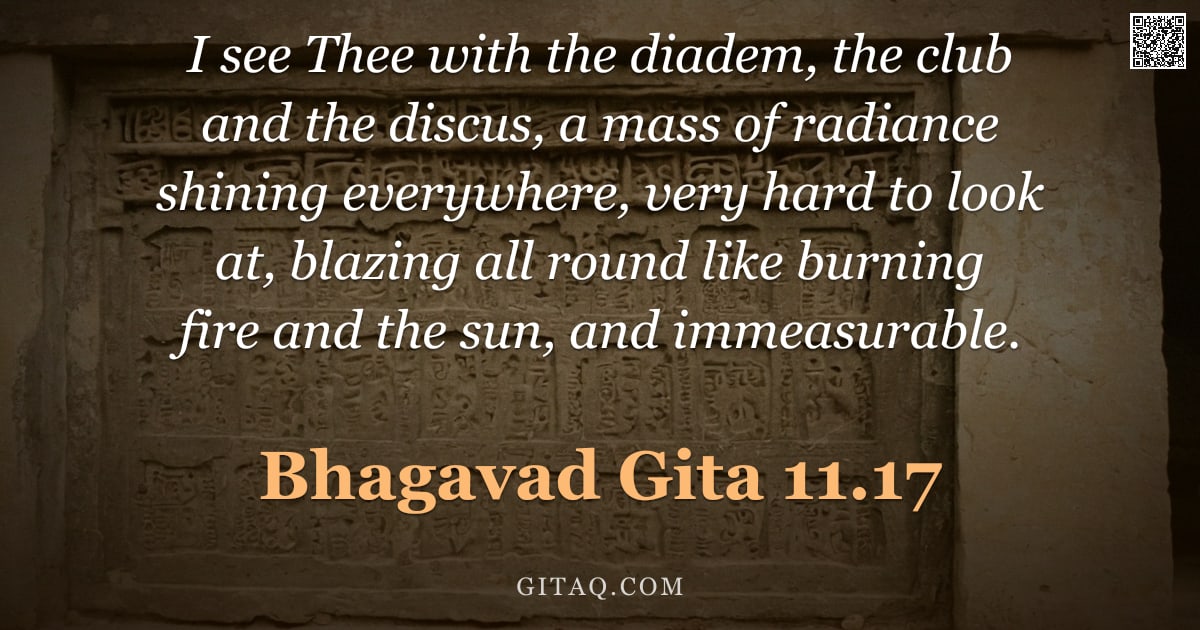
किरीटिनं गदिनं चक्रिणं च तेजोराशिं सर्वतो दीप्तिमन्तम् | पश्यामि त्वां दुर्निरीक्ष्यं समन्ताद् दीप्तानलार्कद्युतिमप्रमेयम् ||११-१७||
kirīṭinaṃ gadinaṃ cakriṇaṃ ca tejorāśiṃ sarvato dīptimantam . paśyāmi tvāṃ durnirīkṣyaṃ samantād dīptānalārkadyutimaprameyam ||11-17||
What Does This Verse Mean?
In this verse, Arjuna is speaking to Lord Krishna after witnessing the terrifying and magnificent Cosmic Form (Vishvarupa). He describes seeing a blinding light filled with infinite radiance that surrounds every direction, making it difficult for human eyes to look at directly. The key teaching here is the realization of God's overwhelming glory, which transcends ordinary perception like trying to stare into the sun or a massive fire.
The Teaching Behind It
This verse belongs primarily to Jnana Yoga (the path of knowledge) and Bhakti Yoga (the path of devotion), as it combines intellectual realization with emotional surrender. It develops the concept of 'Akshara Brahman'—the formless, infinite reality that is beyond all measurement yet manifests in every direction.
Word by Word
Classical Commentary
Where This Happens
This verse occurs in Chapter 11 of the Bhagavad Gita during the Kurukshetra war, where Arjuna has just asked Krishna to reveal his universal form. After granting this vision, Krishna displays a cosmic body filled with thousands of mouths and eyes that glow like fire and the sun, terrifying yet magnificent to behold. At this moment, Arjuna is overwhelmed by awe and fear, realizing he is standing before the ultimate reality rather than his friend or charioteer.
Living It Out Today
When you face a high-stakes professional decision where the stakes feel too big for your current understanding, remember that clarity often comes from stepping back to see the bigger picture. Just as Arjuna could not bear the direct glare of the Cosmic Form without preparation, sometimes we need spiritual or mental grounding before facing overwhelming truths in our careers or relationships.
Explained for Children
Imagine if you could see your teacher wearing a giant glowing crown and holding magical items that shine brighter than the brightest flashlight in the world. Arjuna saw Krishna as this amazing, super-bright figure with so much light coming from everywhere that he had to squint his eyes because it was too dazzling. It is like trying to look directly at the sun on a sunny day; you can see how powerful and warm it is, but it hurts your eyes if you stare for too long.
Daily Reflection
You might feel overwhelmed when facing something infinite today, just as Arjuna did before the Cosmic Form. Yet remember that the very light which seems too bright to behold is also the source of your deepest peace and safety. When you look at the world with this divine vision, fear dissolves into awe.
A Practice for Today
Close your eyes and visualize a light so vast it has no edges, yet you are standing safely within its warmth rather than being burned by it. As the radiance surrounds you like fire or sun, silently acknowledge that this brilliance is not separate from your own true nature.
Key Teachings
- The Symbolism of Divine Power
Arjuna identifies Krishna by specific symbols—the crown, club, and discus—which represent sovereignty, strength, and the destruction of ignorance respectively. These icons remind us that ultimate power is wielded with a purpose to uphold cosmic order. - The Paradox of Radiance
The Divine form shines as fire and sun simultaneously, yet it remains 'hard to look at' for those bound by limited vision. This teaches that the truth is often blindingly obvious once revealed, but requires spiritual preparation to perceive without fear. - Boundless Immeasurability
The verse describes a form 'immeasureable' in all directions, transcending physical limitations and spatial constraints. This invites the seeker to realize that consciousness itself is infinite, far beyond any defined shape or boundary.
Themes
Related Verses
Read This Next
- 2.47 — Read this next to recall the instruction on performing duty without attachment, preparing the mind for higher revelation.
- 3.30 — This verse reinforces dedicating all actions and their fruits to the Divine, essential for perceiving His form clearly.
- 12.15 — After witnessing the terrifying Cosmic Form, this verse reveals Krishna's gentle nature as one dear to devotees who seek peace.
Recommended Reading
GitaQ earns from qualifying purchases as an Amazon Associate.