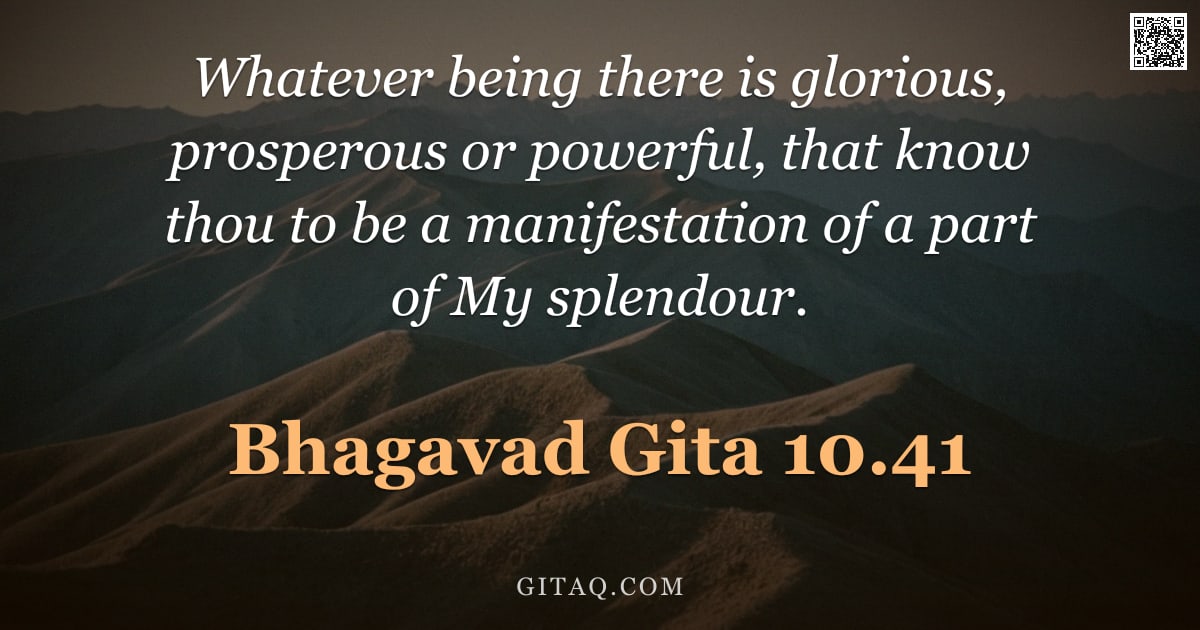
Bhagavad Gita 10.41
Vibhuti Yoga · English Translation
यद्यद्विभूतिमत्सत्त्वं श्रीमदूर्जितमेव वा | तत्तदेवावगच्छ त्वं मम तेजोंऽशसम्भवम् ||१०-४१||
yadyadvibhūtimatsattvaṃ śrīmadūrjitameva vā . tattadevāvagaccha tvaṃ mama tejoṃśasambhavam ||10-41||
What Does This Verse Mean?
In this verse, Lord Krishna is speaking to Arjuna on the battlefield of Kurukshetra, explaining His divine nature through a process called 'Vibhuti' or glories. He teaches that any being in the universe that possesses greatness, prosperity, or power is not independent but arises from just one small part of His infinite energy. The core message is to recognize these moments of beauty and strength as reflections of God rather than viewing them as isolated events or personal achievements.
The Teaching Behind It
This verse belongs primarily to Jnana Yoga (the path of knowledge) and Bhakti Yoga, specifically illustrating the concept of 'Vibhuti' or divine manifestation. It bridges the non-dualistic view that all reality is one with Brahman while acknowledging the dualistic experience where distinct forms appear in the world as partial expressions of the Divine.
Word by Word
Where This Happens
This verse occurs in Chapter 10 during Krishna's discourse on His divine opulences to Arjuna, who has just agreed to fight but still feels overwhelmed by the magnitude of war. After describing specific manifestations like the sun and the moon, Krishna generalizes this principle to all beings to deepen Arjuna's understanding of his own duty. At this moment, Arjuna is transitioning from seeing Krishna merely as a charioteer or friend to recognizing Him as the Supreme Source of all existence.
Living It Out Today
When facing a difficult decision at work where you feel stuck between two options, use this verse to shift your perspective: look for the 'glory' in both paths—perhaps one offers creative growth and the other stability. Instead of seeing these qualities as purely material or accidental, recognize them as signs of divine energy guiding your choices toward what is right. This realization can reduce anxiety by reminding you that even the most powerful outcomes are supported by a larger intelligence.
Explained for Children
Imagine the sun shines its light on a mirror, a lake, or even a tiny drop of water; each reflection looks bright and beautiful in its own way. Krishna is saying that everything amazing you see—like a strong lion, a glowing star, or a kind friend—is like one of those reflections shining from Him. When we feel happy about something wonderful happening, it's because the 'light' of God is touching us through that thing.
Daily Reflection
Today, try looking at ordinary moments—a sunrise, a smiling face, or a thriving plant—and pause to acknowledge them not as separate entities but as intimate expressions of the Divine's splendor. You are never truly apart from this source; even your greatest achievements and deepest struggles carry the fingerprint of that same infinite energy working through you.
A Practice for Today
Sit quietly and visualize a single spark of sunlight or the glow of a candle, recognizing it as a fragment of the infinite Divine light described by Krishna. Slowly expand your awareness to see that same radiant essence shimmering within every living being and natural wonder around you.
Key Teachings
- The Principle of Non-Dual Manifestation
Every instance of beauty, power, or prosperity in the universe is not a separate creation but a direct emanation from Krishna's own spiritual energy. This teaches us to see the One Reality shining through infinite diverse forms. - Sanctifying the Material World
By recognizing the Divine spark in all 'glorious, prosperous or powerful' things, we transform our perception of the material world from mundane into sacred. This shifts our focus from worshiping only distant deities to honoring the presence everywhere. - The Nature of Devotional Humility
When we realize that even our greatest strengths are merely reflections of a fragment of God's infinite power, pride naturally dissolves. This realization fosters deep humility while simultaneously filling us with gratitude for the grace available in every moment.
Themes
Related Verses
Read This Next
- 2.47 — Connects to performing actions without attachment, seeing them as part of the divine order.
- 3.30 — Reinforces surrendering all works and fruits to Krishna, aligning with the verse's theme of offering everything back to Him.
- 12.15 — Describes the qualities of a devotee who is dear to the Lord, completing the picture of how one relates to this pervasive Divine presence.
Recommended Reading
GitaQ earns from qualifying purchases as an Amazon Associate.