Bhagavad Gita 10.42
Vibhuti Yoga · English Translation
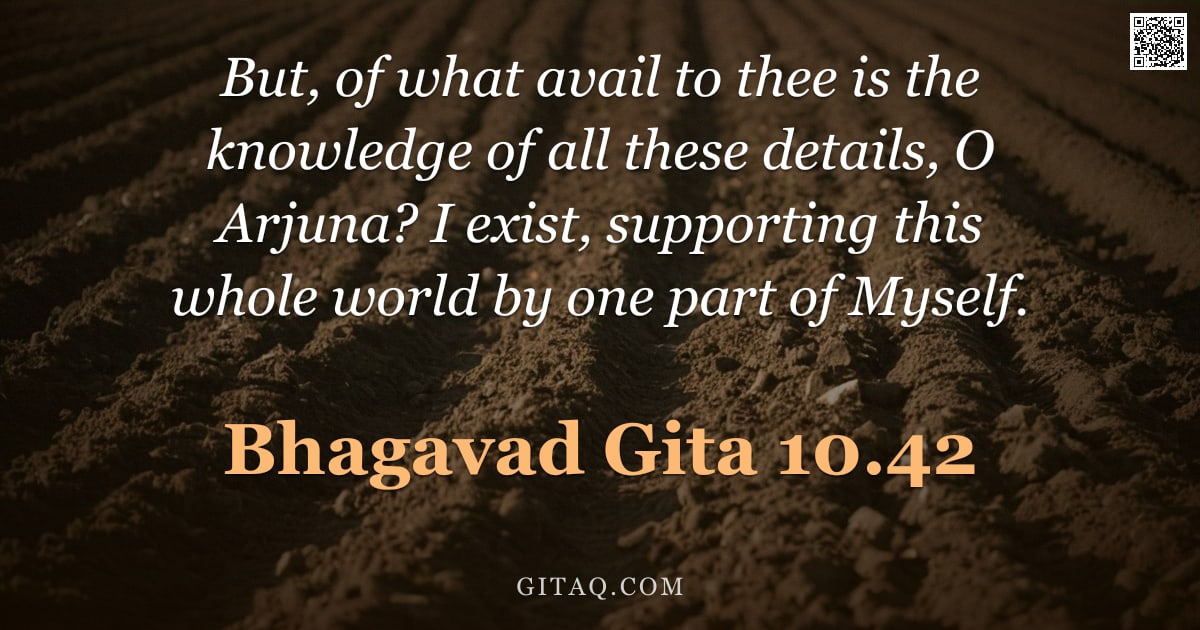
अथवा बहुनैतेन किं ज्ञातेन तवार्जुन | विष्टभ्याहमिदं कृत्स्नमेकांशेन स्थितो जगत् ||१०-४२||
athavā bahunaitena kiṃ jñātena tavārjuna . viṣṭabhyāhamidaṃ kṛtsnamekāṃśena sthito jagat ||10-42||
What Does This Verse Mean?
In this verse, Lord Krishna gently tells Arjuna that listing every divine manifestation is unnecessary for true understanding. He reveals the core teaching: just as a single ray of light or one drop of water contains the essence of the whole sun or ocean, the entire universe rests on and in just one fraction of His energy. This means the infinite Creator sustains all existence without being divided or diminished by it.
The Teaching Behind It
This verse belongs primarily to the Vedantic strand of 'Jnana Yoga' (the yoga of knowledge) and establishes the non-dualistic concept that the finite universe is sustained by an infinite source without division. It develops the theological principle of *Ekamsena Sthita Jagat*, illustrating how the Absolute One remains undivided while pervading all of relative existence.
Word by Word
Classical Commentary
Where This Happens
This verse appears near the end of Chapter 10 during Krishna's discourse on 'Vibhuti Yoga,' where He describes His divine glories to Arjuna. After listing numerous manifestations across nature and humanity, Arjuna is overwhelmed by this infinite display of power, prompting Krishna to pause his enumeration. The conversation takes place in the midst of the Kurukshetra battlefield, moments before the great war begins, as Krishna seeks to instill unwavering confidence and surrender in a hesitant warrior.
Living It Out Today
When you feel paralyzed by trying to analyze every single detail or risk factor before making a difficult career change, remember that this verse teaches trust over total control. Instead of getting lost in the 'how' of thousands of variables, focus on aligning your actions with your core values and trusting the larger order of things to hold everything together while you act. Just as Krishna sustains the world through one part of Himself, a single moment of focused intention supported by faith is enough to move mountains.
Explained for Children
Imagine you are looking at a giant puzzle where every single piece is made from the same special clay as the whole picture itself. Krishna tells Arjuna that instead of counting thousands of pieces, we just need to know one thing: the whole universe hangs together because of Him, like how a tiny spark contains all the heat and light of a massive fire. Even though the world looks huge and complicated, it is held up by His love in just a small part of Himself.
Daily Reflection
You often feel like you must carry the weight of your world on your own shoulders, yet today I invite you to remember that you are never truly alone in your struggles. Just as Arjuna was overwhelmed by the magnitude of Krishna's glories, you might find it hard to grasp how a single point can hold so much; but this verse assures us that the Divine is not distant or divided. That same sustaining power lives within your heart, supporting every moment of your life with effortless grace.
A Practice for Today
Close your eyes and visualize that single breath you just took as the very spark of life holding up the entire universe right now. Rest in the quiet certainty that everything around you, from the vast sky to this room, is sustained by a singular, unbroken presence within you.
Key Teachings
- The Sufficiency of Partial Presence
Krishna teaches that He does not need to manifest in full form everywhere simultaneously; a mere fraction or 'part' of His being is sufficient to sustain the entire cosmos. This reveals an economy of divine power where totality exists within even the smallest fragment. - The Futility of Excessive Enumeration
By asking what Arjuna gains from a detailed list, Krishna shifts focus from intellectual accumulation to experiential realization. The infinite nature of God cannot be fully captured by cataloging examples; it must be understood as an immediate reality. - The Omnipresent Support
The universe is not a collection of independent objects but a unified whole held together by the singular will of the Divine. Every particle and every moment relies on this continuous, unbroken act of support from the One.
Themes
Related Verses
Read This Next
- 2.47 — To understand how Krishna's presence relates to our duty and detachment in action.
- 3.30 — To learn the practical application of surrendering all actions to this sustaining Divine will.
- 12.15 — To explore how a devotee who is not dependent on external things reflects the self-sufficiency described in 10.42.
Recommended Reading
GitaQ earns from qualifying purchases as an Amazon Associate.