Bhagavad Gita 10.29
Vibhuti Yoga · English Translation
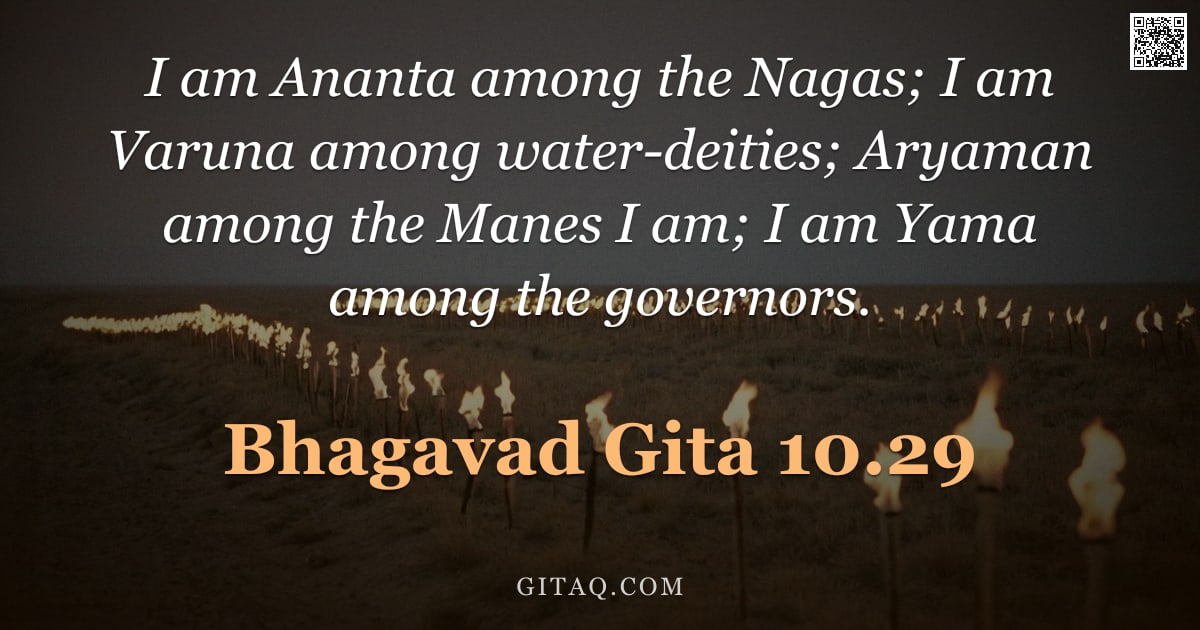
अनन्तश्चास्मि नागानां वरुणो यादसामहम् | पितॄणामर्यमा चास्मि यमः संयमतामहम् ||१०-२९||
anantaścāsmi nāgānāṃ varuṇo yādasāmaham . pitṝṇāmaryamā cāsmi yamaḥ saṃyamatāmaham ||10-29||
What Does This Verse Mean?
In this verse, Lord Krishna tells Arjuna that He is the greatest and most powerful presence behind every category of existence listed: Ananta among serpents, Varuna over waters, Aryaman for ancestors, and Yama as the law of justice. By revealing these glories, Krishna explains that no matter how great a force or entity seems in nature or society, it is merely an expression of His infinite energy. The key teaching is to recognize the divine spark within all powerful things rather than getting lost in their external forms.
The Teaching Behind It
This verse is central to the theme of Vishwarupa Darshana in Jnana Yoga (the path of knowledge), specifically illustrating the concept of 'Vibhuti' or divine manifestations. It teaches that the Absolute Reality does not remain distant but actively pervades and sustains all relative existence, making every powerful entity a reflection of the One.
Word by Word
Classical Commentary
Where This Happens
This verse appears during Chapter 10 on the battlefield of Kurukshetra, where Krishna is explaining His divine opulences to Arjuna. Just before this, Krishna has been listing how He pervades different groups of beings and elements in nature, aiming to shift Arjuna's perspective from seeing Him as a mere charioteer or friend to recognizing the Supreme Personality of Godhead. At this moment, Arjuna is beginning to realize that his duty is not just against enemies but involves aligning himself with cosmic order.
Living It Out Today
When facing a difficult decision at work where multiple leaders have conflicting opinions on how to proceed, you can apply this verse by recognizing the 'Yama' aspect—the principle of justice and self-regulation—within your own conscience. Instead of being overwhelmed by external pressure or fear of failure (the 'nagas'), look inward for that supreme standard of order and integrity that guides all good governance. This shifts your anxiety from a personal struggle into an alignment with a higher, universal law.
Explained for Children
Imagine you are looking at a giant ocean; while we see waves and water, Krishna says He is the very power holding those waters together. Similarly, if there was a super-strong snake or a wise judge who makes sure everyone follows rules, Krishna points out that He is the true source of their strength and wisdom inside them. Just like how your favorite superhero gets all its powers from an infinite energy source, every amazing thing in this world gets its power from God.
Daily Reflection
Today, notice how the divine presence moves through your own world in unexpected ways, perhaps in the quiet strength of nature or the hidden rules that guide our society. You may feel overwhelmed by responsibilities like Yama's judgment or Varuna's vastness, yet remember that these are not burdens but expressions of a higher order you inhabit. When you act with integrity and compassion, you align yourself with Aryaman and become a channel for divine grace in your daily interactions.
A Practice for Today
Close your eyes and visualize yourself as an infinite presence flowing through all forms of water, from the deepest ocean to a single dewdrop. Resting here as Ananta or Varuna, silently acknowledge that you are not separate from these elements but the very life force sustaining them.
Key Teachings
- The Infinite Within the Finite
Krishna reveals that even when appearing as distinct entities like Ananta or Varuna, He remains one undivided consciousness. This teaches us to see unity in diversity and recognize the singular source behind all specialized roles. - Divine Sovereignty Over Nature
By identifying with water deities and celestial beings, God asserts His ownership over natural forces that govern human life. We are invited to respect these powers not as independent gods but as manifestations of the Supreme Controller. - Ethical Governance as Worship
Identifying with Yama among governors suggests that just authority and moral judgment are sacred duties reflecting divine order. Serving others with fairness is thus a direct act of recognizing God's presence in leadership.
Themes
Related Verses
Read This Next
- 2.47 — This verse clarifies that one should focus on duty without attachment to results, which complements understanding God's role as the ultimate governor.
- 3.30 — It instructs in surrendering all actions and their fruits to Krishna, deepening the devotion required to perceive His presence in every form mentioned here.
- 12.15 — This verse describes a devotee who does not cause distress to others but is dear to God, mirroring the benevolent and just nature of Yama as described by Krishna.
Recommended Reading
GitaQ earns from qualifying purchases as an Amazon Associate.