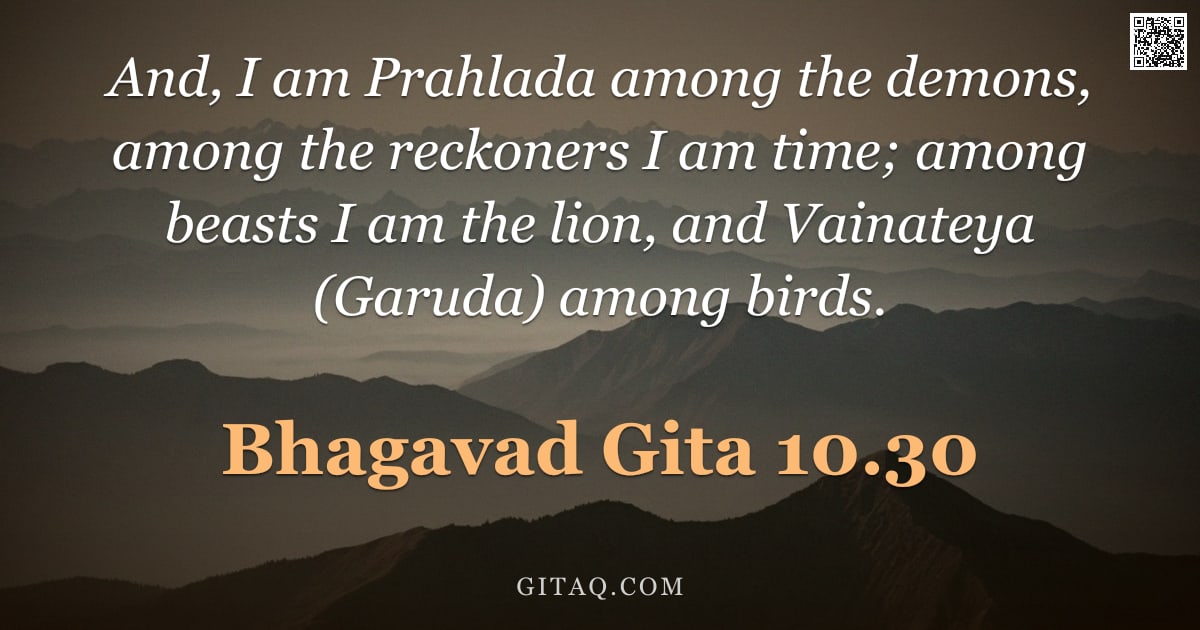
Bhagavad Gita 10.30
Vibhuti Yoga · English Translation
प्रह्लादश्चास्मि दैत्यानां कालः कलयतामहम् | मृगाणां च मृगेन्द्रोऽहं वैनतेयश्च पक्षिणाम् ||१०-३०||
prahlādaścāsmi daityānāṃ kālaḥ kalayatāmaham . mṛgāṇāṃ ca mṛgendro.ahaṃ vainateyaśca pakṣiṇām ||10-30||
What Does This Verse Mean?
In this verse, Lord Krishna is explaining His divine presence to Arjuna by listing the most powerful and beautiful examples found in creation. He identifies Himself as Prahlada among demons, Time itself among those who measure it, the lion among beasts, and Garuda (the king of birds) among all flying creatures. The key teaching here is that God is not distant but resides within the pinnacle of every category, representing perfection, strength, and ultimate authority in everything we see.
The Teaching Behind It
This teaching belongs primarily to Bhakti Yoga and Jnana Yoga, specifically developing the concept of 'Vibhuti'—the manifestation of the Infinite within finite forms. It illustrates the non-dualistic Vedantic principle that while God transcends creation, He is also immanent as the essential essence (Atman) in all beings.
Word by Word
Classical Commentary
Where This Happens
This verse appears during Chapter 10 on the battlefield of Kurukshetra, where Krishna has just begun to reveal His 'Vibhutis' (divine glories) to Arjuna. At this moment, Arjuna is overwhelmed by a mix of confusion and awe as he realizes that his friend is actually the Supreme Personality of Godhead who pervades all existence. Following his confession in Chapter 10 where he asks Krishna to describe His opulences further, this verse provides concrete examples from nature and mythology to help him visualize the invisible.
Living It Out Today
When you face a high-stakes work negotiation or make a critical decision that feels overwhelming, remember that the confidence and clarity of a lion are not just animal traits but reflections of divine strength available within your own potential. Instead of feeling alone in the pressure, view this moment as an opportunity to channel the 'time' aspect of this verse—using every second wisely as part of a larger plan rather than fearing the outcome. By recognizing that you possess these innate qualities (like Garuda's vision or Prahlada's faith), you can approach challenges with the assurance that divine support is intrinsic to your actions.
Explained for Children
Imagine if there was a Super-Dad who wasn't just one person, but lived inside the very best things around us. Just like how you might have your favorite hero toy or your strongest friend at school, God is present as the bravest lion among animals and the fastest eagle in the sky. He says that even when we see something amazing or powerful, we are actually seeing a little bit of Him shining through it.
Daily Reflection
Just as the lion stands supreme among beasts without needing to prove its strength, remember that your true nature is already complete and powerful within you. When challenges arise, look inward for that same unshakeable courage rather than seeking validation from outside sources. You are not merely surviving these moments; like Prahlada or Garuda, you carry a divine purpose that transcends the chaos around you.
A Practice for Today
Close your eyes and imagine the lion's roar as the voice of Time itself, dissolving all fear and marking the inevitable progress of existence. In that moment of stillness, ask yourself: where do you feel most like a protector or a sovereign in your own life today?
Key Teachings
- The Divine in Opposites
God manifests even within those who seem to oppose Him, as seen in Prahlada among the demons, showing that grace is not limited by external labels or categories. This teaches us to look beyond appearances and recognize the divine potential hidden in every being. - Time as the Ultimate Reality
Among all who calculate and measure existence, Krishna identifies Himself as Time (Kala), the force that brings about inevitable change and dissolution. This reminds us to surrender our anxiety over outcomes by trusting in the natural rhythm of the universe. - Majesty in Nature
The lion and Garuda represent supreme strength, speed, and authority within their respective realms, symbolizing how divinity expresses itself through the finest qualities of creation. We are invited to cultivate these same noble traits—fearlessness and devotion—as expressions of our own spiritual nature.
Themes
Related Verses
Read This Next
- 2.47 — To understand how to act with devotion and without attachment, complementing the theme of recognizing time's role.
- 3.30 — This verse expands on surrendering all actions to Krishna, deepening the connection between divine glory and personal duty.
- 12.15 — To see how one who is not agitated by time or fear becomes dear to Krishna, echoing the lion's fearless nature.
Recommended Reading
GitaQ earns from qualifying purchases as an Amazon Associate.