Bhagavad Gita 10.31
Vibhuti Yoga · English Translation
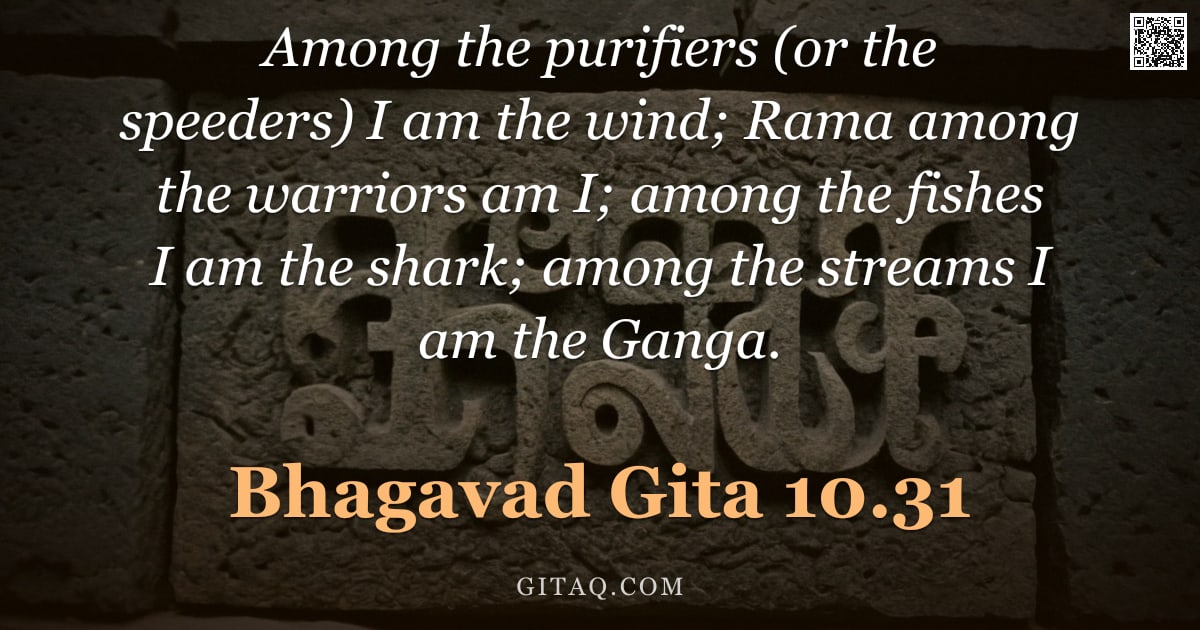
पवनः पवतामस्मि रामः शस्त्रभृतामहम् | झषाणां मकरश्चास्मि स्रोतसामस्मि जाह्नवी ||१०-३१||
pavanaḥ pavatāmasmi rāmaḥ śastrabhṛtāmaham . jhaṣāṇāṃ makaraścāsmi srotasāmasmi jāhnavī ||10-31||
What Does This Verse Mean?
In this verse, Lord Krishna is telling Arjuna that He exists as the most powerful and essential element within every category of creation he listed previously. Just as the wind purifies the air faster than any other force, Rama (the warrior) leads all warriors, the shark dominates fish, and the Ganga river flows above all streams, God's presence is supreme in these specific domains. The key teaching here is that wherever we see greatness, speed, purity, or power in nature or human society, it is a reflection of the Divine energy at work.
The Teaching Behind It
This verse belongs to the framework of Vishwarupa Darshana (the vision of the Universal Form) within Bhakti Yoga and Sankhya philosophy. It develops the concept that God is not distant but immanent, existing as the essential 'best' or most potent form in every category of existence without being limited by it.
Word by Word
Classical Commentary
Where This Happens
This verse occurs during the Vibhuti Yoga chapter on the battlefield of Kurukshetra, where Krishna has just begun revealing his infinite divine forms to Arjuna. After seeing a terrifying vision of time and destruction in Chapter 11 (which follows this section), or rather preparing for it by listing these glories first, Krishna is reassuring a confused Arjuna who cannot comprehend how the Infinite can be contained within finite descriptions. The context is one of divine revelation where the listener, Arjuna, is shifting from seeing his friend as merely human to recognizing him as the Supreme Controller.
Living It Out Today
When you face a high-stakes decision at work or a difficult family conflict that requires clarity and speed, instead of relying solely on your own limited strength, pause to recognize the 'wind' within yourself. Acknowledge that the capacity for quick action (like wind) or leadership (like Rama) is not just yours but an expression of a higher intelligence guiding you through the situation. By viewing these natural strengths as divine gifts rather than personal achievements, you reduce anxiety and act with greater confidence and detachment from the outcome.
Explained for Children
Imagine if you were looking for the best player on every team: the fastest runner, the strongest swimmer, and the smartest leader. Krishna explains that He is actually inside all those amazing things as their true heart or spirit. Just like the wind cleanses a dusty room better than anything else, or how the biggest shark rules the ocean fish, God's special power makes these elements shine so they can help us understand His greatness.
Daily Reflection
Just as the Ganga flows with immense power and purity to nourish all who drink from her banks, let your own actions flow naturally without attachment to outcomes or ego. When you feel overwhelmed by chaos, remember that like the wind, you have an innate capacity to clear obstacles simply by being yourself. You do not need to force change; instead, align with this divine current and allow it to work through you.
A Practice for Today
Close your eyes and visualize the wind moving through your body, carrying away stagnation just as it clears the air outside; feel yourself becoming a force of purification today. In that stillness, recognize that every movement you make is an expression of the divine life force flowing within you.
Key Teachings
- The Divine as Purifier
Krishna identifies the wind (Prana) as the supreme purifier because air is invisible yet essential for life, symbolizing how God cleanses our hearts of impurities. This teaches that spiritual cleansing often happens through subtle forces we cannot see but must trust. - Excellence in Duty
By declaring himself as Rama among warriors and the shark among fish, Krishna highlights that divinity manifests most clearly when one performs their specific role with excellence. Whether you are a leader or an individual contributor, your highest service is to be the best version of yourself. - The Source of All Flow
Identifying as the Ganga among streams signifies that all natural and spiritual currents originate from one singular source. Recognizing this unity helps us see beyond individual struggles to understand our connection with a greater, flowing wisdom.
Themes
Related Verses
Read This Next
- 2.47 — This verse on focusing only on action without attachment complements the idea of being like Rama by doing one's duty perfectly.
- 3.30 — It expands on surrendering all actions to Krishna, mirroring how the shark and Ganga represent divine forms that naturally fulfill their purpose.
- 12.15 — This verse describes a devotee who is dear to God because they are not disturbed by others and do not disturb them, reflecting the purifying nature of wind.
Recommended Reading
GitaQ earns from qualifying purchases as an Amazon Associate.