Bhagavad Gita 10.28
Vibhuti Yoga · English Translation
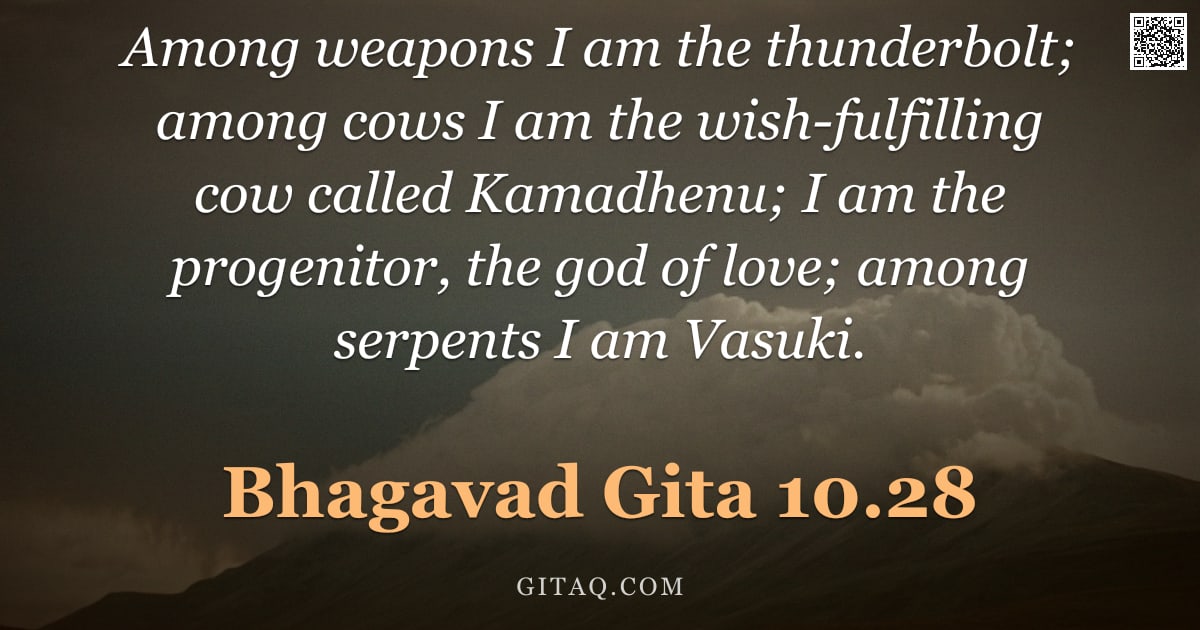
आयुधानामहं वज्रं धेनूनामस्मि कामधुक् | प्रजनश्चास्मि कन्दर्पः सर्पाणामस्मि वासुकिः ||१०-२८||
āyudhānāmahaṃ vajraṃ dhenūnāmasmi kāmadhuk . prajanaścāsmi kandarpaḥ sarpāṇāmasmi vāsukiḥ ||10-28||
What Does This Verse Mean?
In this verse, Lord Krishna reveals his divine presence within the most powerful and precious things of creation to Arjuna. He identifies himself as Vajra (the thunderbolt) among weapons, symbolizing unmatched strength; Kamadhenu among cows, representing boundless abundance; Kandarpa among progenitors, signifying creative energy; and Vasuki among serpents, embodying sovereignty over potent forces. The core teaching is that the Divine is not distant but resides as the essence of all excellence in every aspect of life.
The Teaching Behind It
This verse is a cornerstone of Bhakti Yoga, specifically illustrating the concept of Vibhuti or Divine Glories as a means to realize Brahman through devotion. It bridges the gap between Sankhya's classification of existence and Vedanta's non-dual reality by showing that the Absolute (Brahman) manifests uniquely within relative phenomena without losing its unity.
Word by Word
Classical Commentary
Where This Happens
This verse occurs during Chapter 10 (Vibhuti Yoga) on the battlefield of Kurukshetra, where Krishna is explaining his infinite nature to a confused and reluctant Arjuna. After revealing that he is the source of all creation, Krishna now lists specific examples from the physical world to help Arjuna visualize how the Divine permeates reality. The listener, Arjuna, is in a state of deep shock and reverence (bhakti), realizing his friend Chakshusha is actually the Supreme Lord.
Living It Out Today
When facing a high-stakes negotiation or a difficult decision at work that feels overwhelming, remember this verse to shift your perspective from fear to confidence. Instead of seeing yourself as just one person against many obstacles, recognize that you can access the 'Vajra' (unshakeable clarity) within you for action and the 'Kamadhenu' (resourcefulness) for solutions. This mindset transforms anxiety into a focused state where every resource at hand feels abundant rather than scarce.
Explained for Children
Imagine if you could be everywhere at once: like a super-strong superhero who makes your toys work better when they are powerful tools, or like the magic wish-granting lamp from stories that gives you exactly what you need. Krishna is saying he is inside those special things so we never have to look far for help and strength. Just as a thunderbolt has more power than any other weapon, God's presence makes even the smallest good thing in our world feel full of energy.
Daily Reflection
You often look outward for strength or resources, but today remember that the very essence you seek is already residing within you as potential and grace. Just as the thunderbolt strikes with decisive force when needed, your inner resolve can cut through confusion instantly without hesitation. Trust that this same divine presence flows through your life to provide what you lack, transforming even your deepest struggles into opportunities for growth.
A Practice for Today
Close your eyes and visualize the thunderbolt within you, representing an unshakeable will to act with clarity when faced with obstacles. Then, shift your awareness inward to recognize that same divine power as a source of boundless abundance, ready to fulfill every genuine need of your spirit.
Key Teachings
- The Essence of Power
Krishna identifies the thunderbolt as his supreme form among weapons, teaching that true power is not mere force but the divine capacity to act decisively against ignorance and chaos. - Divine Abundance in Nature
By claiming Kamadhenu, Krishna reveals that all sources of nourishment and wish-fulfillment are merely reflections of his infinite generosity available to those with faith. - The Source of All Life
Through Kandarpa (the god of love) as the progenitor, Krishna illustrates that all creative energy and attraction in the universe originate from a single divine consciousness connecting all beings.
Themes
Related Verses
Read This Next
- 2.47 — To understand how the 'thunderbolt' of action should be performed without attachment to results, complementing the power described in this verse.
- 3.30 — This verse expands on surrendering all actions and fruits to Krishna, deepening the understanding of how divine will operates through human agency.
- 12.15 — After recognizing Krishna as the source of power, this verse guides you toward becoming a beloved devotee who reflects that same peace and non-attachment in service to others.
Recommended Reading
GitaQ earns from qualifying purchases as an Amazon Associate.