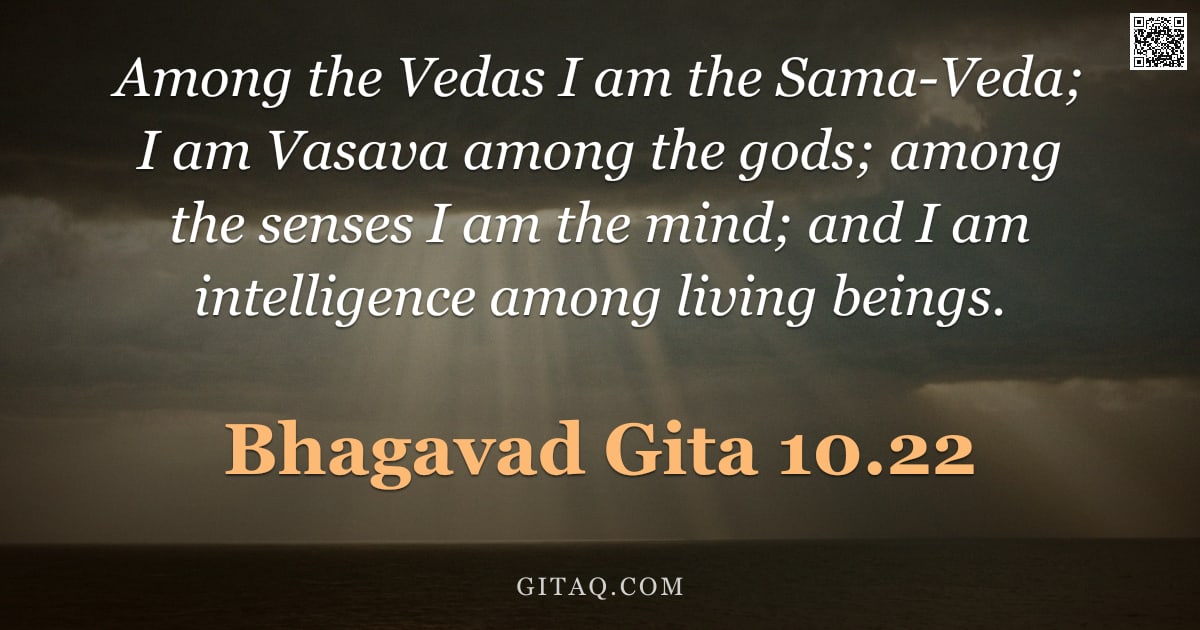
Bhagavad Gita 10.22
Vibhuti Yoga · English Translation
वेदानां सामवेदोऽस्मि देवानामस्मि वासवः | इन्द्रियाणां मनश्चास्मि भूतानामस्मि चेतना ||१०-२२||
vedānāṃ sāmavedo.asmi devānāmasmi vāsavaḥ . indriyāṇāṃ manaścāsmi bhūtānāmasmi cetanā ||10-22||
What Does This Verse Mean?
In this verse, Lord Krishna tells Arjuna that He is the essence of everything great and powerful in existence. Among all sacred scriptures, He represents the Sama-Veda; among the gods, He is Indra; within our senses, He is the mind; and inside every living being, He is consciousness itself. The key teaching here is that while we see many forms of beauty and power, they are merely reflections of one single Divine Source.
The Teaching Behind It
This verse is a core teaching of Jnana Yoga (the path of knowledge) and Bhakti Yoga (devotion), illustrating the concept that the Divine is both immanent in creation and transcendent beyond it. It develops the understanding that all specific excellences we admire are merely partial reflections of one ultimate, non-dual reality.
Word by Word
Classical Commentary
Where This Happens
This verse appears during Chapter 10 on the battlefield of Kurukshetra, where Lord Krishna has just begun his discourse to Arjuna. Having convinced a reluctant warrior to fight for righteousness by revealing His infinite forms (Vibhuti), Krishna now explains that He is not separate from creation but is its very soul and source. Arjuna, who was previously confused and overwhelmed by the prospect of war, begins to realize that his teacher is actually the Supreme Reality itself.
Living It Out Today
When you face a difficult decision at work or feel anxious about an outcome, remember that your ability to think clearly (the mind) and your inner drive (consciousness) are not just biological functions but connections to something greater. Instead of relying solely on external validation from others or the results of your actions, look inward to find clarity and strength in your own awareness. By recognizing this deeper intelligence within you, you can approach challenges with calm confidence rather than fear.
Explained for Children
Imagine you have a huge box of crayons with thousands of colors, but all those colors come from just three main paints: red, blue, and yellow. This verse says God is like that magic source paint for everything in the world. Just as every color comes from those basic paints, Krishna explains that He is inside our minds when we think, inside our voices when we sing hymns, and even inside us as the spark of life itself.
Daily Reflection
Today, pause to notice how your own awareness is acting like a bridge between your senses and your deeper self. When you feel overwhelmed by noise or confusion, remember that the calm mind behind it is not just yours, but a reflection of Krishna's presence in every moment. By honoring this inner guidance, you turn ordinary thinking into an act of worship.
A Practice for Today
Sit quietly and bring your attention to the space between thoughts, recognizing that quiet mind as a manifestation of the Divine presence within you. Offer a silent gratitude for this inner intelligence that guides your senses and connects you to all living beings.
Key Teachings
- The Essence Beyond Form
Just as the Sama-Veda represents the melodic heart of all Vedic knowledge, Krishna reveals Himself not in a specific book but as the essential spirit within it. This teaches us that God is not limited to rituals or scriptures, but resides as their living soul. - The Sovereign Consciousness
By identifying with Vasava (Indra) among gods and intelligence among beings, the Lord establishes Himself as the supreme controller of both cosmic power and individual wisdom. We are invited to recognize that our highest capacities for leadership and understanding stem from this singular Divine source. - The Mind as a Sacred Gateway
Declaring Himself as the mind among senses, Krishna elevates human thought from mere biological function to a sacred instrument of connection. This transforms our daily mental activity into a potential meeting place with the Divine if we align it with pure intelligence. - The Mind is God
Krishna identifies as the mind among all senses, elevating human thought from mere biological function to a sacred instrument of connection. This transforms our daily mental activity into a potential meeting place with the Divine if we align it with pure intelligence.
Themes
Related Verses
Read This Next
- 2.47 — This verse on performing duty without attachment complements the focus on the mind by teaching how to direct your inner clarity toward action.
- 3.30 — Read this next to understand how surrendering all actions and their fruits to Krishna purifies the intelligence that you just meditated upon.
- 12.15 — This verse describes the devotee who is pleasing because they are free from agitation, a state made possible by aligning with the divine mind mentioned in 10.22.
Recommended Reading
GitaQ earns from qualifying purchases as an Amazon Associate.