Bhagavad Gita 10.23
Vibhuti Yoga · English Translation
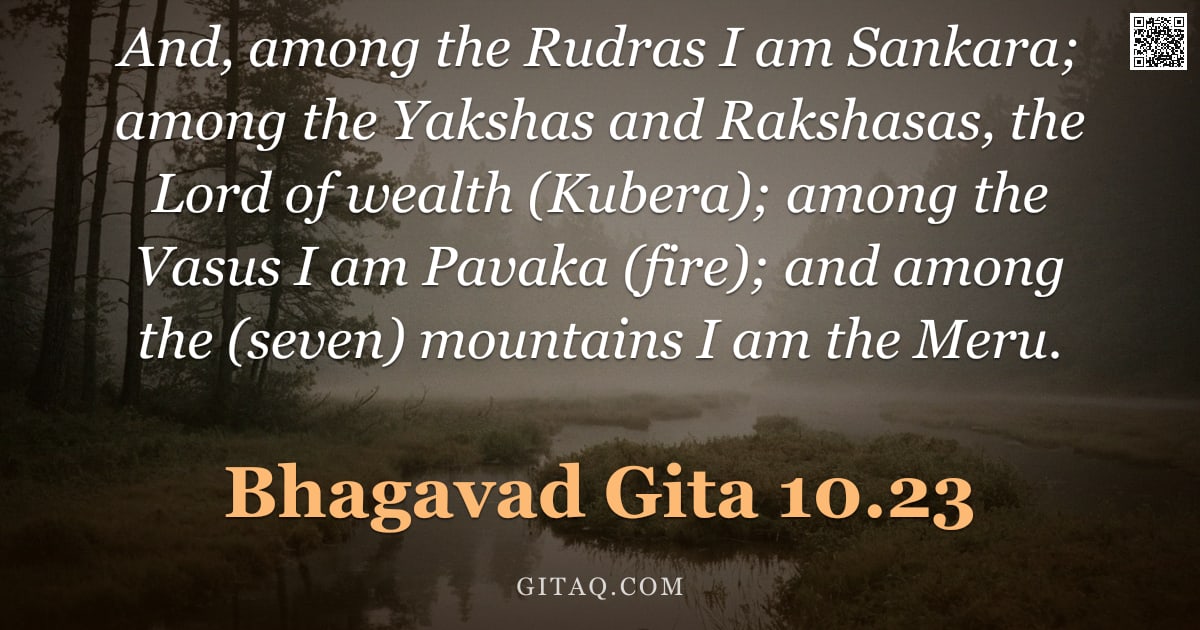
रुद्राणां शङ्करश्चास्मि वित्तेशो यक्षरक्षसाम् | वसूनां पावकश्चास्मि मेरुः शिखरिणामहम् ||१०-२३||
rudrāṇāṃ śaṅkaraścāsmi vitteśo yakṣarakṣasām . vasūnāṃ pāvakaścāsmi meruḥ śikhariṇāmaham ||10-23||
What Does This Verse Mean?
In this verse, Lord Krishna speaks to Arjuna while revealing his divine glory through the concept of Vibhuti Yoga. He identifies himself as Sankara among the Rudras (gods associated with destruction and transformation), Kubera among spirits like Yakshas, fire among the Vasus (natural forces), and Mount Meru among all mountains. The core teaching is that just as one exceptional element stands out in each category of nature or mythology, Krishna himself is the supreme essence behind every powerful force you see around you.
The Teaching Behind It
This teaching belongs primarily to Jnana Yoga (the yoga of knowledge) as it develops the concept of 'Ekam Sat Vipra Bahudha Vadanti'—that there is one ultimate reality manifesting in many forms. It serves as a bridge for Bhakti Yoga, where recognizing the divine presence in all aspects of creation transforms ordinary perception into an experience of sacred unity.
Word by Word
Classical Commentary
Where This Happens
This verse occurs on the battlefield of Kurukshetra during the Mahabharata war, where Prince Arjuna has just refused to fight his relatives out of confusion. Lord Krishna, acting as his charioteer, is now revealing his true cosmic form (Vishvarupa) by listing specific divine manifestations from various categories of existence. Having already described himself among stars and rivers in previous verses, this section focuses on powerful deities and natural forces to demonstrate that He is the source of all strength.
Living It Out Today
When you face a high-stakes decision at work or feel overwhelmed by family conflicts, remember that just as fire cleanses impurities or mountains provide stability, there is a higher intelligence guiding your path. Instead of relying solely on your limited perspective, trust in the underlying order and support (the divine) within the situation to guide you with clarity and strength.
Explained for Children
Imagine a big box full of different kinds of toys: cars, dolls, balls, and blocks. If someone asked which toy was the 'best' one that represented all others, it would be like picking the most important part of each group. Krishna says he is like the king fire in our world or the tallest mountain; just as a single star can make you think of the whole sky, Krishna wants Arjuna to know that He is present and powerful inside every great thing, big or small.
Daily Reflection
Today, notice how the extraordinary is hidden within the ordinary; just as fire warms and mountains stand firm, God's glory sustains your own life even when you feel small. You do not need to seek a distant deity because Sankara or Meru are simply other names for the divine support you already rely on in moments of crisis or stillness. Let this realization soften your heart, knowing that no challenge is too great and no peace too far away.
A Practice for Today
Close your eyes and envision Lord Krishna as Sankara, the supreme healer of all inner turmoil within you right now. Imagine that same divine presence residing within every mountain peak around you, anchoring your spirit in unshakeable stability.
Key Teachings
- The Divine as Supreme Essence
Krishna identifies Himself not merely with the gods but as their highest essence or source. This teaches us to look beyond the external form of a deity and recognize the singular consciousness that animates all divine powers. - The Hierarchy of Manifestation
Just as Sankara stands above other Rudras, every being in creation has a supreme representative. This structure helps us understand that while many forms exist, they are all expressions of one ultimate reality. - Finding Stability and Abundance
By associating with Meru (the mountain) and Kubera (wealth), the verse connects divine presence to both stability and prosperity. It suggests that true spiritual grounding naturally leads to a life of inner abundance.
Themes
Related Verses
Read This Next
- 2.47 — To understand how to perform your duty without attachment after realizing God's presence in action.
- 3.30 — To learn the practical application of surrendering all actions and fruits to Krishna, deepening the theme of devotion found here.
- 12.15 — To explore how a devotee who is dear to Krishna embodies the qualities of those divine glories mentioned in Chapter 10.
Recommended Reading
GitaQ earns from qualifying purchases as an Amazon Associate.